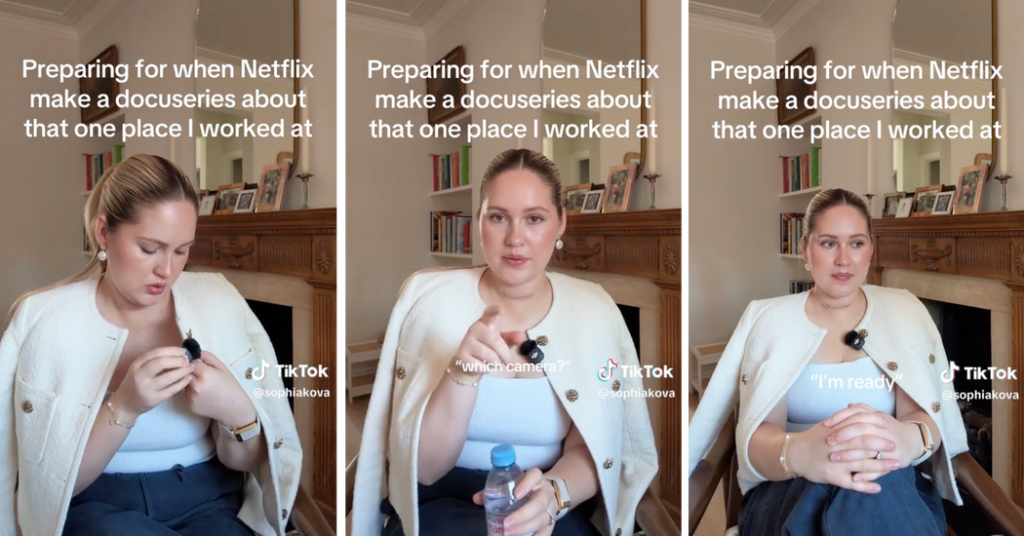
Dramatic orchestral music begins to play as a woman steps into frame, sitting down in a comfortable chair in a well-lit, tasteful-yet-nondescript living room. She tucks a few errant hairs behind her ears, adjusts a microphone on her lapel and wriggles back into the seat to get comfortable.
“Are you ready?” a voice off camera asks.
It’s a scene that is familiar to modern documentary fans — an introduction that suggests interview subjects are about to spill their guts and share their deepest, darkest memories.
It’s also a new social media trend for which, since late June, users on platforms including TikTok and Instagram Reels have filmed videos of themselves imagining sitting down for Netflix documentaries about their own lives: workplace micro-dramas, leaked group chats, the ordeal of living through the Four Loko era. The videos use a song that was featured in the trailer for a Netflix documentary — a real one — about the convicted murderer and former professional football player Aaron Hernandez.
Sophia Barchenkova, who is 30 and recently left a job in investment banking, filmed a version that showed her preparing for when Netflix finally makes a docuseries “about that one place I worked.” It has been viewed 13 million times.
She thought the familiar tropes made the meme funny.
“I love watching Netflix documentaries — I’m like a total true-crime junkie,” Barchenkova, who lives in London, said. “So many of these documentaries, the format is just so relatable. The sitting down, the violins: It’s something that we’ve all heard a thousand times in these docs.”
That instantly familiar hook can be powerful.
“Audiences are really drawn to that moment, which has been used in many documentaries, of a subject preparing for the interview to start,” Adam Del Deo, Netflix’s vice president for documentaries, said. “I think it gives audiences a sense of the relationship between the subject and the director, also with the film crew that’s around them.” (On its official Instagram account, Netflix nodded to the trend, posting a picture of an empty chair with the caption: “about to sit down and watch all these documentaries.”)
Del Deo cited the documentarian Errol Morris, who used a similar conversational technique in his acclaimed 2003 film “The Fog of War,” as one originator of the style of filmmaking that inspired the social media trend.
Jenna Bush Hager, the “Today” show co-host and daughter of former President George W. Bush, posted a video sitting down for a faux documentary alluding to the time she was busted for underage drinking. The actor Morris Chestnut posted one about his character’s tragic death in “Boyz N the Hood” (seemingly converging two trends that have involved the movie). Rufus Wainwright looked pensive as he sat down to talk about how he “quietly shaped the emotional development of an entire generation through Shrek and Meet the Robinsons.” (He had heart-rending songs on both movies’ soundtracks.) And Vanessa Hudgens said she was ready to spill the beans about her time at East High. (That’s the fictional setting of “High School Musical.”)
Stephon Crawford, 27, filmed his version of the trend pretending to sit down for a documentary about vaping. “Me when Netflix is interviewing the few people who never touched a vape & survived in 2045,” he wrote for the caption. Crawford said he felt modern documentaries in the streaming era had moved away from an older, purely educational model to something closer to infotainment.
“Who doesn’t like a little tea or mess every now and then?” he asked with a laugh.
There might be something more to the viral videos, though. While many are presented as jokes, it seems their subjects would be more than ready to make those documentaries in earnest — and take the fame or infamy they came with — if given the chance.
Crawford, an aspiring content creator who works in customer service and lives in Atlanta, said he constantly thought about how his life might translate for an audience.
“I do live my life thinking like any moment could be content,” he said. “I try to record everything.”
Barchenkova, the former investment banker, was struck by the same realization when watching a recent Netflix documentary — “Should I Marry a Murderer?” — that used Snapchat content as a storytelling device.
“People want to be famous,” Barchenkova said. “People want to talk. People love talking about themselves and their experiences.”
Brooke Erin Duffy, a communications professor at Cornell University who researches social media and digital culture, said the trend came from years of conditioning by social media platforms.
“The rise of influencer culture is driven from below, and people wanting to make a living out of this and share content,” Duffy said. “But platform companies too have been prodding us from above and encouraging us to put ourselves out there.” She added that the trend was a “memeified, meta-reflection” on media and culture right now.
“We’re pretending that our lives are a documentary,” she said, “because platform companies have been telling us that they are.”
The post Would Your Life Make a Good Documentary? appeared first on New York Times.