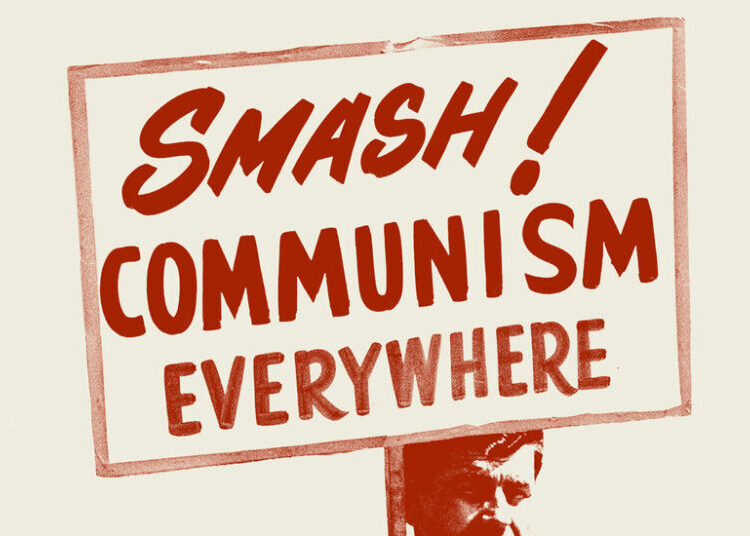
The Iran war isn’t going well for President Trump. The midterms are approaching. What’s a desperate president to do? Turn to Communism. This week the Opinion national politics correspondent Michelle Cottle speaks to the columnists Jamelle Bouie and David French on how conservatives — especially Trump — are using Red Scare tactics to their advantage against the Democrats.
Below is a transcript of an episode of “The Opinions.” We recommend listening to it in its original form for the full effect. You can do so using the player above or on the NYTimes app, Apple, Spotify, Amazon Music, YouTube, iHeartRadio or wherever you get your podcasts.
The transcript has been lightly edited for length and clarity.
Michelle Cottle: All right, starting us off, I have a quick question: What were your first associations with Communism growing up? Jamelle, you’re really too young to remember the Cold War, so how did it come up for you?
Jamelle Bouie: Reading “The Marx-Engels Reader” when I was in high school. That’s going to the public library, picking up a copy of “The Marx-Engels Reader” and reading “The Communist Manifesto” — that is my association with Communism.
Cottle: OK. David, my fellow Gen X-er?
David French: You know, Michelle, I bet we encountered Communism in a very similar way — that you heard about it so much you can’t remember the first time you heard about it.
Cottle: Thank you. Yes, absolutely.
French: This was the dominant confrontation of our childhoods — the confrontation between American and Western democracy and Soviet Communism. And so, you know, when I was thinking this through, I thought it’s very similar — in a reverse sort of way — to someone asking me, “When’s the first time you heard about Jesus?” Well, I don’t know. I grew up in a Christian home. I don’t remember not hearing about it.
Cottle: For me, I was the child of a Navy veteran. My dad was in the Navy during Vietnam. It was always out there. You know, the Ronald Reagan era — “Mr. Gorbachev, tear down this wall.” The Cold War ended when I was in college, so it was just always there until it wasn’t.
And so, I ask this because the Communist threat is part of what we’re got to talk about this week, but not looking back to the ’80s or before. We’re got to dig into a recent piece, Jamelle, that you wrote, about how President Trump has resurrected the specter of Communism as a scare tactic heading into the November midterms.
But first, we’re got to take a look at the on-again, off-again war in Iran, and whether the United States is headed into a new phase of escalation, or even — dare I say it — a quagmire. So maybe the theme of the week is “Everything old is new again.” So, David, back in June, you predicted that “We might cycle through several more stages of almost-war and almost-peace.”
My God, it’s like you’re psychic. So, where are we now in that cycle, and how close do you think we are to full-scale war? With the usual caveat that we are taping on Thursday morning, and it can go anywhere.
French: You know, I want to begin by paraphrasing Darth Sidious from “Star Wars”— all is unfolding as we have foreseen. This is a very predictable outcome, and it’s been very predictable ever since … And I really want to commend our colleagues on the news side. They did this really, I thought, insightful analysis in the middle of one of the rounds of negotiations, because we’ve been through a few rounds of negotiations.
And essentially, what they were saying was, how do you negotiate a resolution to a war when both sides are zealously committed to declaring victory? And one of the things that you have seen here is one of the reasons we keep cycling into not fully war, not fully peace is that both sides have — well, Trump in particular has an aversion to a longer war, and he also has an aversion to having been seen as losing a war. So he’s got both of these things going on at once. The one thing he does not want, by any stretch of the imagination, is for somebody to be able to credibly say, “You cut a worse deal than Obama. You were taken for a ride by the nation of Iran.” That is the absolute last thing that he wants.
At the same time, the Iranian regime also has a desire to be seen as having triumphed over the United States. That’s a very important thing, both domestically and internationally, for Iran to be seen as having triumphed over the United States. So you don’t just have long-term strategic thinking going on here. And in fact, on the U.S. side, I would say that an awful lot of people on the U.S. side are not engaging in long-term strategic thinking at all. Some are, but many are not. But don’t look at this conflict as two coldly rational parties engaging in negotiation, escalation, etc., according to deliberately thought out, strategically valid strategies.
Think of it instead as, there are elements of strategy here, there are elements of essentially posturing here, and they’re adding together into a situation where both sides tend to have their foot on the gas — as I’ve used this analogy before — much more than their foot on the brake when it comes to escalation.
So now we’re beyond just the Persian Gulf. We’ve escalated into the Red Sea. You are seeing very precise and devastating strikes on American facilities that have killed American service members. There is a widening amount of damage in the Persian Gulf region. Iran is obviously suffering as well.
But the one thing that I will say is that I do think, even as Iran is posturing, obviously, it does have a strategy, and I’m not sure that we do. And its strategy is that it wants to emerge from this thing made whole, financially, and in control of the Strait of Hormuz. And when you see that strategy, at least some of what they’re doing makes sense. At the same time, they continue to provoke and to stretch and to extend beyond, I think, their military reach and military capacity. So I think we have two sides that are miscalculating here, is a shorter way of saying it.
Cottle: Jamelle?
Bouie: I am reminded — this has got to be very pretentious — I’m reminded not of Star Wars, but of Carl von Clausewitz, who states —
French: Well, this is so on brand.
Bouie: I know, I mean, that’s why it’s pretentious. It’s like I can’t help myself. He states: “First, the supreme, the most far-reaching act of judgment that the statesman and commander have to make is to establish the kind of war on which they are embarking; neither mistaking it for, nor trying to turn it into, something that is alien to its nature.”
First thing they must do when embarking upon an armed conflict — because in Clausewitz’s famous dictum, war is politics by other means. It is done to achieve a specific political objective. And I think the distinguishing fact about this war in Iran is that that’s not the case. What is the specific political objective this war has begun to achieve?
They could not articulate it at the beginning of the war. They had to search for answers. We know, from observation — from the great reporting of our colleagues in the newsroom — that this war was embarked upon because Donald Trump wanted something to do. He felt confident after the incursion into Venezuela, believed that he could solve the Iranian problem with a few airstrikes, and then there’d be regime change, and they’d greet us as liberators, and etc., etc.
And when that didn’t happen, they were lost — and they’ve been lost ever since. When essentially the fantasy that they had did not come to pass, they found themselves in a conflict that first they began, in a way, as basically guaranteed that Iran was not going to back down, right?
When you launch decapitation strikes, when you do all this stuff, your opponent is not going to want to back down. That’s losing too much face. And — as you said, David — Trump is incapable of losing face, and neither he nor Pete Hegseth — nor really, it seems, anyone in the administration — is even grappling with the larger strategic picture whatsoever.
And they’re also consumed with a fantasy that helped contribute to America’s defeat in Vietnam, which is that you can do everything you want with air power. You just drop some bombs. Drop some bombs, and you’ll fix the problem — and that’s just not the case. And so, they’re stuck in a situation where they don’t have a clear political objective anymore, or at least now that they have one, it’s sort of like the results of the war, right?
It’s, like, maintain freedom of navigation through the Strait of Hormuz — which was the case in the status quo antebellum, right? Like, before the war, we already had that, and now you’re trying to restore that. So, you know —
Cottle: Well played.
Bouie: That’s their objective, such that they have one. They fundamentally don’t understand the nature of the war that they’re fighting, and as such, their tactics — such that they are — are inadequate to the task. And doing anything more that might be adequate to the task, not only is a heavy domestic political lift, but also cuts against Donald Trump’s own fears and instincts.
And so, here we are. We’re just dropping bombs, targeting civilian infrastructure, as if war is a game of how many war crimes you can commit. Maybe you don’t want to use the term “war crime,” but I do think that attacking civilian infrastructure is bad. Doing it, essentially, to punish someone into submission is bad. It’s as if you got into a schoolyard fight and then grabbed the person’s younger sister and beat her up instead, right? And they’re wasting American munitions. I mean, this is one of the things that’s happening. America is literally running out of missiles.
And leaving the country unable to deal with its other strategic goals and other theaters of global conflict of the world.
Cottle: So with that, I want to pause and walk through a few more of the data points that we’ve got on the war so far. So 18 U.S. service members have died so far, and many more have been injured. Just since July 6, 100 troops have been injured, gas prices are back up to around $4 a gallon, Strait of Hormuz remains a flashpoint. Now the Houthis have started blockading and firing on ships traveling to and from Saudi Arabia in the Red Sea.
That threatens to drive oil prices even higher. So, David, how nervous are you about this escalating into a wider regional conflict with all of this going on? How nervous should we be?
French: I think we should be — is this a technical term? — pretty darn nervous.
Cottle: That is the technical term, yes.
French: Pretty darn nervous, but not panicked, is the way that I would put it. And I think there’s also this other element that is overlaying all of this, and that is: Until you encounter MAGA up close, it’s hard to describe how arrogant it is, and that there is an enormous amount of hubris.
If you go back, JD Vance, remember, was being asked about this, because the administration had said that Kamala Harris would drive us into war with Iran, and if you don’t want to go to war with Iran, then vote for Donald Trump. And here we are, at war with Iran. And JD Vance is confronted with this, and one of the things that he says is, well, prior presidents were dumb — they were dumb, and we’re not. And there just seems to be, when you are around MAGA, this view that [they] know obviously true and correct things, and the reason these obviously true and correct things have not been done before is because of cowardice or stupidity, or you name it.
And it’s that level of arrogance that they’ve brought into this almost impossibly complex situation that is contributing immensely to our problem and to our challenge. You know, it’s very interesting, whenever you see something unfold where you can say it wasn’t just predictable how this would unfold, it was predicted. It had been predicted that this is how this would unfold.
And so, I think that’s hovering in the background, Michelle, here, that makes this arrogance, this hubris that we cannot possibly be wrong, that other politicians and political movements were all idiots before us.
Cottle: They just needed more testosterone, right?
French: Just needed more high T, man. And how deeply embedded that level of arrogance is within that MAGA world — that makes me more nervous.
Now, tempering that is also the fact that, I think, Trump very much does not want a ground war. He very much does not want that. And I think that’s one of the few things preventing an out-of-control escalation right now.
Cottle: All right, so domestically speaking, it feels like the trickiest position is the one that congressional Republicans are in. They have to own a war they didn’t really want, they never voted to approve, and yet are now having to publicly defend as they’re going into high-stakes midterm elections, which are generally a referendum on the president. Is this going to bite them, do we think? Just on gas prices alone?
French: I think it will bite them. I think that’s a pretty safe prediction. The perilous prediction is how deep of a bite it will be. That is the question. I do think that you’re looking at some form of rebuke. We just don’t know to what extent we’re got to see the rebuke.
In the right-wing world — that is, right-wing infotainment — remember, there’s generally two kinds of stories: Trump is triumphant and Trump is being unfairly attacked. And you’re still seeing an enormous amount of Republican loyalty. I was looking at some polling data from this last week, and it was saying that Trump, among Republicans, is more popular right now, at this point in his second term, than George W. Bush was with Republicans and Barack Obama was with Democrats. In other words, with the partisan Republicans, Trump still has an enormous amount of support, and we’re still sort of Lucy-with-the-football with the thing that says, “This is the thing that will break that, this is finally the thing.”
Bouie: Just a question: So that’s happening at the same time that his approval with independents has dropped precipitously, right?
French: Right.
Bouie: To what extent are we looking at a function of people dis-identifying as Republicans? So they’re saying, “I don’t think I’m a Republican anymore,” they’re saying, “I’m an independent,” right? And so, they leave the pool of people, and as an independent they disagree, they disapprove of the president. But by leaving the pool, it creates the appearance that his approval hasn’t actually declined much from the Republicans, and all you’re seeing is a shrinking number of Republicans, those who are still on board.
French: I think that’s a super fair observation, and in fact, is buttressed by some data from Gallup, that shows that the identifiers of independence is at a generational, or more, high. So I do think that’s happening. There’s a shrinking, but the shrinking is also occurring with Democrats as well.
They’re shrinking as well. So, I do think there is an intense loyalty that remains within a shrinking pool. There is definitely still that intense loyalty. But — as you note, Jamelle — I do think that the overall pool is shrinking.
Cottle: Yeah, I think you’re seeing that with both sides. And it feeds into the overall distrust of institutions. And if you talk to younger folks, younger voters in particular, they are just suspicious of the parties. But this brings us back to our Red Scare that we mentioned earlier.
Jamelle, you just wrote a piece about how Trump is bringing back the classical American political tactic of redbaiting. Oh, so much fun. And so, rather than focusing on his own record, he is going to spend the midterm run-up accusing Democrats of being Communists and of aiming to turn America into a Communist country.
This really feels stuck in the past, but how does what’s happening now compare with, say, the 1950s and McCarthyism?
Bouie: I mean, the big difference — and let me say real quick, other Republicans are getting in on this as well, and Steve Scalise referred to stopping Bolsheviks, which I just thought was very funny.
French: I loved that.
Cottle: Stopping Bolsheviks.
French. Is it 1917?
Cottle: Wow. Doesn’t he seem hip and modern?
Bouie: But, you know, in the 1950s, the Soviet Union existed. It didn’t just exist, it was a rival superpower. It wasn’t just a rival superpower, it was, in the moment, a viable alternative to American-style capitalism and liberal democracy, right? In the United States at the time, there was — not huge, but significant — an actual Communist Party that was active in American politics.
There is still a Socialist Party in America, in American politics. Not as active, but still there. And the American left was not quite at the high-water mark of its power, but still quite influential. And so, in the 1950s, when the Soviet Union detonated a hydrogen bomb and the nuclear arms race took off; when, again, Soviet Communism was spreading as a geopolitical force and a viable alternative — then warning about the Red Menace makes a bunch of sense, right?
And actually, there are plenty of Americans who will hear about the Red Menace and be like, “Yeah, I’m worried about that. That’s scary to me.” Hollywood is always a great barometer of these sorts of things, and there are plenty of movies in the ’40s and ’50s about Communist infiltrators. I mean, quite famous ones, like “Invasion of the Body Snatchers.” So that’s very much a part of pop culture and a very salient fear.
In 2026, there’s no Soviet Union. China is nominally Communist. I mean, there’s the Chinese Communist Party, obviously an authoritarian formation, but in terms of its economy — that’s capitalism, baby. Or at least state capitalism, right?
So, what are we warning about? It’s not really a threat. What I think it’s supposed to do is take the success of candidates associated with the Democratic Socialists of America and say, “Look: socialist, Communist — it’s the same thing really.” But I think this misses two things: The first is that the American public, which has not become pro-socialism, I think like 39 percent of Americans have a favorable view, right? The second thing is that in an interesting way, D.S.A. seems to connote anti-establishment, not socialism, right? For the public, for voters, it seems to say, “Oh, this is a person who isn’t an ordinary Democrat,” and doesn’t seem to have the same ideological veil. It’s interesting. It’s interesting, the way D.S.A. functions for voters.
And then — this is just an aside from my part — it’s funny to accuse D.S.A. candidates of being Communist, because D.S.A. — I won’t say “famously,” for nerds know this — is formed from at least one organization led by Michael Harrington, in the 1970s, that was explicitly left anti-Communism. These were American leftists, who were anti-Stalinist back in the ’40s and ’50s and were hostile to Communism.
That’s where the “democratic” part of that is supposed to connote “we’re not authoritarians.” So I think that’s the strategy. Like, “Look at Zohran Mamdani, look at the other New York candidates, look at a handful of people — they’re D.S.A. members. They’re socialists. They’re Communists. They’re scary.” But it doesn’t land with anyone, especially not when you came to office promising to lower gas and food prices and housing prices, and you haven’t done it. And not only that — you’ve made them worse.
Cottle: OK, so I take the differences in the reality that you’re talking about. I get all those. Trump’s great gift, politically, has always been, however, to take this germ of a fact, or a reality or something, and just spin it into some kind of insane baroque dark fantasy. Whether you’re talking about government corruption or immigration, or crime or whatever, he has the ability to take something and turn it into something entirely fantastical.
But in this case, for people who don’t pay that much attention to what exactly the D.S.A. stands for — or how it differs from regular socialism even, much less Communism — David, do you think that he will have much success making this link in people’s minds and turning this into not a referendum on him so much as a referendum on Democratic extremism?
French: Yeah. I fully take Jamelle’s points that he just raised, as you just said. I mean, one of the differences between the McCarthy era and now is that in the McCarthy era, there was a Red Menace. Like, the Soviet Union was an expansionist genocidal power that, by the 1980s, had millions of troops poised in Eastern Europe, poised for an invasion of NATO — tens of thousands of nuclear weapons, on both sides, pointed at each other.
Like, the differences here are such an order of magnitude, between that and a few D.S.A. politicians hyper-concentrated in New York City, that there’s just no comparison. But anyone who underestimates the ability of Donald Trump, and the entire right-wing infotainment universe, to turn — at least in the minds of millions and millions and millions of Americans — this contest in their favor. “Whatever you want to say about the MAGA people, whatever flaws you want to say, they’re American patriots who like capitalism and they like the American system, and then you’ve got these Marxists over there.”
I don’t know if you guys have noticed this, but the focus of evil in the Democratic world has moved from A.O.C. over more to Rashida Tlaib or Ilhan Omar. The right-wing infotainment world absolutely has the ability to take fringe individuals and elevate them and say, “This is who the Democrats are.”
And the interesting thing about that conundrum is, if I’m a Democrat, I’m not necessarily loving the D.S.A. that much, because it will often feel as if the D.S.A. is not so much focused on defeating Republicans as it is focused on defeating establishment Democrats. Which is a very similar dynamic that you saw unfold in the Tea Party side of the Republican Party, where really, if you wanted to get a hard-core Tea Party person agitated, absolutely say the name “Barack Obama.”
They did not like Obama. But I tell you, you would see almost equal anger when you’d use the name Mitch McConnell. And so, when you have these factional fights in a larger, bigger movement — and one faction seems to be concerned primarily with taking control of the movement, more so than essentially defeating the actual political opposition — I think that’s a real issue for Democrats right now.
And the bottom line is, I know the D.S.A. has different factions, and you can’t call them all Marxists. You can’t call them all socialists, truly. But there is some real extremism within the D.S.A. — some real extremism that is, in some cases, very ugly extremism. And so, I think I completely take the point that an actual Red Scare is ludicrous. It is also true that there are actual real extremists, who actually are not all that excited about defeating Republicans compared to destroying the Democratic establishment, and I think that’s a problem.
Bouie: I have two thoughts: The first is just on the ability of the conservative media apparatus to create a message. I think my view is that discourse actually doesn’t move everything, right? Discourse is most effective when it dovetails with things people are actually experiencing.
And so the president’s immigration fearmongering dovetails with the sense from a lot of Americans that the border is out of control, that kind of thing. There’s no sense in which Americans are threatened by Communism. It’s just not a thing.
And second, this would be different if the president and the Republican Congress had fulfilled the promises that they used to get elected, but they haven’t. The conditions that got them elected don’t just remain, but their policies have worsened them. And so, the reason I’m very skeptical of this is that you can scream about Communism, you can show darkened pictures of Tlaib and Omar as much as you want, and it doesn’t change the fact that when someone goes to fill up their car, they’re spending $60, right?
And so, again, you can scream all you want about assorted threats, about the Red Menace — but I do think that there is a hard limit to what that can do to persuade voters when you haven’t done anything to alleviate their concerns. And critically, the one piece of legislation you passed, the Big, Beautiful Bill, is resulting in massive cuts to food assistance, massive cuts to health care, right? And I myself am exceedingly skeptical of the ability of messaging to overcome actual material conditions, especially for those voters who aren’t plugged in to conservative media; those voters who are not in the middle ideologically, but are loosely attached to the electorate, and who are going to be voting, if they vote, on the basis of their vibe about the world, and their sense of where they are, in terms of their pocketbook.
The other really quick point is just that I think it’s important to see that a lot of the success of D.S.A. candidates, there aren’t enough self-identified socialists or progressives to help a D.S.A. candidate win in a typical Democratic primary. There just aren’t, even in New York, right? The success of these candidates has, I think, been about the fact that D.S.A. candidates seem to want to fight Republicans in a way that establishment Democrats do not. Like, the complaint with establishment Democrats isn’t ideological; it isn’t that they aren’t going far enough on a set of policies.
The complaint is that, while Donald Trump is running roughshod over American democracy, a Chuck Schumer or a Hakeem Jeffries is talking about their friends on the Republican side. And D.S.A. candidates are presenting themselves as candidates who will actually show the level of aggression that Democratic voters want to see against Republicans. I mean, defeating the establishment Democrats then becomes a means to an end, and not an end in and of itself.
I think that’s a version of the dynamic you saw with the Tea Party. I mean, defeating the establishment Democrats then becomes a means to an end, and not an end in and of itself. And I think that’s an important wrinkle to recognize.
Cottle: So, speaking to your point, Jamelle — can the D.S.A. mobilize people with their kind of fighting spirit with Trump? At the same time, as my inbox will attest, the Republicans are going all in on turning this into what has become known as “the hate election,” which is how much can you get, not just your voters, but people who might be anxious about the idea of more extremist Democratic candidates turning the country into something they don’t recognize.
How much can you mobilize them? Certainly, they are working this, on the fund-raising side, just incessantly. There’s always the issue of, you know, the balance between a candidate that excites their own voters versus the candidate who also is exciting the other side’s voters. And I think that’s what’s making a lot of Democrats nervous in places outside of New York.
Obviously, if you’re a safe blue district in New York, whoever you nominate is going to get it, just, like, as the Democratic nominee. This is not the same for, say, Colorado Eight — big swing district, Republican incumbent, very vulnerable. The more liberal progressive candidate won, and that makes a lot of people nervous about whether or not they can pull it off. Same thing with a lot of what we’re seeing in Michigan. So, that’s my question.
Bouie: I mean, I don’t know. There’ve been a bunch of generic ballot polls the past couple of days. Fox News has the generic ballot D plus seven; Emerson has it D plus 11, which is wild. But the spread is D plus four to D plus 11. And you look at individual Senate races, the Democratic candidate in Iowa — whose name I cannot recall at the moment — is, like, even in that race.
Cottle: Are you talking about the Senate candidate? Josh Turek?
Bouie: The Senate candidate. Jon Ossoff is likely going to win his Senate election, his re-election, at close to double digits, it’s looking like, if current.
Cottle: Georgia has been a freak show on the Republican side from the beginning.
Bouie: Yeah, but I mean, this is my point, right? When you’re looking at individual races, it doesn’t look like a picture where Republicans are on the offensive. It looks like a picture when they’re very much on the defensive; where they’re having to focus much more on races that, in an environment where things were much more in their favor, they wouldn’t have to, right? The Senate is in play, in a way that it simply wasn’t a year ago.
And I just don’t think that screaming about Communism is going to change that, because the Senate’s in play, because people are responding to conditions. This is where I’m really going to double down on this. Like, actual material conditions really matter. It’s not all discourse.
Our jobs are discourse. I think it’s very tempting to imagine that everything is shaped by discourse, but it is not.
Cottle: The fundamentals are against the Republicans in every way this time, so it will be interesting to see how much the discourse matters.
French: Let me use an analogy that my friend Sarah Isgur came up with, which I think is just brilliant when it comes to politics and the discourse, or politics and even campaign consultants and campaign strategists. She used the analogy of curling. In curling, what do you do? You throw a big rock. And then you have the sweepers, right? And the sweepers, they vigorously work, and if they do their job perfectly, they can slightly adjust the trajectory of the rock.
Slightly, right? And that slight can make all the difference in a very close Olympic match. But the bottom line is, if that initial slide — throw, whatever you want to call it — is bad, and it goes off in a wrong direction or a bad direction, you can have the world’s best sweepers, and they’re not got to move, they’re not got to move the needle in any meaningful way.
And I think what Jamelle is talking about, is the underlying conditions of the country are the rock here. That is the thing that is the fundamental unyielding reality of this election — that Donald Trump walked into office with a mandate to mainly repair the economy and fix inflation, and provide a degree of normalcy, etc., at the border. And he created an enormous amount of chaos.
He flipped inflation back in the wrong way, and that’s all the rock. And all of these fund-raising emails and texts — a friend of mine sent me one, and I will read it to you. Very, very measured: “A Communist plot unearthed four miles from your home. Trump begged the Pentagon for $350 billion to respond.” And I don’t think it’s going to really work.
So yeah, I totally agree with Jamelle. The core of this election is going to be rejection of Donald Trump and the economy, and the world that he’s created, and I think it will be so comprehensive that multiple factions within the Democratic Party will be able to say, “See? It worked,” that you’ll have some D.S.A. candidates win, you’ll have mainstream candidates win, and so they’re all going to have a case for how they can be the standard-bearer going forward.
Cottle: OK. That’s going to be 2028 — fun.
French: Yeah, but at the margins, this stuff still does matter.
Cottle: OK. Well, I can’t resist drawing this to a close on a curling analogy. Because how often do we get to do that? So, let’s just take that and move right on into recommendations. Who wants to go first? Tell me what you got. Jamelle, you go.
Bouie: Sure. My favorite director is Sidney Lumet. Not an auteur, so doesn’t necessarily have a big reputation outside of nerds. But if you watch a lot of movies, you’ve seen a Sidney Lumet film — “12 Angry Men” is a famous one, “Serpico,” “Network.”
I mean, the guy did a lot, worked a lot, and made a lot of great movies. I’ve seen most Lumet movies. So I recently watched “The Pawnbroker,” which is about a Holocaust survivor who works as a pawnbroker. He’s the titular pawnbroker in an East Harlem pawn shop. And it is marvelous — a marvelous film. Rod Steiger’s performance is incredible, and it is this look at how trauma is something that may be impossible to get by. I’ll say that this is not a happy movie. This is not a happy picture. It’s actually quite bleak. And it’s a character study, first and foremost. There’s not much of a plot to it, and it’s simply examining this person who is so deeply affected by their trauma that they really cannot get past it, and all the ways that kind of renders them lonely in their life.
And it’s very reminiscent of the work of the Safdie brothers. Lumet, who is a great New York director — there’s some clear Lumet DNA in the Safdie brothers’ work, and you can kind of see that if you watch these two, back to back. And now, Jamelle, the film critic, turns off. Watch “The Pawnbroker.” It’s great.
Cottle: And moving on to David, the film critic.
French: OK. The easy thing to say is, go see “The Odyssey,” but it just requires more conversation than this. I saw it over the weekend. I’m going to see it again this weekend.
Here is my actual recommendation. OK, Apple TV’s “Cape Fear.” Now, it’s based on a book called “The Executioners.” I think there’s a 1962 movie that I —
Cottle: Which is fantastic.
Bouie: It’s amazing.
French: Yeah, I’ve heard this. There’s a 1991 movie, with Robert De Niro and Nick Nolte, that I have seen, that was really good and also great. But imagine this, y’all. Imagine you have the writer’s room, and in walks the showrunner, or the director or whatever, and he distributes scripts to the 1991 “Cape Fear,” and he says, “OK, I want you to use this as a basis, but before you start writing, I’ve got to distribute crack pipes laced with LSD, and I’m going to ask you to just go ahead and puff up and then start writing.” Because this story takes an already wild story and turns it into something that is just a carnival fun house of horrors, and it’s a spectacular ride.
Cottle: OK. I wanted to be on theme. I felt the need, so I went back and rewatched “The Death of Stalin” —
Bouie: Great movie.
French: Oh, fantastic.
Cottle: Armando Iannucci, kind of dark comedy, political satire, and it’s all about what happens after Stalin drops dead in 1953, and the ensuing power struggle. You’ve got Nikita Khrushchev, and Georgy Zhukov, and Georgy Malenkov, and Vyacheslav Molotov.
And the sniveling sycophancy combined with the cutthroat ambition, and just, like, it’s brilliant. I’m an Iannucci fan. Although I tend to like the stuff he did back in the U.K., with “The Thick Of It,” even better than “Veep,” so I was primed to like this. But that said, it feels a little too on point at certain moments in our current political situation, so just go in with that warning.
It’s very funny, but at some point you’re likely to go, “Oh, OK. OK. That feels a little too real.”
Bouie: Can I say too, that I love — in that movie — that no one attempts a Russian accent. They all have their particular U.K. accents, and I think that actually really works, because it gives you a sense of how the actual guys were from different parts of the Soviet Union. They would’ve had different accents, spoke Russian in different ways.
Cottle: Well, there we go. Jamelle has elevated this. I hadn’t even thought of that, so there.
Bouie: I’m a big movie nerd, folks.
Cottle: There you go.
French: What? Really?
Cottle: And with that, we’re going to land this plane. Guys, as always, thank you. I feel we’ve solved the world’s problems this week. Let’s do it again soon.
Thoughts? Email us at [email protected].
This episode of “The Opinions” was produced by Vishakha Darbha. It was edited by Kaari Pitkin. Mixing by Pat McCusker. Video editing by Kristen Williamson. The postproduction manager is Mike Puretz. Original music by Carole Sabouraud and Pat McCusker. Fact-checking by Annika Robbins and Kate Sinclair. Audience strategy by Shannon Busta and Kristina Samulewski. The director of Opinion Video is Jonah M. Kessel. The deputy director of Opinion Shows is Alison Bruzek. The director of Opinion Shows is Annie-Rose Strasser.
The Times is committed to publishing a diversity of letters to the editor. We’d like to hear what you think about this or any of our articles. Here are some tips. And here’s our email: [email protected].
Follow the New York Times Opinion section on Facebook, Instagram, TikTok, Bluesky, WhatsApp and Threads.
The post The New Tactic Trump Thinks Will Rally Voters appeared first on New York Times.