When Kylie Corbitt got out of a 30-day addiction treatment center, a familiar problem was waiting outside.
“My entire network was all people who used,” she said. “I didn’t even know what it meant to be truly sober.”
Her methamphetamine use had intensified slowly during the Covid-19 pandemic, as she lost a job she had held for a decade, grieved the death of the grandmother who helped raise her and grappled with depression. With little structure to her days, each one felt like “Groundhog Day,” Ms. Corbitt said; she would tell herself that she’d get high one last time and then seek help. “And it just never ended,” she added.
Treatment interrupted this cycle, but her life wasn’t set up to support her sobriety. Ms. Corbitt, who is 37 and lives in Milton, Mass., tried Alcoholics Anonymous but struggled to feel a sense of fellowship, finding some meetings “a little judgy.”
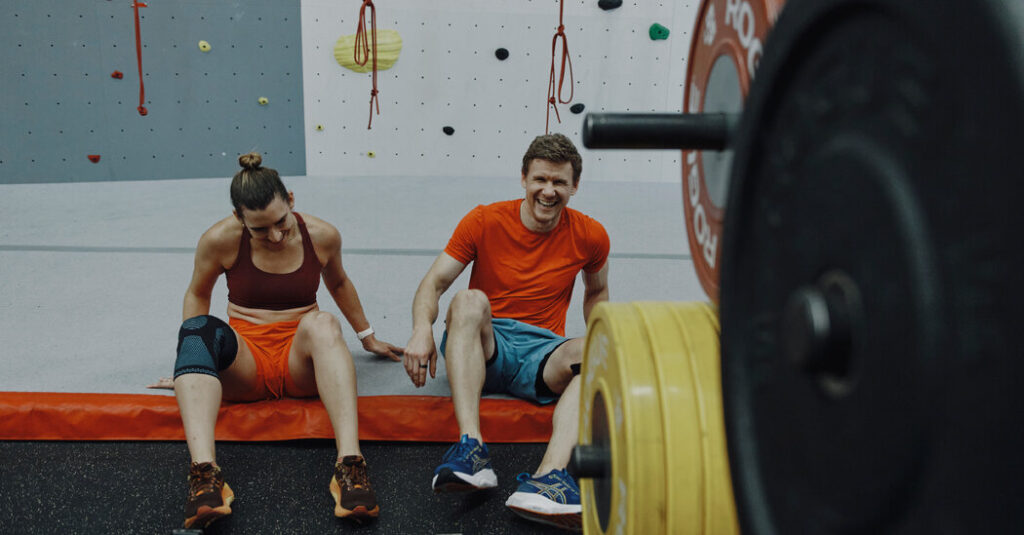
Desperate and unsure where else to go, Ms. Corbitt decided to check out the Phoenix, a free gym and recovery community, where members are asked to be 48 hours sober before every visit. There, she started rock climbing and later took up CrossFit, finding that sobriety could be built around healthier routines and friendships.
“We’re not sitting there talking about addiction all day,” Ms. Corbitt said. “We’re talking about getting healthy and getting better.” On July 6, Ms. Corbitt marked two years without drugs, the “longest length of time sober I’ve ever had.”
For decades, addiction treatment in the United States has been viewed as a clinical problem or a spiritual struggle. These approaches have helped millions of people, but they have had their limits. Medical care is often delivered in short, time-limited episodes, while 12-step programs can feel one-size-fits-all, with their emphasis on a higher power and complete abstinence.
But there’s a growing model: sober spaces built around fitness, music, meditation and other activities. The concept is not entirely new, but there has been a “bit of a renaissance of the recovery movement,” said John Kelly, director of the Recovery Research Institute at Mass General Brigham. For example, the Recovery Café Network, which offers free hot meals and coffee, grew to 92 cafes in 2025 from 21 cafes in 2020; the Phoenix’s new member enrollments also climbed, to more than 433,000 from about 20,000 over the same period.
Sober spaces can’t replace traditional treatment or 12-step programs, and research on them remains limited. But the model draws on evidence that loneliness and familiar environmental cues can make relapse more likely, while connection and belonging can help sustain sobriety.
These spaces offer a place for recovery to unfold outside a treatment center, doctor’s office or group meeting, said Brandon Clark, who supports addiction recovery work at the St. Anthony Foundation in San Francisco, and who is recovering from fentanyl use. “People need new places to go, new people to know, new rituals and new ways to be useful,” he said.
Replacing the Rituals of Addiction
Sober spaces do not follow any one template. The Phoenix in Boston is essentially a stripped-down warehouse, lined with rock climbing walls and filled with training equipment like free weights, rowing machines and battle ropes, as well as jiujitsu mats and wooden gymnastics rings. Meanwhile, the first Recovery Café in Seattle is a mix between a cafeteria and a neighborhood coffee shop, with a free buffet and latte bar, pendant lights hanging over the counter and words like “love,” “forgiveness” and “grow” spelled in looping cords on the walls.
Like 12-step programs, sober spaces tend to be free and low barrier, asking participants for some sobriety but affirming it through the honor system rather than a drug test. But these spaces are generally more accommodating than 12-step programs, which define success through a zero-substance approach, sometimes even including regulated, effective medications.
“We’re not necessarily abstinence-based,” said Ruby Takushi, a founder of the Recovery Café Network, asking members for sobriety only on the day they come to the cafe. “We’re just about what is the healthier choice for you today.”
Still, having this dedicated sober space matters because many people are trying to stop using drugs while in environments that keep pulling them back, said Keith Humphreys, a psychologist and co-director of the Stanford Network on Addiction Policy.
Ryan Forrester, for example, stopped using drugs in 2018 and was under house arrest while living with a relative who smoked marijuana. For a while, Mr. Forrester stayed away from it, retreating to his room to try to avoid the smell.
“Then one day, I buckled,” he said. Smoking turned into drinking, and one drink turned into a couple, which turned into getting hammered. Mr. Forrester got off house arrest in April 2019 but didn’t quit drinking again until November 2024, when he started going to the Phoenix. It offered some distance from his old cues, he said, and the same all-or-nothing energy that had fed his addiction could be channeled into a healthier outlet.
“You come in here, and you start to get friends,” Mr. Forrester said. “Then, you’re lifting these weights that you never knew you could lift, and you’re doing these races like half marathons. You’re like, I can’t believe I just did that — like this is me.”
At their best, these spaces make care and belonging feel less like an intervention than an array of ordinary gestures, like someone remembering your name, checking up on you and making you feel welcome, said Killian Noe, a founder of the Recovery Café. Fostering a community around a social activity also gives people a reason to return beyond overcoming their addiction. “Recovery is not shoved down your throat,” said Dina Gonsalves-Perez, a staff member at the Phoenix, who is recovering from heroin addiction. “That being said, you are never alone.”
Such hospitality can even make returning after relapse less fraught. One member came back within 24 hours, Ms. Noe recalled, because he said it was the first time he had a group of people who cared whether he came back.
“People don’t want to be alone,” Mr. Forrester said. “They want to matter, to have accomplishments, to know that they can do things, to know people care.”
What Sober Spaces Can and Can’t Do
Researchers have long known that social connection is an important part of recovery, helping people move away from relationships organized around drug use and toward relationships that support sobriety. In fact, one of the clearest ways that 12-step programs appear to help, is by reshaping people’s social networks, said Dr. Humphreys, the Stanford psychologist.
“You’ve got to have people who know the way — how to live in recovery, what you do, what you don’t do, how you build a life worth living,” Dr. Kelly of Mass General Brigham said.
The Phoenix reports that 83 percent of its new members remain sober after three months. Dr. Kelly also followed Phoenix members for six months and compared them with nonmembers, also in addiction recovery: Although there was no difference in drinking days or heavy drinking days, Phoenix participants reported fewer harms from alcohol or drug use overall, like financial problems, hurting their families, damaging a friendship or taking foolish risks. These results were preliminary, however, and had not yet been peer reviewed.
In general, the evidence for specific sober social spaces is fairly limited, partly because they are “pretty hard to study,” Dr. Humphreys said. For example, researchers cannot easily assign some people to a recovery cafe or gym while excluding others, he added, and standardizing the experience too rigidly could make it feel less like a community.
There are also practical limits: Sober spaces aren’t equipped to help someone detox, to treat severe withdrawal or to manage an acute crisis, and because there are no court mandates and no required attendance, they rely on someone’s internal motivation to join and keep showing up.
So, the people who turn to these communities, Dr. Humphreys said, are generally “not at the point where every single day is a struggle on a substance front.”
That is why these spaces are best understood as complements to 12-step programs or medical care, not replacements, he added. Their promise is not in curing addiction but addressing the loneliness, boredom and disconnection that can make recovery harder.
For Ms. Corbitt, addiction had been transactional, she said, full of people who didn’t know her name — only “hey, you” — and little sense of safety. She carried that same isolation into recovery, never telling anyone when she was trying to quit, leaving her with little to no support.
Alcoholics Anonymous gave her a powerful, healing community once she found the right group, she said. But at the Phoenix, the help was woven into the ordinary rhythm of the place. “To be in an environment where people were warm and welcoming and actually wanted to talk to me — and didn’t just want something from me — it made me feel like a person again,” she said.
Now, Ms. Corbitt spends much of her free time volunteering at the gym, helping other people feel, as she did, that they don’t have to recover alone.
The post Can Rock Climbing, Weight Lifting and Free Lattes Keep People Sober? appeared first on New York Times.