Ashely Alker is an emergency medicine physician and the author of “99 Ways to Die: And How to Avoid Them.”
On the morning of her fifth birthday in 1953, Martha Ann Lillard woke to discover she could not lift her head.
She had polio. The disease’s progressive paralysis left her unable to breathe on her own. She would spend the remainder of her life in and out of an iron lung, a negatively pressurized chamber that supported her breathing. When she died last month at age 78, Lillard was the last American still dependent on the device.
In 1955, just two years after Lillard contracted the virus, the first polio vaccine became available, and by 1979, the disease was eliminated in the United States.
But when it comes to vaccine-preventable diseases in the U.S., society can be a victim of its own successes. As public health efforts such as vaccines eliminate the suffering caused by a disease, collective memory of the illness fades. Contemporary health information is often gathered from personal networks, the internet and the media, none of which is compelled to cover seemingly obsolete vaccine-preventable diseases, such as rubella, diphtheria and polio. The paucity of accurate information leaves a gap for profiteers, who may sensationalize vaccine skepticism in the hopes of going viral. This has proven especially concerning when supported by the leader of the Department of Health and Human Services, Robert F. Kennedy Jr.
Polio, or poliomyelitis, was once a feared childhood viral infection in the U.S., with 58,000 reported cases in 1952. Common symptoms include fever, sore throat, nausea and vomiting. The virus may spread through the bloodstream to the brain stem and spinal cord, where it attacks motor nerves, causing paralysis known as paralytic polio and often called infantile paralysis in children. Polio is still present outside of the U.S., with 52 cases confirmed last year, and most commonly affects children under age 5. Among those paralyzed, up to 10 percent will die once paralysis affects the breathing muscles. The disease is highly contagious: Patients can spread the virus for several weeks, which is how it killed or paralyzed over half a million people a year globally before the vaccine.
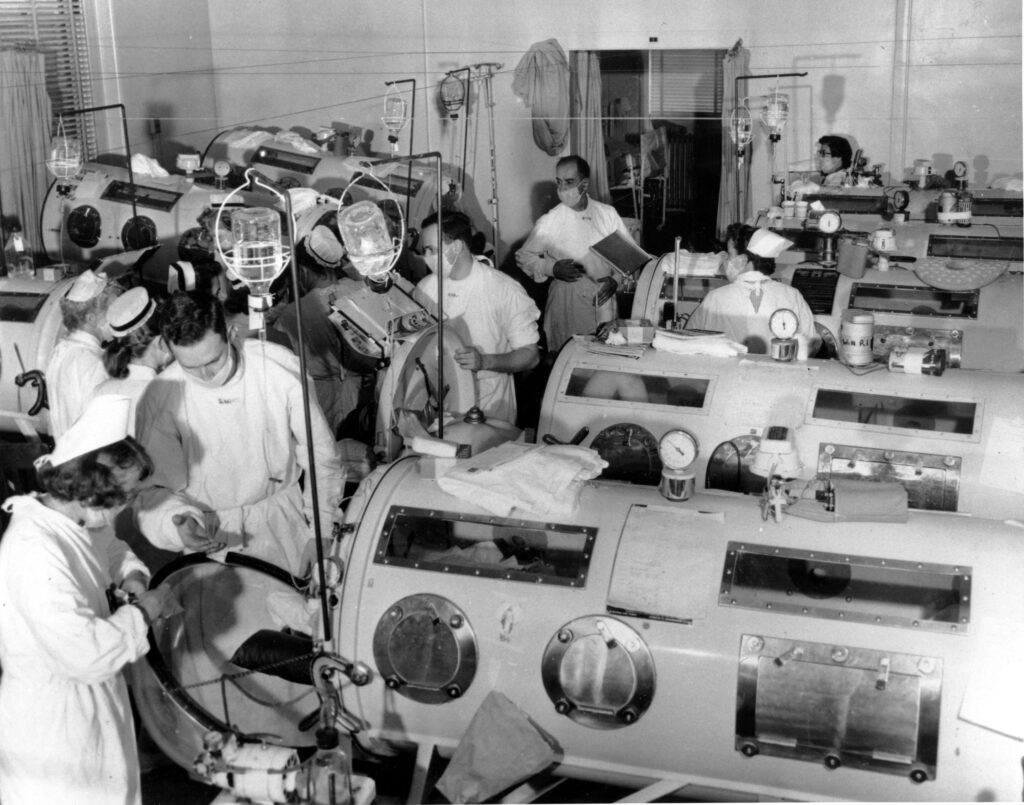
Before mass vaccination, polio epidemics led parents to keep children away from public swimming pools, playgrounds and movie theaters. Hospitals were filled with children who could no longer walk, waiting to see if the virus would paralyze their breathing muscles and condemn them to iron lungs. Americans who were around for the pre-vaccine era are likely to remember images of warehouses with rows of the metal chambers containing patients during epidemics. Some would remain in the contraptions for months, while others, like Lillard, would spend a lifetime.
Over the past 50 years, global immunizations have saved the equivalent of six lives a minute, an estimated 154 million lives — most of them infants. There is no effective cure for polio, or for most other vaccine-preventable diseases. Without adequate vaccine coverage in the population, outcomes may resemble those of the pre-vaccine era.
And vaccines do more than save lives; they protect economies and safeguard future generations — and ensure military readiness. In April, Defense Secretary Pete Hegseth rescinded the U.S. military’s influenza vaccine mandate. Late last month, an influenza outbreak occurred at Lackland Air Force Base in Texas, with initial reports of more than 280 ill, four hospitalized and one young man dead. Shortly after — by coincidence, said one Pentagon official — the Defense Department’s influenza vaccine mandate was partially reinstated.
Science may offer the most up-to-date information on vaccine-preventable disease, but history is an indispensable public health tool, too. On March 11, 1918, one of the first reported cases of the flu pandemic occurred at Fort Riley, Kansas, where overcrowding and poor sanitation led the virus to spread to more than 500 men within a week. This strain of influenza was more devastating than World War I, infecting one-third of the world and killing an estimated 50 million people. In 1945, when the influenza vaccine was licensed, it was immediately mandated by the Defense Department for active-duty service members, a decision that was informed by the memory of violent illness.
Likewise, Lillard’s story is an essential piece of American history. Understanding the risk posed by a vaccine-preventable disease is essential to the success of future public health initiatives. If Americans forget what vaccines fight against, then neither will they understand the importance of maintaining defenses.
The post Vaccines are a blessing. Let’s not forget why. appeared first on Washington Post.