Last month, China blacklisted two American companies crucial to U.S. efforts to create a supply chain for making powerful rare earth magnets.
On Friday, Beijing took similar action against even more companies in Europe.
China’s Ministry of Commerce announced that it had banned any further shipment to 14 companies in the European Union of “dual-use” materials or products — items that China describes as potentially having both military and civilian applications. As a result, the companies may struggle to buy many of the critical minerals they need to make products like rare earth magnets and semiconductors, which are essential for cars, offshore wind turbines, robots, drones and other advanced manufacturing applications.
Over the past 16 months, China has used its dominance over the mining and processing of rare earths as leverage in economic disputes with trading partners.
In a statement on Friday, China’s commerce ministry noted that it had acted one day after the European Union sanctioned 14 companies in mainland China and Hong Kong in connection with Russia’s war effort in Ukraine. The E.U. said that these companies, along with 24 Russian companies and 10 firms elsewhere, were “entities that are part of or support Russia’s military-industrial complex or enable the circumvention of E.U. sanctions.”
Many of the European companies targeted by China play a crucial role in turning rare earth metals and other critical minerals, like antimony and tungsten, into alloys and specialty chemicals that are needed by manufacturers.
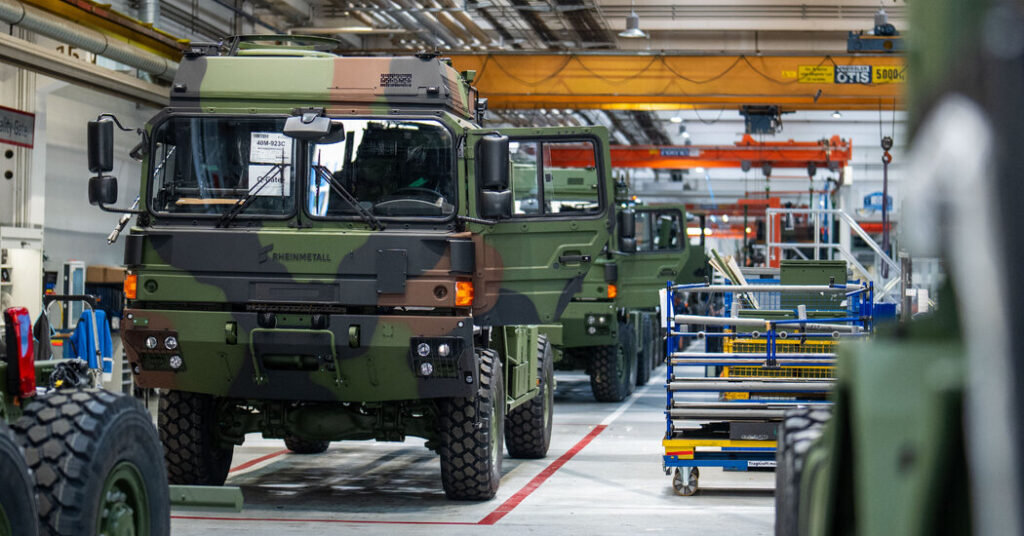
Also on China’s list was Germany’s largest defense contractor, Rheinmetall, which has been central to Germany’s effort to rearm following Russia’s full-scale invasion of Ukraine in 2022. Military hardware uses a lot of super-hard tungsten and some rare earths.
Critical minerals have received growing attention in the West, especially since China imposed export restrictions in late 2024 on four critical but obscure minerals: tungsten, antimony, gallium and germanium. China then put export restrictions in April last year on seven kinds of rare earth metals that are crucial to a very wide range of manufacturing, and has announced plans to impose restrictions in November on five more kinds of rare earth metals.
The Trump administration and the European Union are each trying to build mines for critical minerals and construct refineries that can turn ore into pure mineral powders and eventually into strong metal alloys. The production process is complex and can be dirty: Converting the powders into metals involves sometimes toxic chemicals.
Almost all of the world’s capacity for rare earth metal conversion and alloy making is in China. Many of the European companies targeted by China on Friday are small and medium-sized enterprises that hold what little expertise remains outside of China for the advanced processing of critical minerals.
One of the companies on China’s list is Germany’s Sindlhauser Materials. Sindlhauser’s website says that it makes yttrium alloys with zircon. Yttrium and samarium have been the two kinds of rare earths in shortest supply outside China after Beijing imposed export controls, with prices rising as much as 100-fold.
Yttrium alloys with zircon are used in making advanced semiconductors. Makers of semiconductor manufacturing equipment have been complaining for months about acute shortages of yttrium compounds.
Sindlhauser declined to comment on China’s action.
Another company sanctioned by China was one of Europe’s premier manufacturers of custom-designed electric motors with powerful rare earth magnets inside, Italy’s Lafert Group. Lafert’s motors power many of the robots and other industrial automation in Europe’s factories.
Beijing has been encouraging multinationals to move more of their supply chains into China, including buying electric motors from Chinese companies. While Beijing has severely restricted exports of rare earths and rare earth magnets, it has allowed unrestricted exports of fully assembled electric motors with the rare earth magnets already inside.
Rheinmetall and Lafert did not immediately respond to requests for comment.
The European Union Chamber of Commerce in China has previously criticized the very broad dual-use designations on many critical minerals like those that China cited to restrict sales to the 14 European companies on Friday.
The post China Wields Its Rare Earths Leverage Over Europe With Export Controls appeared first on New York Times.