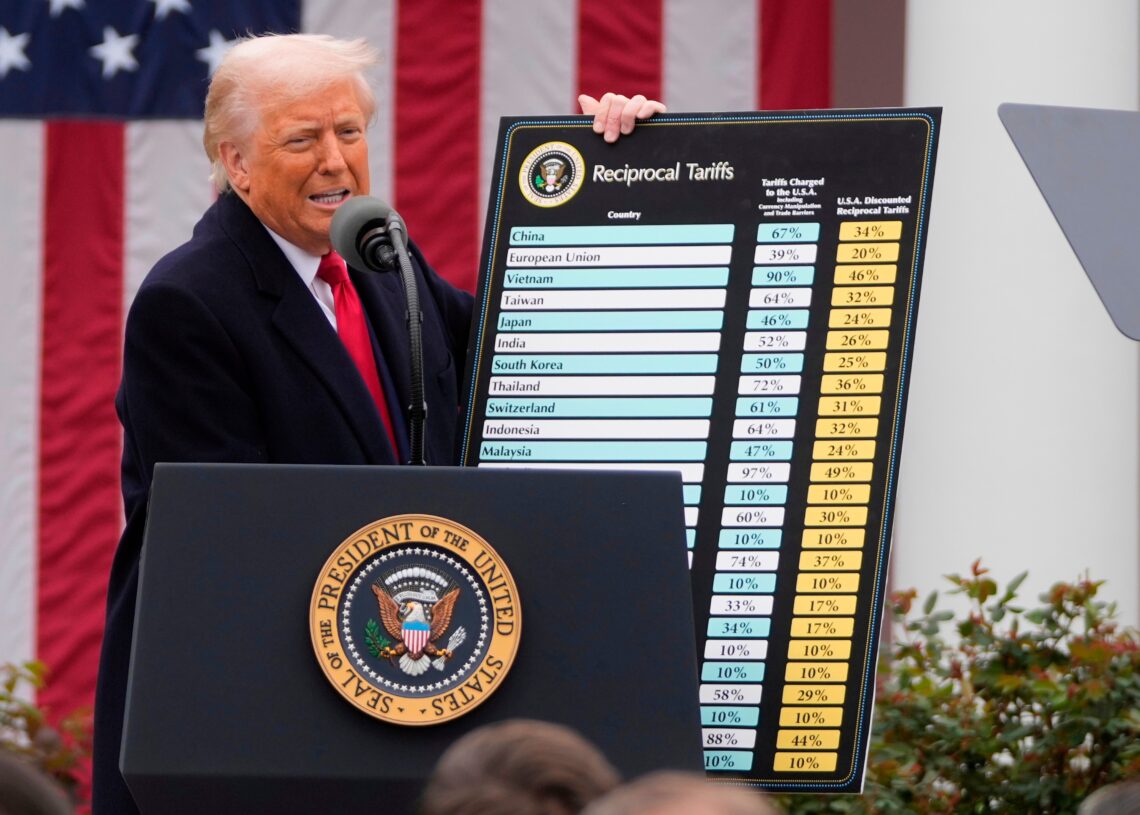
The Trump administration is expected as soon as this week to introduce permanent new tariffs to replace the temporary import penalties it imposed after the Supreme Court earlier this year abruptly upended President Donald Trump’s trade strategy.
The first batch of new tariffs is expected to affect 60 nations that the administration said in June were importing goods produced using forced labor, putting higher-paid American workers at a disadvantage.
Nations that do not prohibit such goods would face tariffs of 12.5 percent, while those that have such laws but fail to enforce them would be hit with 10 percent levies, under a proposal that Jamieson Greer, the president’s chief trade negotiator, made public last month. The president could adjust those numbers before taking final action on what are called “Section 301” tariffs.
Those tariffs would fill the gap left by the scheduled expiration at 12:01 a.m. Friday of a stopgap measure that Trump introduced in February after the nation’s high court invalidated levies he imposed last year under the 1977 International Emergency Economic Powers Act.
In response, Trump used a different legal authority to levy a 10 percent tariff, limited to just 150 days. Now those tariffs are lapsing.
Forced to start his tariff campaign anew, Trump appears eager to pull every lever of trade power he can identify, using laws considered less vulnerable to challenge than the rushed approach he employed last year. Some are well-established weapons in major laws dating to 1962 and 1974. Others, like his use this week of an untested 1930 law to challenge Canada, reflect his unquenchable desire to test legal limits.
“The specific authorities this administration is using have changed but the trade strategy has not,” Greer told the Senate Finance Committee on Wednesday.
Indeed, the president’s goal of greater domestic manufacturing has remained constant since he entered the political arena more than a decade ago. Through tariffs, he aims to encourage manufacturers to invest in new American factories rather than import foreign products.
In his Senate testimony, Greer said the administration is making progress. The trade deficit through the first five months of the year is down by almost 4 percent, according to Commerce Department data. The United States is exporting more merchandise and — rather than buying foreign consumer goods — is importing machinery needed to equip new factories that will employ American workers, he said.
The administration has used tariff pressure to secure 10 so-called reciprocal trade arrangements, which pried open some foreign markets while cementing in place higher U.S. tariffs. Broader trade and investment accords have been reached with the United Kingdom, Japan and the European Union.
“They’ve gotten a number of trade agreements that they otherwise would not have,” said Blake Harden, managing director of Washington Council EY, a consultancy. “The way that they used [the International Emergency Economic Powers Act] really resulted in commitments by trading partners that the U.S. has been seeking for quite some time, both on tariffs and nontariff barriers.”
Yet U.S. factories employ 75,000 fewer workers than when Trump returned to the White House. And despite administration denials, tariffs are aggravating inflation, according to a recent study by the Federal Reserve Bank of Dallas. Without tariffs, the Fed’s preferred inflation measure would have risen at an annual rate of 2.3 percent in March, instead of its actual 3.2 percent figure, the Dallas bank said.
Meanwhile, Trump’s insistence on using the International Economic Emergency Powers Act (IEEPA) to impose his initial round of tariffs in April 2025 — which permitted him to take immediate action — has had far-reaching consequences. After the Supreme Court disallowed his use of the law in February, the administration was required to refund tariffs it had illegally charged importers, an amount the Cato Institute estimated at more than $170 billion. Through the end of June, the government had paid out more than $71 billion, U.S. Customs and Border Protection told a federal judge this month.
As Trump has sought to rebuild his tariff wall, he has turned instead to Section 301 of the Trade Act of 1974. In addition to pursuing the forced-labor tariffs, the administration is probing 16 nations it says deliberately maintain excess production capacity, leading to a global glut of low-cost products. Some of the largest U.S. trading partners — including China, the European Union, Japan, Mexico, South Korea and India — subsidize manufacturing at the expense of U.S. producers, the administration says. New levies could result from that probe within weeks.
The latest flurry of tariff activity began with the imposition earlier this month of 25 percent tariffs on Brazilian goods, which the administration said was a response to Brazil’s “unfair” trade practices.
On Tuesday, the president took to social media to announce a 100 percent tariff on imported generic drugs, effective Aug. 1, 2028, and rising to 200 percent one year later.
And on Monday, he cited an untested 1930 trade law to threaten 50 percent tariffs on Canadian products, which would take effect in 30 days.
In addition, the Commerce Department has a number of open investigations under Section 232 of the Trade Expansion Act of 1962, which authorizes the president to impose 25 percent tariffs on national security grounds.
And Trump could get new tariff powers under a Russian sanctions bill in the Senate that would empower him to levy 100 percent tariffs on major importers of Russian oil. Business groups such as the National Foreign Trade Council oppose the provision, fearing that Trump would stretch those powers in unforeseeable ways. China, India and the E.U. could be at risk of punishing trade taxes if the legislation is approved.
The administration’s renewed legal maneuvering will arm the president for future trade negotiations, including ongoing talks over revisions to the U.S.-Mexico-Canada Agreement, and equip him to respond when domestic industries seek protection, said John Veroneau, a U.S. trade negotiator under President George W. Bush.
“The steps they’re taking to get their legal house in order does not necessarily mean that they’re gearing up for massive levels of new tariffs. I think it does suggest they need to get their legal house in order and want to have flexibility to act in targeted ways as they see fit,” Veroneau said.
Still, this month’s spate of tariff news has left importers and foreign governments scrambling to keep pace.
“There’s a little bit of whiplash in terms of keeping track of the various duties on Brazil, France, Russia, Canada, you know, the hits just keep on coming,” said Jake Colvin, president of the NFTC, which represents companies such as Coca-Cola, Google and IBM. “It feels like the administration is trying out every tool in its toolbox to come up with new tariffs.”
The post Trump is poised to launch new tariffs that sidestep Supreme Court appeared first on Washington Post.