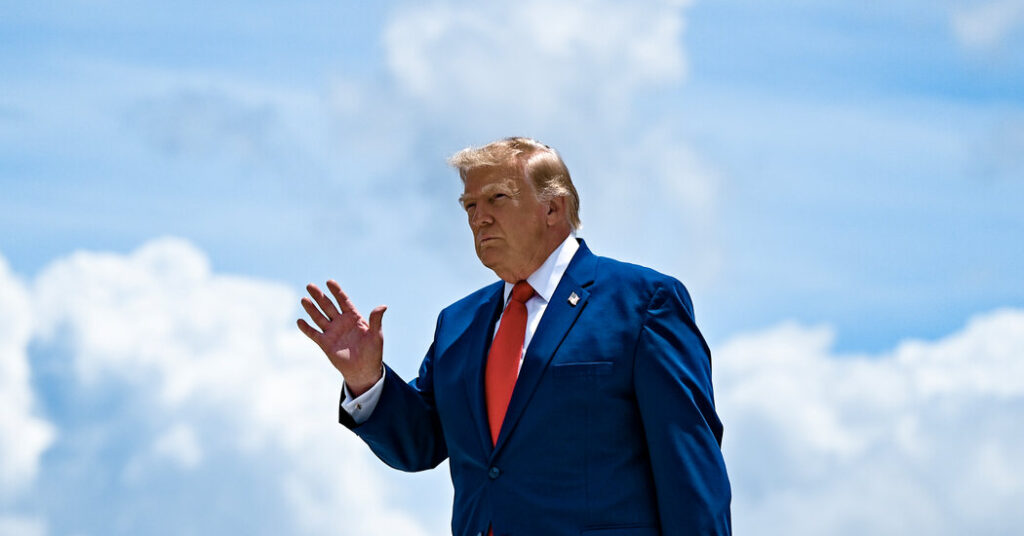
This summer, we learned that Donald Trump made at least $2.2 billion in his first year back in the White House. That’s a crazy amount of money. No other American president or leader of a liberal democracy has even come close to becoming so rich while in office.
And it comes with an unprecedented number of potential conflicts of interest, not just at home but also abroad, in countries with a much worse track record for good governance than the United States. Today, I write about how Trump’s global moneymaking enterprises risk empowering autocrats and seeding corruption around the world.
President Trump’s annual financial disclosure form gave my colleagues who scrutinize his finances a lot to work with.
I spoke with my colleague Eric Lipton, who covers the Trump family’s business operations. Throw a dart at the map, he suggested, and chances are it will land somewhere the American president or his family have business interests. As Eric has documented, Trump’s holding company last year collected at least $125 million in direct payments from foreign sources in countries including Britain, India, Indonesia, Ireland, Oman, the Philippines, Qatar, Romania, Saudi Arabia, South Korea, Turkey, Vietnam and the United Arab Emirates.
Last year, an investment firm tied to the United Arab Emirates bought nearly half of the Trump family’s main cryptocurrency company, World Liberty Financial. Four months later, the Trump administration agreed to give the Emiratis access to sophisticated computer chips powering artificial intelligence.
Not long after, Trump got on the phone with the president of Kazakhstan to help a little-known American mining company win access to one of the world’s largest untapped reserves of tungsten, a critical metal. A short time later, Trump’s two eldest sons, Donald Trump Jr. and Eric Trump, became investors in a company that now owns a stake in that mining company.
The list goes on. Government officials in Vietnam fast-tracked a Trump golf development at the same time that they were trying to avoid steep U.S. tariffs. A South Korean company that has lobbied the U.S. to not impose penalties on its aluminum exports made a $2 million payment to Trump’s holding company for a golf course project. A drone maker backed by Trump’s two oldest sons is negotiating with Gulf countries that need to defend themselves because of a war started by their father.
Many have written about the potential impacts of these dealings on the U.S. itself — their effect on the rule of law, on public faith in government, on Trump’s ability to focus on the interests of the American people, rather than his own.
What might be going underappreciated is that they’re likely to have ripple effects around the world, too.
From enforcer to enabler
For a long time, the U.S. played a very different role: It was an enforcer of anti-corruption rules.
In 1977, after a series of scandals in which American companies secretly paid hundreds of millions of dollars in bribes to foreign officials, the U.S. passed the Foreign Corrupt Practices Act. It threatens fines and even prison sentences for executives who pay officials overseas to win or keep business.
Then, the U.S. went even further, lobbying to have its anti-bribery standard adopted by more than 30 countries. U.S. regulators began rigorously enforcing the law against not just American companies, but any foreign corporation that used the U.S. financial system or markets.
The enforcement efforts “were so intense and the penalties so severe that international corporations really became quite concerned and adapted their practices,” Eric told me.
Under Trump, two things have shifted, Eric said. On the policy side, one of the first things Trump did after returning to the White House was to largely suspend the enforcement of the Foreign Corrupt Practices Act. The administration effectively turned a blind eye to bribes from American companies in the name of economic and national security, arguing that the law, as enforced, made it harder for U.S. companies to acquire critical assets like minerals and deepwater ports.
Then there are Trump’s own potential conflicts of interest. Combined, the two risk being read as a green light for pay-to-play schemes around the world.
(The White House says there are no conflicts of interest because Trump’s sons run the family business operations.)
It’s impossible to say how much this has increased corruption globally. Such schemes, by definition, tend to happen in secret, making them difficult to measure.
But “the United States, the cop on the block, has walked away,” Eric said. We might not know the degree to which that has affected corruption around the world — but we can make a pretty good guess at the direction.
Transactional, with a twist
Liz David-Barrett of Sussex University, who studies transnational corruption, told me that America’s relationship with the rest of the world has changed. Today, she said, it’s looking increasingly like Russia’s or China’s relationship with the world.
Russia and China have a track record of regularly investing in countries with poor governance.
Russia, for example, exploited corrupt governments in Serbia and Hungary to get investment deals in the state energy monopoly and key infrastructure projects. China has cut deals with repressive governments around the world to secure critical resources, including oil from Venezuela and lithium from Zimbabwe.
It’s a transactional, no-questions-asked model favored by countries that have lax labor and environmental rules, and leaders open to corruption. Most experts agree it helped prop up corrupt and authoritarian regimes, including those of Bashar al-Assad in Syria and Viktor Orban in Hungary.
Now, Trump is doing something that looks roughly the same, those experts say, but with a twist: He openly blurs the line between what’s in his country’s interest and what’s in his own interest.
That risks creating problems for America. But it might create problems for the rest of the world, too.
OTHER NEWS
-
Trump put the newly signed U.S.-Saudi nuclear deal in doubt with a new condition: The kingdom must first establish diplomatic ties with Israel.
-
The Iranian-backed Houthi group in Yemen said it had struck two Saudi tankers with drones and missiles, sending oil prices soaring to more than $100 per barrel.
-
A Russian spy left Japan after his activities were revealed by The New York Times.
-
The European Union fined Google $1 billion for anti-competitive practices in its search engine.
-
The influencers Andrew and Tristan Tate, who are being extradited to Britain on charges including human trafficking and rape, are losing the support of allies in Trump’s orbit.
-
Four mathematicians were awarded the Fields Medal, which is given every four years to the brightest young researchers in the field.
-
The U.S. Justice Department will withdraw subpoenas for New York Times journalists who reported on the security capabilities of Trump’s new Qatari-built Air Force One.
TOP OF THE WORLD
The most clicked link in your newsletter yesterday was about the death of a man who introduced Jeffrey Epstein to young women.
SCAM OF THE DAY
Wellness influencers, generated by A.I.
You might have seen them on your feed: hyperrealistic ads promising medical miracles with plant-based pills and supplements. A Times analysis found campaigns by hundreds of A.I.-generated doctors, healers and wellness influencers on social media. Many appear to be targeting older women, while making misleading health claims for profit.
MORNING READ
“I’ve had a hand in killing around six people. Maybe seven,” writes Thomas Gibbons-Neff, a a former U.S. Marine in Afghanistan who later became a Times journalist. “These decisions to pull the trigger were the final steps of our part in a strategy that was doomed before I even deployed.”
After covering several conflicts as a journalist, Thomas ultimately decided to leave The Times to become an English teacher. In May, during his final weeks at The Times, he returned to Afghanistan to speak with someone he once fought against: a Taliban commander. Here’s what he found.
AROUND THE WORLD
A gallery reopens, sans stolen jewels
The Louvre Museum’s Apollo Gallery is crammed with paintings, sculptures and tapestries. But earlier this week, when the gilded gallery opened for the first time in more than nine months, it felt strangely empty: The crown jewels, once a centerpiece of the room, were missing. They were stolen in October by burglars who made off with gems worth more than $100 million.
The museum visitors who returned to the room said they had been traumatized by the heist. “It was like a piece of myself was gone,” one said. “There is a void.” Read more about the missing jewels.
RECIPE
Bibingka is a Filipino cake traditionally made with rice flour and coconut milk that’s baked to supreme fluffiness over banana leaves in a terra-cotta oven. This version is built to fit in the palm of one’s hand. The final touch is macapuno — opalescent strands from rare, prized coconuts with jellylike flesh.
WHERE IS THIS?
Can you guess this national park?
BEFORE YOU GO …
Interviewing Zohran Mamdani last week in New York was a big moment for the newsletter. (It also gave me a lot of street cred with my 14-year-old daughter and her friends.) I’d like to have more of these kinds of conversations, and to take The World into the room with me. So if there’s anyone you’d like to hear from — including anyone who is currently flying a little more under the radar — send me a note!
It’s interesting — at a time when people are turning away from national politics, recent polls show Mamdani has actually become more popular among New Yorkers. Those polls don’t say why, but many of the people I talked to told me stories of running into Mamdani around the city — out at a night club, or visiting a school, or even just walking around the streets of Queens.
There’s something intriguing here about local politics and the link mayors have with their voters that feels noteworthy in this polarized moment. Andy Burnham, the new British prime minister, is also a former mayor. I’m hoping to explore this in a future edition of The World.
But first — vacation! I’m off next week, and my holiday playlist is almost finished. (Don’t worry, the newsletter will go on without me.) The first song, and one that I have been playing on repeat for happy vibes, is “You Got the Love” by Rufus & Chaka Khan.
See you in August! — Katrin
TIME TO PLAY
Here are today’s Spelling Bee, Mini Crossword, Wordle and Sudoku. Find all our games here.
We welcome your feedback. Send us your suggestions at [email protected].
The post Trump, His Money, and the World appeared first on New York Times.