In the summer of 2021, Ivanka Trump and her husband, Jared Kushner, were cruising the Mediterranean by yacht when they stopped for a swim off the Adriatic coast. They splashed over to an island and hiked, barefoot, across its hilly, rugged terrain. “Effectively that’s how we found it,” the president’s eldest daughter would later recount.
The Albanian island that the Trump heirs stumbled on, Robinson Crusoe–like, is called Sazan, once the site of a top-secret military base. Sazan is not undiscovered territory to Albanians; it’s their country’s largest island. Because it was uninhabited for many years, vegetation and wildlife flourished, making it a cherished nature preserve. Luckily for the Trump couple, Albania’s prime minister, Edi Rama, was a guest on the same yacht one of the nights they were on board.
Three years later—and about two months after Donald Trump’s reelection in 2024—an investment committee led by Rama gave preliminary approval to the couple’s plans to develop the island into an opulent resort. The venture extends to nearby land next to a coastal lagoon, which serves as a crucial habitat for flamingos, sea turtles, and other species. The couple’s partners in the project include a pair of Qatari brothers who have financed ultra-luxury developments across the Middle East and South Asia and an Albanian conglomerate with holdings in energy, construction, infrastructure, insurance, and tourism. In a recent podcast interview, Ivanka Trump described the project as “the culmination of all of my experience in real estate, all of my travel, a lot of reflection on how I want to live, how I think people increasingly are wanting to live.”
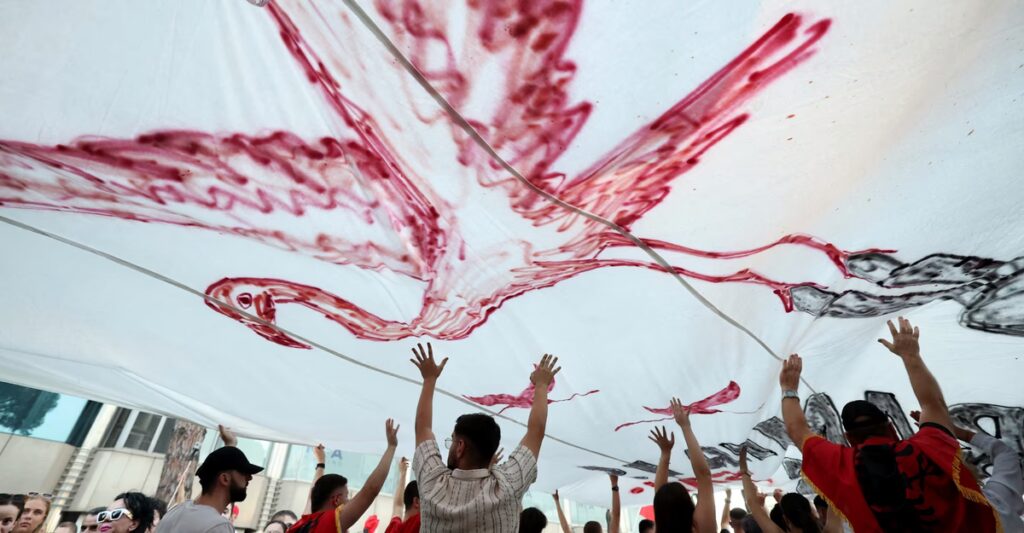
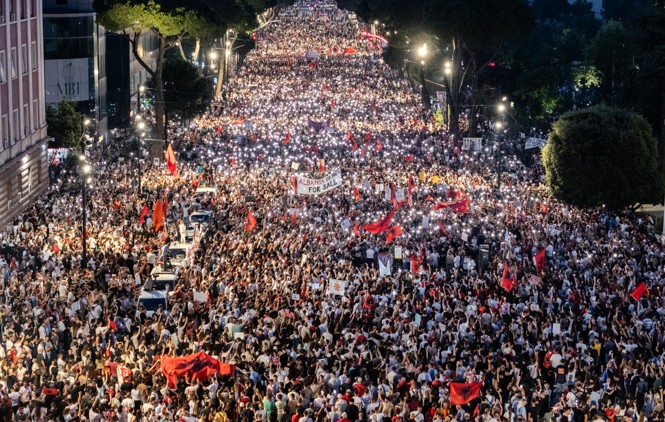
Many Albanians see matters differently. Hundreds of thousands have joined daily protests against the plans, in one of the country’s largest social mobilizations since the end of Communist rule 35 years ago. The uprising, called the Flamingo Revolution, takes its name from the wild birds that breed in the wetland habitat. Protesters have carried inflatable flamingos and placards with drawings.
The unrest has it all: accusations of organized crime and drug trafficking, competing claims of foreign influence, a cameo by Kanye West. For the participants I spoke with, the demonstrations are about accumulated frustration with Albanian politicians who have failed to give the country a solid economic foundation. “You can interpret it as an anti-Trump demonstration in the sense that it’s opposed to a Trump-like system we see here,” Fatos Lubonja, a writer and dissident who was imprisoned during Albania’s Communist dictatorship, told me: “government decisions made in secret, for the benefit of the few, motivated by money linked to oligarchs.”
The beauty of the landscape discovered by the American president’s daughter “belongs to all Albanians,” Lubonja said. He paraphrased Dostoyevsky: “And beauty will save the world.” But Rama, a former professional artist, won’t hear it. “I can be lectured about many things—about economy, about legal affairs, about agriculture, about health care,” he said in a recent interview. “But there is one thing that nobody can lecture me, which is beauty.”
The Flamingo Revolution seems, at first glance, the unlikeliest of anti-Trump protests. Albania, a nation of fewer than 3 million people, is one of the most pro-American countries in the world, and has been since the United States opposed Albanian partition all the way back in 1920. More recently, Washington backed Albania’s entry into NATO, in 2009, and has upheld its security in a historically volatile region that’s sometimes called the powder keg of Europe.
In the 18 months since Trump returned to power, I have traveled extensively in European countries with some of the strongest postwar ties to the U.S., including Britain, Germany, and Denmark. One of the questions I hear most often is why the Americans opposed to Trump aren’t mounting larger and more sustained demonstrations against him. The question arises especially when I ask European diplomats why the leaders of their countries don’t stand up more forcefully to an American president who insults them and entertains annexing their territory. They turn the inquiry back on me, asking, Why aren’t Americans standing up? Millions have marched in “No Kings” protests; the mobilization in the spring was one of the largest single-day protests in American history. Still, the point remains. Trump made at least $2.2 billion during his first year back in office, as wage growth slowed. He is pursuing an unpopular war, unauthorized by Congress and unsanctioned by international law. Even pro-American Europeans want to know: Why aren’t people in the streets every day?
[Read: Trump is learning that bullying has consequences]
In Albania, a small country on Europe’s Balkan Peninsula, they are. Today marks the 54th consecutive day of protests triggered by the Trump-family development project. Few would have pegged Albania as the center of the international anti-Trump opposition. But a tour through the country’s recent history suggests that it isn’t as unlikely as it appears.
Albania was once one of the most isolated countries in Europe. It was ruled, from the end of World War II until 1985, by a ruthless and paranoid Communist dictator, Enver Hoxha, whose fear of foreign invasion spawned the construction of an estimated 173,000 bunkers. Albania earned the nickname “Europe’s North Korea.” The Communist state was abolished in 1991, and the anti-Communist opposition swept to power in parliamentary elections a year later. But the transition to a market economy wasn’t easy. Breakneck privatization under a system known as “shock therapy” devastated local industries and drove mass unemployment. In 1997, the collapse of massive, state-sanctioned pyramid schemes wiped out the life savings of about two-thirds of Albanians. A small cadre of politicians has competed for control of the country ever since. Because of its recent experience, the population is highly attuned to signs of autocracy, Dana Fisher, a sociologist at American University who has studied the demographics of the No Kings protests in the U.S., told me. Familiarity can breed complacency. But in this case, it’s inspiring fierce resistance.
The Trump family triggered the uprising, but the target of the protests is Rama. The leader of his country’s Socialist Party, Rama came to power in 2013, as Albania was still sloughing off its insular identity. Albania became a candidate for European Union accession the following year. Rama was once a vehement Trump critic who greeted the prospect of the mogul’s nomination in 2016 by remarking, “God forbid!” He foresaw harm not just to the United States but to the “democratic world.”
Rama is now much more supportive. He hailed Trump’s “remarkable victory” in 2024 and, a year later, echoed the president’s assertions of divine providence, adding, “When Trump says that God saved him to Make America Great Again, he tells only half of the story. The other half is that he saved Trump also to make Europe wake up and get its act together.” Rama is one of the only European leaders to accept an invitation to the Trump-chaired Board of Peace. Domestically, he has sought to improve the Albanian economy by upgrading the hospitality industry. He told The Guardian last year: “We need luxury tourism like a desert needs water.”
That’s in line with Kushner’s ambitions. “I was very, very impressed with his vision for what he wanted to do with Albania,” Trump’s son-in-law told an investment conference. Kushner continued: “I really didn’t know anything about the country. I didn’t understand the history, and the darkness of the history with the Communism, and the terrible leadership actually led to it being fully undeveloped as a nation.”
It’s not Kushner’s first attempt at high-end development in the Balkans. Last December, he pulled out of plans to build a Trump Tower in Belgrade, at the site of the former Yugoslav defense ministry, which was bombed by NATO in 1999. His investment firm withdrew from the project hours after the country’s organized-crime prosecutors indicted the culture minister for allegedly forging documents as part of the process to remove the building’s cultural-heritage status. The company issued a statement saying the plans would not proceed, because “meaningful projects should unite rather than divide.”
In Albania, people involved in the resort project maintain that construction isn’t yet under way, even though environmental activists say fencing has gone up, trees have been removed, and sand dunes have been flattened. The country amended its environmental regulations in 2024, cutting a path for the development by lifting construction bans in protected ecological zones. The move drew a warning from the European Parliament about compliance with environmental standards as part of Albania’s bid to join the bloc. Rama’s office didn’t respond to a request for comment, but Asher Abehsera, one of the Trump couple’s partners in the endeavor, told me in a statement, “Our goal is simple: celebrate Albania’s natural beauty, create jobs, and build something future generations can be proud of.”
He added: “Its future will ultimately be determined by Albania and the Albanian people.”
Large-scale demonstrations began in Albania at the end of May, after video circulated of private security guards punching and dragging a protester along a beach in Zvërnec, the coastal enclave where part of the Trump-family project is planned. “This was the tipping point,” Ditmar Bushati, a former Albanian foreign minister, told me. “It started as a dispute over access to the sea and access to nature, and it was transformed in a couple of days into a protest about who should decide the future of the country.”
Thousands mobilized in Tirana, the capital, with signs proclaiming that the nation was not for sale and declaring, I don’t want Albania like Dubai. Rama also dug in his heels, issuing a statement saying, “There is absolutely no chance that the investment will stop as long as I am here.” As the protests grew, they became a platform for frenzied speculation and conspiracy theories. Some protesters saw parallels to Kushner’s support for a proposed “Gaza Riviera,” fearing that Albanian land would be used to resettle Palestinians. Further afield, online commenters called the development “another Epstein island,” a reference to the late sex offender Jeffrey Epstein’s hideouts in the U.S. Virgin Islands. A separate controversy, over government-backed plans for a Kanye West concert outside Tirana, added to the grievances. Attention came from all ideological corners. Senator Bernie Sanders welcomed the protests as a dissent against “global oligarchy.” Alex Jones, the right-wing conspiracy theorist, enthused about an impending “civil war.”
The prime minister argued that the protests had been hijacked by foreign actors, blaming “Trump haters” as well as “enemies of Israel and Albania.” Albania, where about half of the population is Muslim, has strong ties to Israel rooted in historical goodwill. During the Second World War, Albanians motivated by an ancient honor code called besa, literally “to keep the promise,” hid thousands of Jewish refugees; it was the only European country with more Jewish residents after the Holocaust than before. In this century, Albania made itself a target of the Iranian regime when it agreed, at the request of the United States and the United Nations in 2013, to host exiled members of the dissident group Mujahedin-e-Khalq, or MEK. In 2022, Albania expelled Iranian diplomats after concluding that Tehran was behind a wave of cyberattacks aimed at government institutions and critical infrastructure. In recent weeks, Rama has accused Iran of waging a “hybrid war” by spreading disinformation about the development and inflaming opposition to his government’s plans. Iran has denied the accusations.
Protesters appear intent on proving that the uprising is authentic and homegrown. Bushati, the former foreign minister, has celebrated the protests as “the best investment in our image as a people and in our path towards the European Union.” He said as many as 200,000 people mobilized over the July 4 weekend and dismissed claims of foreign interference. “Iran has zero influence in Albania,” he said. “This is a country living happily in the U.S. orbit.”
Iranian influence hardly seems necessary to destabilize the resort plans. The land on which part of the project is planned is contested. Sazan, the island, is owned by the state, so a lease would ultimately be necessary; the Trump-linked consortium currently has what’s called “strategic investor” status, which helps accelerate permitting and negotiations for a long-term agreement. The coastal land in Zvërnec, however, is private. Entities linked to the Trump couple purchased it from a Miami-based businessman, Artur Shehu, who insists that his family’s claim on the land dates to Ottoman times. Locals in Zvërnec argue that they are the rightful owners. It’s a messy picture because land was requisitioned by the state during the Communist period; when properties returned to private hands in the 1990s, ownership was often disputed.
The saga became considerably more dramatic this summer, when an Albanian agency devoted to countering financial crimes, the Special Structure Against Corruption and Organized Crime, said it was investigating whether Shehu had forged deeds to the property. Finding out whether he has lawful title to the land is just one part of a broader probe by the agency into allegations that Shehu and his associates had trafficked cocaine into European ports and then laundered the money for real-estate projects. A message sent to a number associated with Shehu went unanswered; his attorney denied the allegations to Reuters. The Trump couple and their partners in the venture are not accused of wrongdoing. A spokesperson for the venture said, “The Albanian legal system is the appropriate venue for resolving questions about land ownership and the integrity of prior transactions. We respect that process, and as always, we will cooperate with any lawful process as required.”
The Flamingo Revolution reflects dissatisfaction with Albania’s democratic institutions 35 years after the fall of Communism. Yet the popular mobilization, combined with the anti-corruption inquiry that seeks to validate some of its core claims, is evidence of democratic maturity. Albanian society has developed antibodies to signs of state capture. The irony is that an initiative emanating from the American president’s family would trigger such a powerful immune response.
The post The Trump Family Sparks a Revolution in Albania appeared first on The Atlantic.