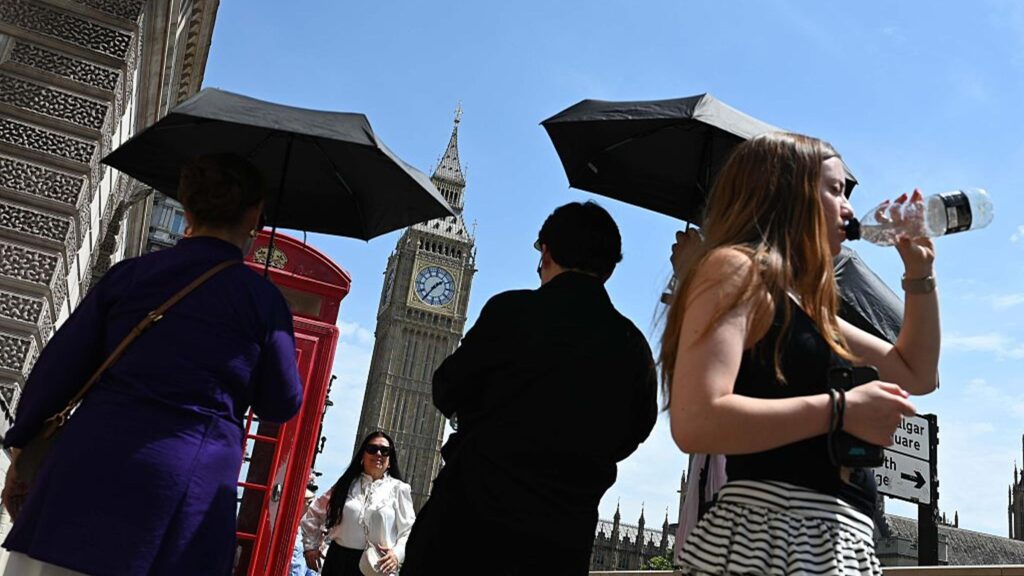
Last month’s heat wave in the U.K. not only broke June temperature records but may have cost the country more than £1 billion ($1.33 billion) in lost economic output. That’s according to a new analysis by the Grantham Research Institute on Climate Change and the Environment and the Euro-Mediterranean Center on Climate Change (CMCC).
The heat wave, which lasted between June 18 and July 1, resulted in England’s warmest June since records began in 1884, with daily maximum temperatures often reaching over 90°F. A provisional high of 37.7°C (99.86°F) was recorded at Lingwood, Strumpshaw Hill in Norfolk on June 26, the most significant new national record for June. High temperatures led to delayed and cancelled trains, while shops, offices, and schools were forced to close.
Elizabeth Robinson, director of the Grantham Research Institute, and Shouro Dasgupta, environmental economist at the Euro-Mediterranean Center on Climate Change and visiting senior fellow at the Grantham Research Institute, carried out a survey to better understand how the heat affected workers around the country during the week of June 22. They then scaled that information to calculate the cost to the economy.
Read more: Why Is Europe So Ill-Equipped to Handle Heat Waves?
The two researchers surveyed 1,950 U.K. adults across sectors, asking them the perceived impact the heat wave had on a number of factors—including working hours, effort while working, health, ability to sleep, changes to how they got to work or their place of work, and their working environment. They were then able to estimate the economic cost imposed by the heat wave in terms of lost output: approximately £1.15 billion (over $1.5 billion) of lost output in a single week.
The figure is likely higher, says Robinson. “We don’t include whether people have reduced their effort, [as in] the productivity per hour, because you can’t measure that with the approach we take,” she notes. “So it gives us quite a conservative estimate of the economic costs of the heat wave.
According to the survey, the average reported reduction in hours worked across the week of the heat wave was 0.47 hours—which would suggest approximately 16 million lost hours in a working population of 34.4 million. Those working in physically demanding jobs or those exposed to heat, like construction and agriculture, reduced their hours by more than those working in low-exposure and physically undemanding jobs such as office workers. About 3.6% of respondents, equivalent to approximately 1.25 million workers in the population as a whole, reported that they did not work at all that week because of the heat.
Many respondents reported a number of adaptations to deal with the heat—be it changing the hours they worked, the effort they put into working, where they work, or their commute. Forty-nine percent of workers said they had access to air conditioning, while 27% said their employers made changes to the work environment to cool it down—like installing A.C., increasing ventilation, or providing shade.
“We’ve got very clear evidence that adaptation measures do successfully reduce how many hours are lost to heat, and adaptation measures do successfully protect workers’ health to some extent,” says Robinson.
Even still, the findings point to a country unprepared for heat waves—which are only expected to grow more frequent and intense with climate change. The U.K. is particularly vulnerable when it comes to heat waves. Much of the country’s housing stock is old, and built for a much cooler climate. Buildings were designed to keep heat in, turning them into furnaces during the now more frequently occurring heat waves. “The U.K. is built for a country that’s cold and not too hot, and now we’re having [what feels like] Mediterranean weather with buildings that are built to keep us warm, not to cool us down,” says Robinson.
“We are woefully under-adapted to the changing climate,” says Robinson. “[This survey] provides evidence for governments and employers that it makes sense to invest in adaptations because the frequency of heat waves [and] the intensity is only going to get worse.”
Dasgupta also hopes that the findings encourage governments to create regulations around heat and working environments to ensure that heat adaptation becomes more widespread. “We need regulations in terms of either maximum temperature thresholds, mandatory rest breaks, or additional hydration breaks,” he says. “The effects are right now too significant for this to be left alone.”
The post The June Heat Wave Cost The U.K. Economy Over $1.5 Billion appeared first on TIME.