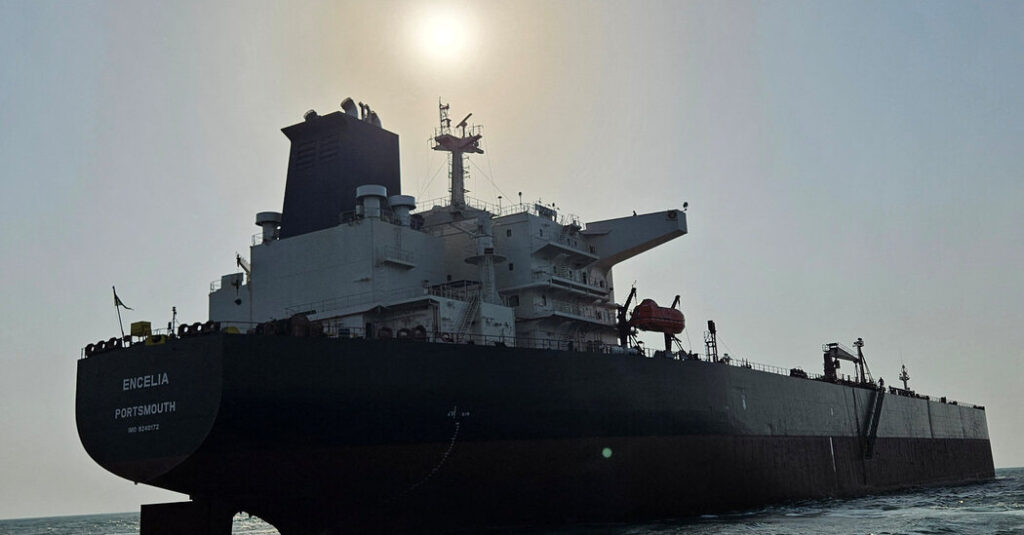
The price of oil hit $100 a barrel on Thursday for the first time since May after militants allied with Iran said they had hit two Saudi tankers in the Red Sea, stoking fears that another crucial shipping route may be choked off with a cascade of consequences for the global economy.
President Trump said he would hold Iran responsible for any further attacks by the Houthi militants, who control much of Yemen. He also threatened to expand the war to include the group itself. The warning came after the United States and Iran traded strikes across the Middle East for a 12th consecutive night.
The maritime strikes claimed by the Houthis’ were the first since the group announced a blockade on Saudi vessels earlier this week.
If the Houthis hit any more ships, Mr. Trump wrote in his post, “major military punishment will be inflicted upon Iran and, of course, the Houthis, themselves, who I am very disappointed with in that they have, until now, acted very professionally and smart.”
With the cease-fire between Iran and the United States in tatters, Democrats and a handful of Republicans in the House of Representatives on Thursday voted for a second time to demand that Mr. Trump seek Congressional authorization to keep U.S. troops engaged in the war. The president effectively ignored a similar rebuke last month. The Senate voted 49 to 47 against taking up its own war powers resolution.
When the United States and Iran reached a deal in June to cease hostilities and reopen the Strait of Hormuz, oil prices plummeted to prewar levels. Countries that rely on Middle Eastern supplies relished a reprieve from a crisis that forced the cancellation of thousands of flights and ate into the budgets of hundreds of millions of people. Farmers who use diesel fuel for irrigation and machinery as well as petrochemical products like fertilizer were especially hurt.
“Ships of the World, start your engines. Let the oil flow!” Mr. Trump declared when the deal was announced.
The collapse of the cease-fire earlier this month and the resumption of daily airstrikes had already put oil-importing countries back into crisis mode. Now the entry of Houthi militants into the war, and their attacks on ships using another critical waterway, has deepened the oil shock by cutting off another shipping route to Asia.
The war in Ukraine has also contributed to the oil market turmoil, disrupting shipments in the Black Sea as well as fuel production at Russian refineries.
U.S. stock markets opened sharply lower on Thursday. And the yield on the 10-year treasury bond, a key indicator that influences mortgage and student loan rates, jumped past 4.7 percent, its highest level in many months.
The European Central Bank, which last month became the first major central bank to raise interest rates in response to the war with Iran, held them steady at a meeting on Thursday. But the head of the bank, Christine Lagarde, told reporters that “uncertainty remains high.”
The Houthi attacks raise the prospect of wider economic turmoil, especially in the shipping business.
Some ships bound for Asia this week have been forced to embark on lengthy detours through the Suez Canal, the Mediterranean Sea and around the southern tip of Africa. The delays and added costs blunt the effectiveness of a pipeline that crosses the Arabian Peninsula, which Saudi Arabia has relied on heavily during the war as an alternate pathway for oil exports.
With the Persian Gulf largely closed off, oil prices are now 40 percent higher than they were before the United States and Israel launched the war against Iran in February. The average price of gasoline in the United States was $4.09 on Thursday, according to AAA, a 15-cent jump from a week earlier.
The Saudi authorities on Thursday confirmed a strike on one of its ships, the Encelia, without specifying the origin of the attack. It said that the crew was safe. The Saudis have not commented on the Houthi claim regarding a second ship.
Neither the United States nor Iran has signaled much appetite for a return to negotiations. In recent days, Iranian and American officials have instead vowed to respond to each other’s attacks with fresh ones of their own.
U.S. Central Command, which coordinates military operations in the Middle East, said it had launched a wave of strikes overnight to degrade Iran’s ability to threaten commercial shipping, targeting drone and missile storage sites and air defenses.
That language, which the U.S. military has employed on a daily basis, does not explicitly acknowledge U.S. strikes on infrastructure that can be used for civilian purposes, like roads and ports. Such attacks could be considered war crimes under international law.
Mr. Trump has threatened to attack a bridge or power plant “any time the Islamic republic of Iran shoots at a ship in the Strait of Hormuz.”
Iran’s Islamic Revolutionary Guards Corps said overnight that it had launched attacks on U.S. military targets in Jordan and Kuwait, including a communications tower, accusing U.S. forces of attacking equivalent infrastructure in Iran.
Videos circulating on social media and verified by The New York Times showed two of Iraq’s border crossings attacked on Thursday, with people carrying suitcases fleeing the explosions.
The first attack occurred in the early hours of Thursday near the Iranian side of the Shalamcheh border crossing in Khuzestan Province. Iranian and Iraqi media outlets reported that a rest station for police officers at the crossing had been hit by U.S. airstrikes. U.S. Central Command did not immediately respond to questions about the attack.
Additional footage showed a damaged telecommunications tower inside a small compound within the border crossing facility.
In what appeared to be a retaliatory strike, the Abdali border crossing between Kuwait and Iraq was also hit on Thursday afternoon.
Gen. Saud Abdulaziz al-Otaibi, a spokesman for Kuwait’s defense ministry, said in a statement that the crossing had come “under attack by hostile drones,” without specifying their origin, and that there had been no casualties.
Reporting was contributed by Shirin Hakim, Robert Jimison, James McManagan, Sanjana Varghese, Aruni Soni and Euan Ward.
The post Strikes Against Saudi Tankers in the Red Sea Send Oil Past $100 a Barrel appeared first on New York Times.