In 1989, the Iranian government called for Salman Rushdie’s death after he published “The Satanic Verses.” After years in hiding, Mr. Rushdie resumed a normal life, making public appearances and ditching his armed security.
That normality was shattered on Aug. 12, 2022, when a young, disillusioned man rushed onstage in western New York, where Mr. Rushdie was giving a talk, and stabbed him 15 times. The attack left the author blind in one eye, with damaged nerves and scars all over his body.
On Thursday, Mr. Rushdie, 79, recalled in harrowing detail how he encountered his stabber, Hadi Matar. He saw Mr. Matar, whose face was obscured by a black mask, in a sideways glance to his right as Mr. Matar approached and threw Mr. Rushdie violently to the ground.
“I tried to get away, but he was on top of me, stabbing away,” Mr. Rushdie said in Federal District Court in Buffalo, N.Y., wearing a dark suit with soft-soled shoes and a closely cropped goatee.
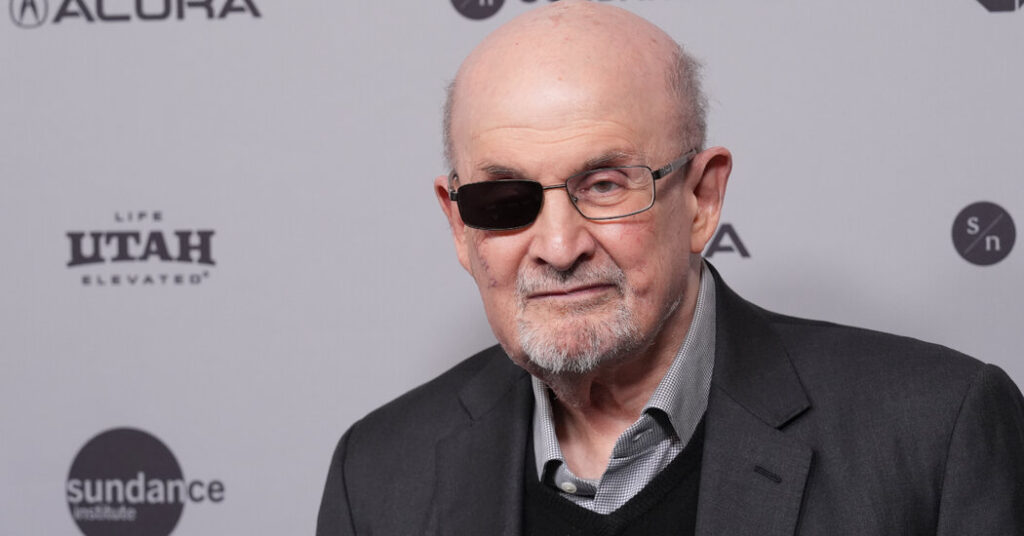
At one point, Timothy C. Lynch, a federal prosecutor, instructed Mr. Rushdie to remove the distinctive eye glasses he has worn since the attack. One lens was clear, while the other was darkly shaded, covering his damaged eye.
“As you can see, there’s nothing there now,” Mr. Rushdie said after taking them off.
Mr. Rushdie testified last year about the stabbing during Mr. Matar’s trial on state charges in Mayville, N.Y. Mr. Matar was convicted of attempted murder and sentenced to 25 years in prison.
He is now on trial for federal crimes, and Mr. Rushdie’s testimony is a critical piece of the government’s case: that Mr. Matar did not just try to kill Mr. Rushdie, but that he had acted at the direction of Hezbollah, the Iran-backed militia in Lebanon, and committed an act of terror by enforcing the fatwa, a religious edict.
Nathaniel L. Barone II, Mr. Matar’s lawyer, has argued that while his client was upset over Mr. Rushdie’s work, he was neither following orders from Hezbollah nor doing the Iranian government’s bidding.
If Mr. Matar is convicted of the federal charges — two counts of providing material support to a terrorist group, and one count of terrorism that transcends national boundaries — he could spend the rest of his life in prison.
Mr. Rushdie has been a target of rage among Islamic extremists for decades. The government of Iran in 1988 issued a fatwa against him over “The Satanic Verses,” a novel that depicted a fictionalized version of the Prophet Muhammad and outraged many Muslims.
For nearly 10 years after the fatwa, Mr. Rushdie largely lived in isolation in London, with constant security. But in 1998, an Iranian government official dropped the death threat against Mr. Rushdie as Iran resumed diplomatic relations with the United Kingdom. British intelligence services assured Mr. Rushdie of his safety, he said in court on Thursday.
Mr. Rushdie began living a largely normal life in New York. He had arrived at the amphitheater in August 2022 to deliver a speech that focused on writers living in political exile.
Mr. Matar, according to federal prosecutors, had plotted the attack for months. He researched the fatwa, spliced together pro-Iran propaganda videos and told others about his desire to kill Mr. Rushdie for what he saw as his blasphemy.
On Thursday, Mr. Rushdie recalled a flurry of stab wounds, including several to his midsection, his left hand and, what would bring the most lasting damage, his right eye. Mr. Matar’s knife pierced his optic nerve and stopped within one millimeter of his brain, he said.
“I could feel the pain, and I yelled out, ‘What happened to my eye?’” Mr. Rushdie recalled.
He credited a firefighter with saving his life, by using his thumb to slow the bleeding of an artery. Still, Mr. Rushdie said, he was aware of “an enormous and expanding lake of blood.”
He was put on a gurney and flown by helicopter to a hospital in Erie, Pa., where he spent 17 days, before being transferred to NYU Langone’s Rusk Rehabilitation center in New York City, where he spent about a month.
It took seven months of physical therapy before he could use his damaged hand normally again. He can no longer drive, and the injuries have also made it difficult to write, he said.
He now lives in New York City, where he is a visiting professor at N.Y.U. In 2024, he published a memoir about the attack and its aftermath, “Knife: Meditations After an Attempted Murder.” In it, he imagines a conversation with Mr. Matar, whom he wanted to meet.
At one point, Mr. Barone grilled Mr. Rushdie about the subject matter of “The Satanic Verses” and whether he should have anticipated the reaction the book received from Islamic extremists.
“I don’t believe the book is on trial,” Mr. Rushdie responded. “Somebody else is on trial.”
The post Salman Rushdie Recalls ‘Lake of Blood’ in Testimony Against His Attacker appeared first on New York Times.