On Wednesday, the Pentagon reported on its casualties website that a total of 18 American service members had been killed during the war in Iran.
By Thursday, the Defense Department had lowered that number, reporting that 14 American troops had been killed in the war.
Three military officials said that one reason behind the change was that the Trump administration decided to remove four service members killed this past weekend from the list — three in Jordan and one in northern Iraq — because their deaths occurred after President Trump declared a cease-fire in the war in April.
The officials described sensitive internal discussions on the condition of anonymity.
The acting press secretary for the Pentagon, Joel Valdez, attributed the change instead to “temporary data disruptions” on the website that he suggested would be quickly fixed.
Since the cease-fire collapsed, the Pentagon has provided little information about the American military strategy and has been slow to release information about troops injuries. The last major Pentagon briefing on the war was in early May.
The Defense Department has said that disclosing Iranian strikes on bases where U.S. troops are housed would compromise operational security.
The Pentagon withheld information about three Iranian strikes last week in Jordan that injured dozens of U.S. service members and damaged several helicopters, according to several U.S. officials, who spoke on the condition of anonymity to discuss operational matters.
After an Iranian strike in Jordan on Friday killed three soldiers, the Pentagon’s chief spokesman, Sean Parnell, acknowledged that the number of U.S. military casualties since July 7 had risen to nearly 100.
Defense Department officials say they are bound by law to report troop deaths, but not injuries. Critics, including Democratic senators, say the Trump administration is obligated to inform the public about the conduct of the war.
“The administration seems to have a real hard time being honest about what is going on — not just about casualties, but about the whole war in general,” said retired Lt. Gen. Ben Hodges, a veteran of the wars in Iraq and Afghanistan, who commanded U.S. forces in Europe at the start of Mr. Trump’s first term.
General Hodges said that downplaying deaths during war indicated “an unwillingness or inability to aggressively learn from mistakes.”
The issue of troop deaths is significant because both President Trump and Defense Secretary Pete Hegseth have essentially made it so. Both men have repeatedly said that their predecessors, President Joseph R. Biden Jr. and Defense Secretary Lloyd J. Austin III, as well as Vice President Kamala Harris, were personally responsible for the deaths of 13 American service members in a suicide attack in Kabul in 2021.
“These people shouldn’t have died,” Mr. Trump told podcaster Lex Fridman in 2024. “They died because of Biden and because of Kamala. They died just like if they pulled the trigger.”
Dozens of Afghans were also killed in the attack at Abbey Gate, a main entryway at Hamid Karzai International Airport, during the chaotic U.S. evacuation from the country.
The Pentagon has indicated it is preparing to release a review of the Afghanistan withdrawal that Mr. Hegseth ordered. That review, led by Mr. Parnell, will “ensure ACCOUNTABILITY to the American people and the warfighters of our great Nation,” Mr. Hegseth wrote last year in announcing the effort.
In its casualty toll for the Iran war, the Pentagon has separated the number of troops killed under fire from those killed in accidents. As of Wednesday, its data showed that 11 service members were killed in hostilities and seven in accidents related to the war.
The seven killed in accidents include the crew of a U.S. military KC-135 refueling aircraft that crashed in Iraq in March, as part of the war campaign in neighboring Iran.
Mr. Valdez said that comparing the troops deaths under the Trump and the Biden administrations was an “attempt to politicize the sacrifices of America’s finest warriors in Iran.”
By Thursday morning, the number of deaths on the site had been changed to 14, with seven classified as hostile.
Mr. Valdez referred to the changes as “site anomalies” and said they were being resolved.
“The department attempted to explain the anomalies to The New York Times ahead of publication, but given their lack of knowledge in this area, they proceeded to write a non-story,” he said in an email, adding: “We remain committed to ensuring the utmost accuracy of all casualty reporting.”
Mr. Trump has continued to refer to the higher number of U.S. troop deaths. In comments on Thursday, he compared the toll from other American wars to the war against Iran, saying that even one death “is too many, but it’s 18.”
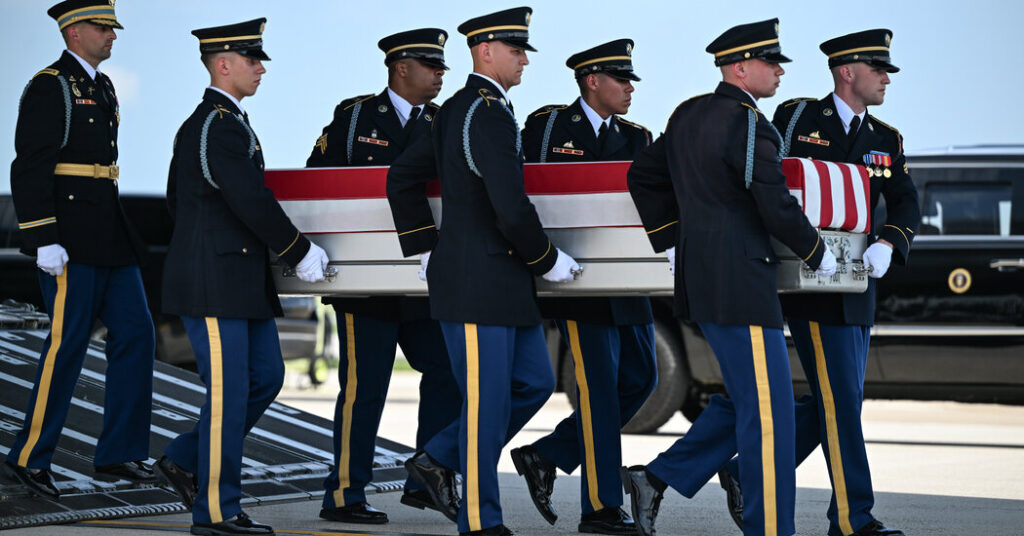
On Wednesday, Mr. Trump witnessed the return of the bodies of the four service members at Dover Air Force Base in Delaware, calling them “great heroes.”
“All of them said, very strongly, that we can’t let Iran have a nuclear weapon, so we’re going to honor them,” Mr. Trump told journalists as he was departing for the dignified transfer.
Later, Mr. Trump took one soldier’s grieving family to his political rally in Georgia.
Peter Feaver, a political science professor at Duke University who studies the military, said the loss of any service member was a tragedy.
“It’s important to remember that every one of those numbers is a personal story,” he added.
Lazaro Gamio contributed reporting.
The post Number of U.S. Troop Deaths Suddenly Appears Lower on Pentagon Website appeared first on New York Times.