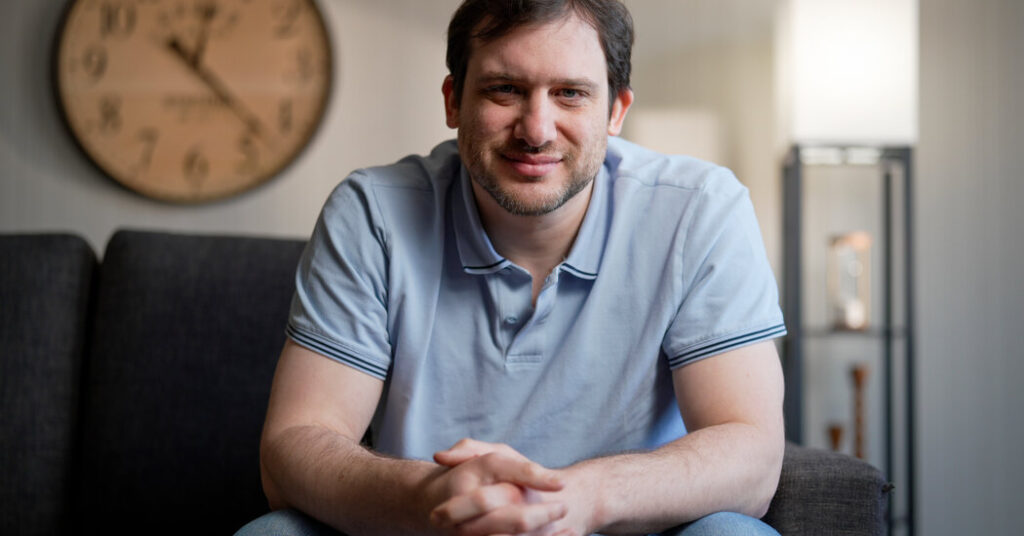
Jacob Tsimerman tells people that he is a number theorist, but admits it is not easy to explain what a number theorist does.
Soon, he won’t have to worry as much about that. He is changing the focus of his math research to the underpinnings of artificial intelligence. A.I. is rapidly changing many professions, including how mathematicians do mathematics.
Mathematicians can prove a more rigorous understanding of how those systems work and help ensure that they do not run amok, Dr. Tsimerman said.
The number theory work of Dr. Tsimerman, 38, a professor of mathematics at the University of Toronto, is what earned him the honor of one of this year’s Fields Medals.
“It’s not really about providing answers,” he said of number theory. “It’s more about providing questions. And then to actually solve stuff, it usually pulls from other fields.”
One of the most famous problems in the history of mathematics involves number theory.
In 1637, the French mathematician Pierre de Fermat made a seemingly simple assertion: Equations of the form aⁿ + bⁿ = cⁿ do not have solutions when n is an integer greater than 2 and a, b and c are positive integers. (If n is equal to 2, the statement becomes the familiar Pythagorean theorem that describes the relationships between the lengths of the sides of a right triangle. There are many combinations of integers for a, b and c that satisfy the equation.)
Fermat wrote that he had a “truly marvelous demonstration” to prove his assertion, but that it would not fit within the margins of the book he wrote in. Mathematicians sought for centuries to come up with a proof for what became known as Fermat’s last theorem. In the 1990s, Andrew Wiles, then a professor at Princeton, finally came up with a proof using modern advances in number theory.
“In some sense, that’s kind of a random equation,” Dr. Tsimerman said of aⁿ + bⁿ = cⁿ. “It’s elegant, which is why people have studied it. It has some history. But you can write down many equations like Fermat’s theorem, most of which we don’t know how to do anything with, and so why do you study these equations?”
Dr. Tsimerman said he had two reasons. One is that questions like these are “inherently beautiful.” The second is that solutions to the problems reveal surprising connections between different areas of mathematics.
The tools that Dr. Wiles used to prove Fermat’s last theorem “became this very rich source of mathematics that is now applicable in string theory and other stuff as well,” Dr. Tsimerman said.But the study of integer solutions to more complicated versions of equations similar to Fermat’s remain “poorly understood,” said Peter Sarnak, a professor of mathematics at Princeton who was Dr. Tsimerman’s doctoral adviser.
In 2021, Dr. Tsimerman was one of a group of mathematicians who completed the proof of the André-Oort conjecture. That work, Dr. Sarnak said, ”stands as one of the few higher-dimensional settings in which such basic problems have been resolved.”
Born in Kazan, Russia, Dr. Tsimerman and his family emigrated to Israel in 1990 and Canada in 1996. He completed his Ph.D. in 2011 and joined the University of Toronto in 2014.
In the future, Dr. Tsimerman may find it easier to talk about his work, because he is pivoting from number theory to artificial intelligence. Over the past couple of years, A.I. has doubled his productivity by summarizing papers and sketching drafts of proofs, he said. “I think it will very shortly become more capable than mathematicians in the act of mathematics.”
But he also worries about the dangers of A.I.. “My views are pretty extreme by most people’s measures,” he said. “I think A.I. is going to be a serious threat for society, for humanity.”
Mathematicians, he said, can help provide a theoretical foundation for understanding how the large language models that underlie ChatGPT, Gemini, Grok, Claude and other A.I. systems work.
“It’s mostly an empirical and engineering kind of science,” Dr. Tsimerman said. “If we understood how these things work better, we might be able to steer them better, or understand them better, or control them better.”
The post Jacob Tsimerman Lives in Number Theory appeared first on New York Times.