Health and weather authorities in Japan were at a loss. A record number of people suffered from heat stroke last year as more cities experienced their highest-ever temperatures, despite official warnings about the dangers of excessive heat.
They decided to tackle the problem by giving it a name. Earlier this year, the Japan Meteorological Agency held a public poll to select a name for a day of temperatures of 40 degrees Celsius (104 degrees Fahrenheit) or higher, to signal that precautions were needed. The winner, with more than 40 percent of the vote was kokushobi, meaning “cruel heat day.”
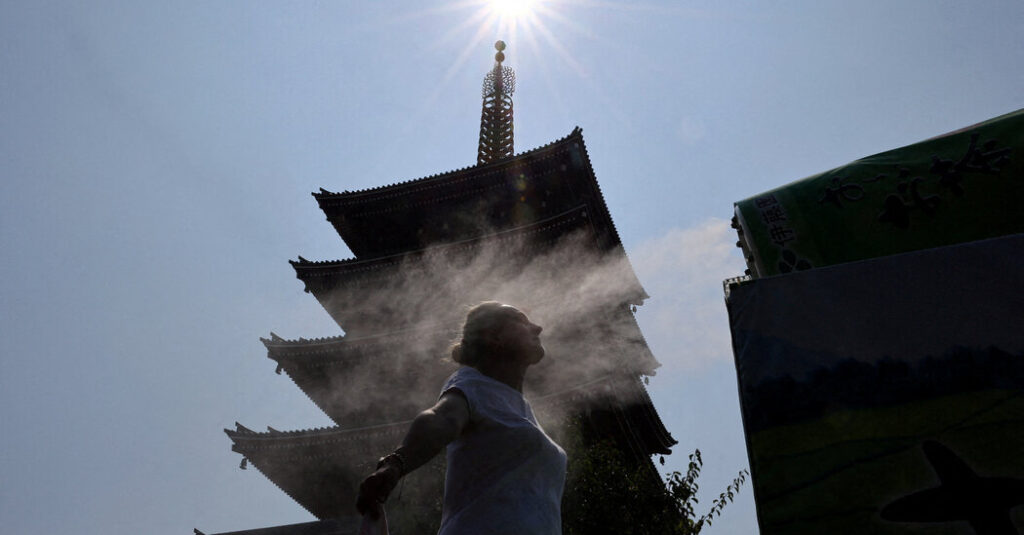
The term got its first use on Tuesday, when three cities in central Japan recorded 40-degree temperatures, a first for the country this year. Officials urged people to stay indoors, use air-conditioning and drink water.
There were signs that many people had heeded the warnings, as popular sites such as Osaka Castle and Kyoto’s Kiyomizu Temple saw smaller crowds than usual on Tuesday.
“Numbers are difficult to understand because people perceive them differently. By giving it the name ‘cruel heat day,’ people will understand it better just by hearing it, and they’ll feel that today is dangerous,” said Taro Kawasato, the assistant director of the Japan Meteorological Agency’s climate prediction division.
The agency’s public poll in February and March garnered more than 400,000 votes, according to a statement. Kokushobi bested a dozen other terms that translate to “dangerously hot day,” “sweaty day” and “sauna day.” Mr. Kawasato said that meteorologists consulted with media and linguistics experts to form the list of names.
And the dangers persist, even with slightly cooler weather on the horizon. Last week, even before the first kokushobi, 14 people died from heat-related illnesses, Japan’s Fire and Disaster Management Agency said.
Japan is the latest country where officials have sought new terms to communicate the risks of rising temperatures.
In Britain, the Met Office began issuing extreme heat warnings in 2021 to highlight the impact of high temperatures on health, infrastructure and public services. (A red warning, the highest level, was issued when a heat wave baked European countries last month.) The United Kingdom Health Security Agency also issues “heat health alerts” for England to inform those in the health sector about the potential effects of high temperatures, especially for older people and others who are more vulnerable.
In recent years, Chinese-language media have also searched for phrases to describe the summer heat. News headlines in Taiwan have described the weather as being like a sauna, with people “roasting like a sweet potato.”
Health authorities in Shenzhen, a city on China’s southern coast, said in a social media post that temperatures in early July had risen to “barbecue mode.” During that period, 62 people called for ambulances because of heat stroke, two of whom died, the authorities said.
Mr. Kawasato said that the Japanese government started issuing heat stroke alerts in 2021, as sweltering days grew more frequent across the country. Last year, 30 locations recorded temperatures of at least 40 degrees Celsius, the highest of which was 41.8 degrees — or 107 degrees Fahrenheit — in Isesaki, a city north of Tokyo, according to the Japan Meteorological Agency.
Heat stroke is among the heat-related illnesses that occur when the body loses the ability to cool itself, putting pressure on the heart. Symptoms can range from confusion, dizziness and nausea to a rapid heartbeat and shallow breathing.
Last summer in Japan, emergency workers responded to more than 100,000 cases of heat stroke from May to September, the most since the Fire and Disaster Management Agency began collecting data in 2008.
Siyi Zhao and Nazaneen Ghaffar contributed reporting.
The post It’s So Hot That Japan Needs a New Word for It appeared first on New York Times.