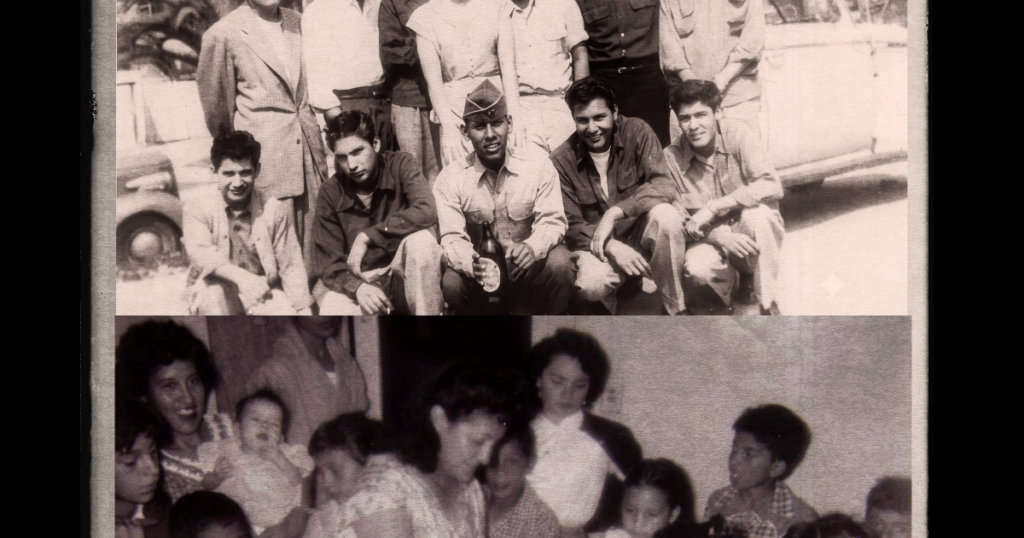
Every summer at the Elysian Park Recreation Center, outside what is now Dodger Stadium, families gather to preserve the memory of the working-class individuals who once lived there — Mexican Americans who were forcibly evicted by the city under eminent domain in the 1950s.
Last Saturday morning, dozens of families set up their canopies for the annual Chavez Ravine community picnic, bringing photo albums and other cherished keepsakes to display table side. Among each other, they shared oral histories or firsthand accounts of the demolished neighborhoods of Palo Verde, La Loma and Bishop that once encompassed the nearby canyon.
“We had a good life there. We grew our own vegetables. We had chickens and pigs. Believe it or not, it was just a very pure, simple, innocent way of life,” said Cahuilla Margaret Cabrera Red Elk, a former Chavez Ravine resident who traveled from Colorado for the gathering.
The joyous event is a tradition spanning over half a century. It’s hosted by Los Desterrados, or “the uprooted,” a group made up of former Chavez Ravine residents.
While city plans for the area were initially intended for a public housing project, the land was eventually repurposed for Dodger Stadium, leading to the forceful eviction of a few remaining residents — and the infamous photograph of Aurora Vargas being carried out by Los Angeles County sheriffs in 1959.
“My dad’s claim to fame was that his umbilical cord was buried on third base, so whenever somebody hit a triple or home run, he’d get a pain in his stomach,” said Eddie Santillan, the son of Lou Santillan, who started Los Desterrados as a way to unify the three neighborhoods.
While there was no trace of scorn in the spirit of the event, there was one lingering question, as individuals proudly displayed picture frames and T-shirts of their dearly departed: What happens to the treasured memories of Chavez Ravine once all its former residents have died?
Earlier that day, former residents and descendants of Chavez Ravine gathered inside a gymnasium for the unveiling of “Chavez Ravine: An Unfinished Story,” an archive that digitizes community-curated histories, images and memories of those who lived in the shallow canyon.
“It’s not about baseball, it’s about people,” said Carol Jacques, a lifelong activist and former resident of the Palo Verde neighborhood, in her opening statement.
Jacques helped co-found the digital archive alongside Priscilla Leiva, an associate professor of Chicana/o and Latinoa/o studies at Loyola Marymount University. For the last 11 years, Leiva worked alongside Jacques and other community members to document and preserve the histories of the historic hill, once home to over 1,000 families.
“It only takes one generation to lose history. What we’ve decided to do is to try and preserve the history of Chavez Ravine so that they are never forgotten,” said Leiva. “This is an archival home that you can go back to, because the residents can’t go back to their real homes.”
The special online collection is preserved by LMU’s William H. Hannon Library, but all donors are given the option to retain the copyright of their personal photos. Online users can log onto the webpage and browse through dozens of family portraits or a few oral interviews on the site, including that of the Gamboa family, which lived in the Bishop neighborhood.
In 2001, Cenovia Gamboa Madero — lead singer and soloist in Santo Niño Church in Chavez Ravine — was interviewed by Jordan Mechner for the 2023 PBS documentary film, “Chavez Ravine: A Los Angeles Story.” In the full interview, now available on the public site, she recalls the vines that grew around her childhood home — and how all that was left when they returned to the site was the house’s foundation and some rubble.
“My grandfather was a gardener. She would tell cute little stories about him,” said Rosemary Madera, Cenovia’s daughter, who traveled to the event from Montana. “Being here, there’s such a connection of community and I get that sense of how my mother must have felt.”
But the archive goes beyond capturing the devastating changes that occurred in the three L.A. neighborhoods; it documents the rich life that existed there, prior to the demolition of homes. For example, a picture provided by Bobby A. Rodriguez — an early donor of the project who died two years before its completion at the age of 86 — showed family at a wedding party in 1940, dressed to the nines.
“People think we were all dirty, playing in the hills. No, we had style, class. We weren’t rich by any stretch but we had pride,” said Sonia Rodriguez Flores, Bobby’s daughter, who brought a suitcase full of photographs to the weekend function.
She pushed back on the narrative that the idyllic hills where her father once frolicked would be considered “slums” — a term used by angry city officials to describe the area, when 20 families refused their buyout offer.
“It’s sort of a cyclical history of us losing our spaces and then reclaiming our spaces,” said Rodriguez Flores of her family’s legacy. “The fact that this is now archived and retrievable with metadata is amazing, because anybody doing research will now be able to access this information. It’s not just in my dad’s folder.”
The post Chavez Ravine was once home to thousands of Mexican Americans. A new digital archive tells their story appeared first on Los Angeles Times.