Young people in India — 40 percent of the world’s biggest country — have been taught that they are inheriting a country that is shining brightly, thanks to Prime Minister Narendra Modi’s leadership. Their disillusionment, with a lack of jobs and a troubled education system, now poses one of the biggest challenges to his popularity in 12 years in power.
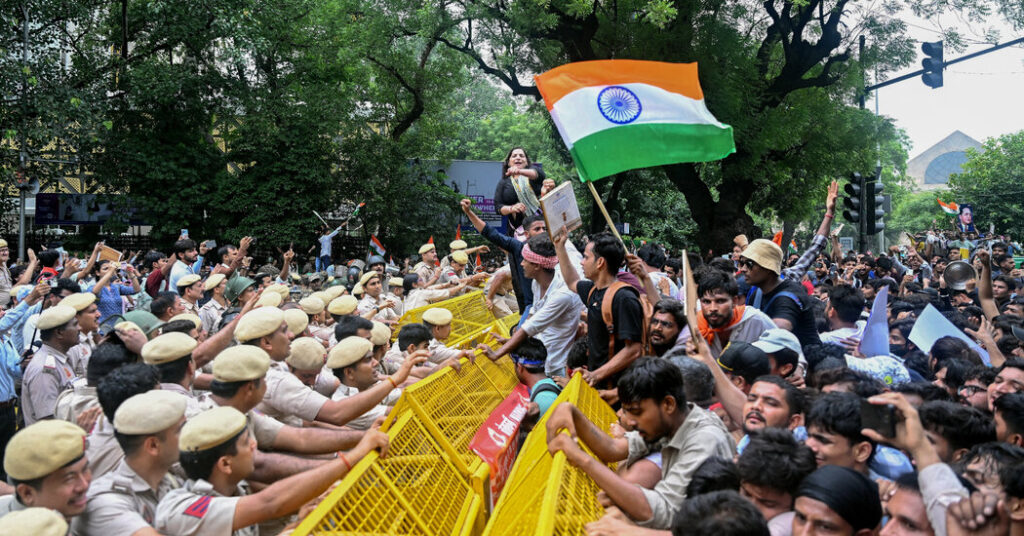
These long-simmering frustrations have spilled into the open in recent days, with thousands of people from around the country protesting on the streets of New Delhi, the capital.
The demonstrations were triggered by the canceling of medical school entrance exams after a question paper leaked, but they are about something much deeper: holding the government to account.
Ignoring their demands brings political risk for Mr. Modi, because India’s largest single demographic is under 25 years of age — a voting bloc too big to ignore.
But the protests aren’t like the Gen Z uprisings that shook India’s neighbors, Bangladesh and Nepal, where joblessness was also a common underlying cause. The two smaller countries underwent uprisings that quickly spiraled into bloodshed and violence, but toppled governments and installed new leaders; Indian protesters have been deliberate and clear about taking a peaceful approach. Also, in a country as large and diverse as India, with multiple states, political parties and agendas, overarching issues rarely unify enough people to bring that kind of threat.
Thousands of protesters remained camped out in Delhi on Wednesday with a list of demands for the government, which has made no concessions so far. Here’s what to know.
What is causing the frustration?
Students navigate a pressure-cooker education system that many say often deters rather than supports them. They spend years studying for competitive exams, seeking upward mobility and financial security. But increasingly, those with higher education degrees are finding there are far fewer suitable jobs. More than 14,400 students took their own lives in 2024, according to India’s National Crime Records Bureau. The bureau said that student suicides are increasing faster than those of the overall population.
That frustration erupted in early May, after more than 2.2 million aspiring doctors and dentists sat for an entrance exam that is the only way to get into undergraduate medical school in India. It later turned out that the questions for some exams matched closely with so-called “guess” papers — sample exam questions — that had circulated online before the exam. The government testing agency scrapped the exam and ordered everyone to take the test again.
It wasn’t the first time. India’s National Testing Agency, set up under the Modi government to centralize the process for many entrance exams, has been criticized for its inefficiency, and a failure to prevent leaks or ensure exams are fair for all.
Getting into a school itself is tough, with too many students vying for too few seats. The pattern repeats itself when students enter the job market, with millions of people applying for thousands of government jobs. Nearly 40 percent of graduates between the ages of 15 and 25 are unemployed, according to a 2026 study on India’s work force.
Stories of college graduates working as full-time delivery drivers have become commonplace.
Nidhi Sah, a designer and artist who flew in from the city of Ahmedabad to Delhi to join Monday’s protest, said she considered this underemployment a bigger problem than unemployment. “The cost of quality education in India is high, so a well-paying job is a justified expectation,” she said. So when people work longer hours for lower salaries, or take jobs below their qualifications, she added, “the frustration builds up.”
How has the government responded to the protests?
Mr. Modi has so far refrained from speaking publicly about them. Nor has he addressed the demands of the prime organizer, the Cockroach Janta Party, a satirical movement inspired by a disparaging remark by a judge comparing India’s youth to “cockroaches,” which has since turned into a political force.
On Tuesday, a senior government minister said Mr. Modi had addressed students’ concerns about the exam questions leak during an internal meeting, saying that those involved will be brought to account. Mr. Modi also said the safety and security of India’s youth was a priority, according to the minister.
Even that subtle acknowledgment was rare for Mr. Modi, a strongman leader, and is a sign of the delicate dance he has to perform between placating students and ensuring that his political party doesn’t look weak.
The C.J.P. has demanded the resignation of the Dharmendra Pradhan, the education minister, whom they hold directly accountable for the recent leak. But Mr. Pradhan is a key operative for the B.J.P., credited with helping the party come to power in some recent state elections.
As the protests persist, Mr. Modi’s ruling Bharatiya Janata Party has begun blaming the main opposition party, the Indian National Congress, its longtime rival, for exploiting the students’ concerns after it began its own related protests.
How much momentum is there for the protesters?
Protests in Delhi and elsewhere have been going on for more than a month, ever since Abhijeet Dipke, the 30-year-old founder of the C.J.P. and a graduate of Boston University, turned his joke into a serious movement. Sonam Wangchuk, a prominent education activist, joined the protest and is on the 25th day of a hunger strike. He was forcibly moved by the authorities to a private hospital and is on an intravenous drip as his health deteriorates. But the C.J.P.’s call to march to Parliament on its first day in session on July 20 gave the movement enormous momentum.
Shabana Azmi, a well-known actress, and Arundhati Roy, a Booker Prize-winning author and activist, have expressed their solidarity.
The protests have also provided opposition parties an opportunity to attack the B.J.P. On Tuesday, Rahul Gandhi, a leader of the Congress party, and also the leader of the opposition in the lower house of Parliament, marched toward the prime minister’s residence with his own list of demands to support the students’ cause. He and his sister, Priyanka Gandhi Vadra, also a Congress leader, and other party members were detained but later released.
“The government has lost the first round,” said Ashutosh Varshney, a professor at Brown University who studies Indian politics. The attention around Mr. Gandhi’s detention has given the opposition an unexpected lift, but its will to continue and the length of the protests are likely to determine whether Mr. Modi can “overcome this moment,” Mr. Varshney said.
What happens next?
Mr. Dipke and other C.J.P. leaders said they would continue to protest until their demands are met. But they said they would not lead more marches to prevent further injuries to protesters from police crackdowns.
On Wednesday, the protest site in central Delhi was surrounded by security forces and partly barricaded, but the protests stayed largely peaceful. In some places, dozens of delivery drivers waited nearby on their bikes, bearing food that people had sent to the protesters. Some said there was no specific delivery address provided other than “Jantar Mantar,” the name of the 18th century observatory next to which the government has built a dedicated protest space.
Anurag Kumar, who works for Swiggy, a delivery platform, said he was handing over orders to people outside the site because the police wouldn’t allow him to go any further. Mr. Kumar said he had delivered 11 orders since 7:30 a.m. Other workers said deliveries included sanitary pads, ointments and other products that protesters might need to sustain the protest.
Mr. Dipke put out a video urging Mr. Wangchuk to end his fast. But the veteran activist said he had no plans to end protests until their demands are met.
Suhasini Raj and Akansha Bahadur contributed reporting.
The post What Now for India’s Young Protesters? appeared first on New York Times.