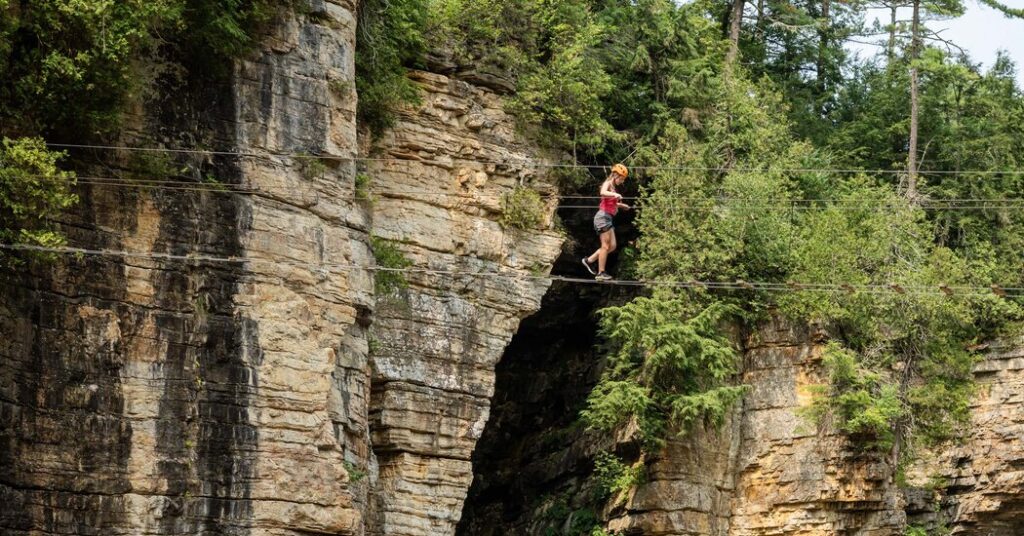
I stood perched on a ledge, a river churning some 30 feet below and a line of people waiting at my back. A suspension bridge with three cables, one for my feet and two for my hands, stretched across the chasm like a tightrope. A tremor was already creeping up my legs, and I had nowhere to go but forward.
Like everyone on the tour of Ausable Chasm, a gorge carved into the Adirondacks in upstate New York, I wore a harness to catch me if I fell. Maybe it would save my life, but it didn’t do much to ease my anxiety.
We were following a via ferrata (Italian for “iron path”) that zigzagged across the gorge and took us high onto its sandstone walls, clinging to metal rungs, unclipping and reclipping the two safety lines on our harnesses. This exhilarating route was, admittedly, a bizarre choice for someone like me, who struggles with a paralyzing fear of heights.
But that was precisely why I was standing before this swaying tightrope bridge. The via ferrata tour was just the latest round in my yearslong regimen of self-directed exposure therapy, which had already taken me onto scary rock scrambles and exposed summits across the Adirondacks, in an attempt to cure my acrophobia.
“Don’t lead me to my death,” joked the woman behind me as I tested the cable’s give.
“I’ll do my best,” I said. Another step took me past the ledge, leaving nothing but open air and crashing white water below.
A Natural Next Step
Soren Kierkegaard, the 19th-century Danish philosopher and father of existentialism, saw in the fear of heights a metaphor for all human anxiety. Standing at a precipice, Kierkegaard imagined, a person becomes instantly and acutely aware of their power to jump — and with it, the dizzying breadth of human freedom.
I can’t say that heights have ever granted me such an epiphany. But I know that something has always drawn me toward them, despite my trepidation. It was through hiking that I began to test the limits of that attraction.
I fell in love with hiking while I was living in Albany, N.Y., a gateway city to the peaks and cliffs of the Adirondacks. There, I gradually probed the limits of my fear, pushing myself closer to the edges of mountaintop overlooks, and then seeking out increasingly challenging routes that tested both my footing and my nerve.
It turns out there’s science behind that approach. Incremental exposure therapy remains the gold standard for treating the fear of heights, said Dorothée Bentz, a clinical psychologist and researcher at the University of Basel in Switzerland.
“If people are treated, there’s a response rate of about 80 percent,” Dr. Bentz said. “But people have to engage,” she added, “and that means you have to expose yourself.”
A via ferrata seemed like the natural next step in that process.
Despite their dramatic vertical settings, via ferratas are, in terms of technical difficulty, not that far removed from a playground jungle gym. Climbers are harnessed in along the entire route, keeping at least one carabiner clipped to the safety cable at all times. Though the danger is limited, the exposure is not — exactly the type of challenge I was seeking.
Modern via ferratas were largely a product of World War I, developed as a makeshift system to move troops through the Dolomites as the Italian and Austro-Hungarian armies fought over the peaks. In time, those early installations would be refined into recreational climbing routes, featuring metal rungs and hanging bridges. From the Alps they spread worldwide, allowing thrill seekers everywhere to navigate sheer cliff faces and deep canyons.
Though via ferratas have flourished in the United States in recent years, options near New York City remain limited for the casual day hiker on a budget. The Adventure Trail at Ausable Chasm, a privately owned attraction just south of Plattsburgh, N.Y., was both inexpensive (about $20 for entry to the chasm, $45 for the via ferrata) and approachable.
Clipped In
I drove up to the Adirondacks in late May, a few weeks ahead of peak tourist season, and headed to the chasm early the next morning to book a slot on the via ferrata. The roughly 90-minute guided tours are first come first served, and the property’s website warns they can book up fast.
Looking down from the rim of the gorge, I got my first glimpse of the via ferrata. I saw four cable bridges over the river, stretches of rock ledges and metal rungs between them. Sure, I thought, I could manage that.
A half-hour later, our 42-year-old guide, Colby Walker, was showing my roughly 12-person tour group how to clip and unclip our harnesses around obstructions, always keeping one secured to the safety cable that ran the length of the course.
I wound up at the front of the line, ahead of three friends in their early 30s — Kathryn Patton, Jacqueline LaPres and Mary Fredendall — in town for a wedding. We climbed a cargo net from the chasm floor up to a ledge, and I was the first to follow Colby onto the initial bridge.
Out over the drop, I began thinking in fractions: Just get a quarter of the way across, now half, now two-thirds. … My stomach dropped each time my harness hit an obstacle and I needed to refasten my carabiners to the next stretch of open cable, leaving me momentarily frozen.
Max Wühr, a researcher at Ludwig Maximilian University Hospital in Munich who has studied the fear of heights, later explained my reaction this way: Deprived of the nearby visual reference points that it relies on to control balance, my brain sensed that my body was unstable. My body responded in kind.
But with Colby and Kathryn’s encouragement, I finally conquered Zeno’s paradox — the notion that if you do something in fractions, you’ll never reach the end — and made it to the other side, dismounting (another stomach drop) onto a set of metal rungs that ascended to a narrow ledge.
Another high-wire river crossing awaited. This one was more forgiving, with three metal cables underfoot instead of one. To soothe my nerves, I chatted with Kathryn, Jacqueline and Mary. Inevitably, we discussed our feelings about heights.
Kathryn loved them, she said. So did Mary. Jacqueline, not so much.
It turned out Jacqueline and I had both taken the same approach to exposure therapy, albeit in different parts of the country. She lives in Utah, and tested herself first in the state’s national parks. But even conquering Angels Landing in Zion National Park, one of the country’s most nerve-racking hikes, hadn’t been enough to defeat her anxiety.
“I’m not as scared of heights as I used to be,” she said. “But it’s still not comfortable.”
I sympathized. How is it, I thought, that the initial rush of panic still finds me, no matter how many times I face it, while others never feel it at all?
Take Colby, our guide. He moved back and forth along the cliff faces with practiced ease, talking all the while about the chasm’s history. Was there ever a time, I asked him, when he’d had to conquer the fear?
He shook his head. “My parents had to keep me out of the pine trees when I was young,” he said. “I’ve been climbing since I can remember.”
The Big Pivot
Now, another cable bridge — this one with wooden planks spaced far enough apart to pose a challenge — led us back across the chasm. The section that followed was the longest of the route: a stretch of narrow platforms and metal rungs anchored high on the rock wall between us and the final bridge.
Water trickled down from the layers of sandstone above. The slick handholds fueled my anxiety, and for a second time that day, a wave of terror froze me in place. I pushed it down and forced myself to inch along.
Eventually, I reached the last cable bridge, the highest of the crossings, sloping down from about 65 feet above the river. I had to make an awkward pivot from the metal rungs onto the bridge’s first plank, a final jaw-clenching challenge.
But as I neared the bridge’s midpoint, I noticed something strange: My legs felt steady. I didn’t feel compelled, as before, to scramble to the next patch of stable ground. I stopped and took a deep breath. Yes, my hands still clung tight to the cables, but I felt almost at ease.
Later, safely back in my Brooklyn apartment, I told Dr. Bentz about my moments of panic on the course, and the peace that followed. Could any amount of exposure therapy, I wondered, ever fully banish the former?
Maybe not. Dr. Bentz explained that exposure therapy isn’t necessarily about eliminating a fear, but learning you’re capable of forging ahead despite it. And through repeated exposure — pushing past the mental barrier posed by fear, again and again — you can meaningfully blunt the anxiety response.
“It’s not like you learned it and your brain is reprogrammed,” she said. “It’s more like the brain learns something new.”
In other words: Courage takes practice.
I thought back to that moment of near-serenity, standing in the middle of the final bridge. For the first time, I could really see past my own feet and appreciate the way my shadow stood backlit against the frothing water below.
Like Kierkegaard’s man at the precipice, I’d faced the dizzying prospect of my own freedom: the choice to turn back or step out over the void, and in doing so, to keep pushing the boundaries of my fear.
Follow New York Times Travel on Instagram and sign up for our Travel Dispatch newsletter to get expert tips on traveling smarter and inspiration for your next vacation. Dreaming up a future getaway or just armchair traveling? Check out our 52 Places to Go in 2026.
The post To Confront My Fear of Heights, I Crossed a Chasm on a Cable appeared first on New York Times.