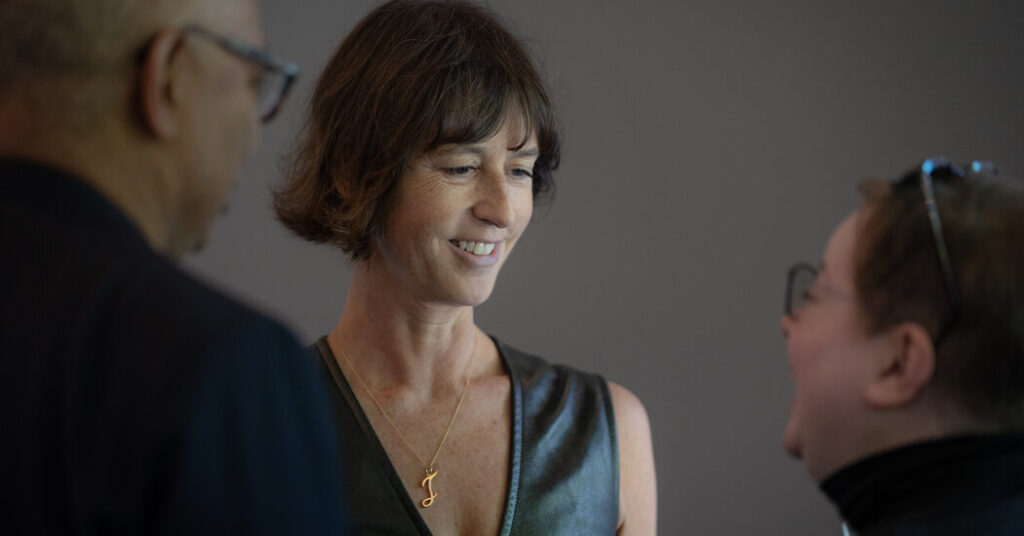
Jessica Morgan, the director of the Dia Art Foundation, the renowned contemporary art organization best known for minimalist exhibitions at its vast Hudson Valley site, was announced on Wednesday as the next leader of Tate, the British organization that runs some of the world’s most visited art museums.
Some of Britain’s major artists welcomed the news of Morgan’s appointment, although it comes at a challenging time for the museum group, which includes Tate Modern and Tate Britain in London, as well as the group’s smaller sites in Liverpool and St. Ives, a seaside town in southwest England.
“The future looks bright with her at the helm,” Steve McQueen, who installed an immersive exhibition at Dia’s site in Beacon in the Hudson Valley during Morgan’s tenure, said in a statement. Cornelia Parker said in a statement that Morgan had “ambition, flair and daring, attributes which I’m sure she’ll put to use in her new role.”
Tate is facing financial challenges, and visitor numbers at its main London sites were last year over two million below the levels seen before the coronavirus pandemic. The numbers are still down despite two ongoing record-setting blockbusters showing work by Tracey Emin and Frida Kahlo.
Staff morale has also plummeted amid significant cuts to employee numbers, while British art critics have panned several of Tate’s recent shows, saying that they put political posturing above the quality of the art.
A spokesman for Tate said that Morgan was unavailable for interview, and in the news release announcing her appointment Morgan did not mention any of those challenges, simply calling her appointment “an immense privilege.”
“I look forward to this pivotal next stage at Tate, and most importantly, continuing and advancing the incredible work of Tate’s committed and talented team in the years to come,” she said.
The post is a homecoming for Morgan, 57, who was born in London and studied art history at the University of Cambridge and the Courtauld Institute of Art. Before her move to the Dia Foundation, Morgan worked at Tate from 2002 to 2014, including as Tate Modern’s curator of international art, and was responsible for several major shows including “The World Goes Pop,” a global survey of pop art.
She has also held curatorial positions at the Museum of Contemporary Art in Chicago and the Institute of Contemporary Art in Boston. She is scheduled to take up her new Tate role on Jan. 1.
Most museum professionals in Britain get paid far less than their American counterparts, and Morgan will likely take a significant pay cut at Tate. At the Dia Foundation, she was paid about $840,000 in 2024, according to tax filings; at Tate, Maria Balshaw, the previous director, was paid about 222,000 pounds, or about $296,000, according to Tate’s latest accounts.
After decades of curatorial experience, Morgan’s reputation as a museum leader has solidified since 2015, when she joined the Dia Art Foundation. The organization is best known for its Dia: Beacon site in upstate New York and for overseeing site-specific art installations across the United States, including Robert Smithson’s “Spiral Jetty” in Utah.
At Dia, Morgan opened a renovated site in Chelsea, bought its first works by African American artists and oversaw acclaimed shows like Steve McQueen’s “Bass,” a retrospective by the performance artist Tehching Hsieh, and “Party/After-Party,” in which the D.J. Carl Craig turned Dia Beacon’s basement into a lonely nightclub.
Jason Farago, reviewing that show for The New York Times, called it a “triumph for Dia, which has been quietly broadening its roster of participants without dissolving its commitment to a cool, narrow strain of minimal, conceptual and environmental art.”
These successes, and her past work at Tate, meant British art critics long considered Morgan the front-runner for the Tate job. In May, when she opened a retrospective at the Venice Biennale of work by Lee Ufan, the minimalist South Korean artist, journalists asked her if she was about to take the position. “Everyone’s asking me that,” she told one art critic, adding, “We’ll see.”
The post Tate Museums Tap Leader of Major U.S. Art Group as Next Director appeared first on New York Times.