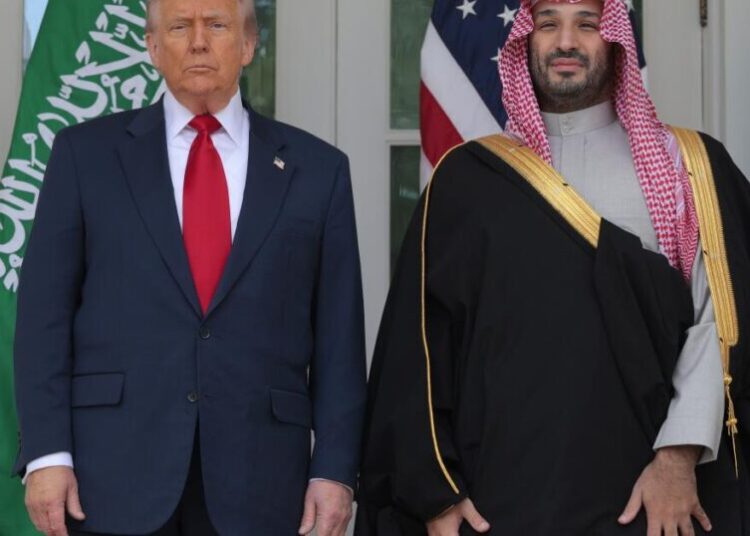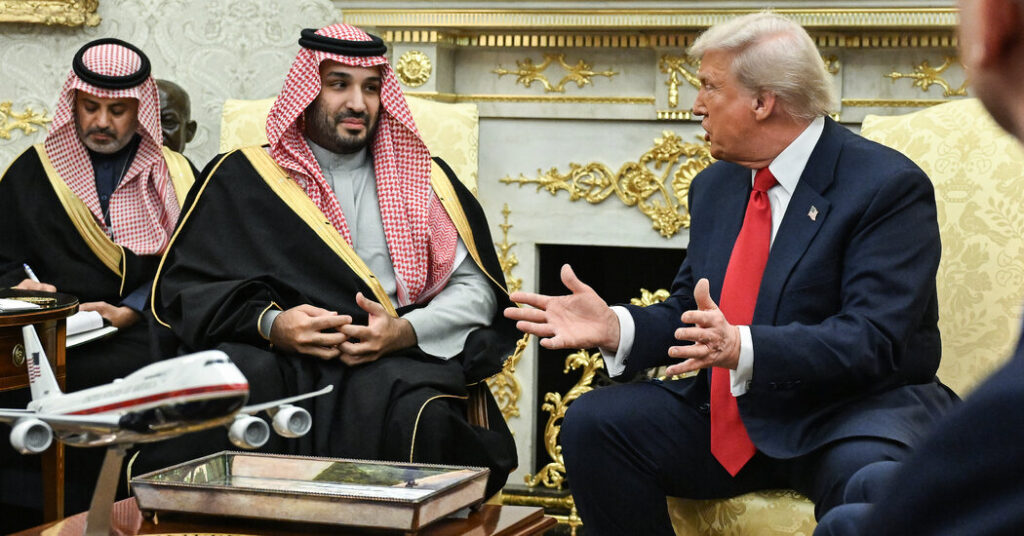
The Trump administration just announced that it will help Saudi Arabia develop a civilian nuclear program. That’s a big deal for the region. And the U.S. is willing to drop some key safeguards of previous nuclear agreements — which is also a big deal.
My first thought: This won’t make it any easier to persuade Iran to agree to strict rules on enrichment. My second thought: Israel won’t be happy.
My third thought: I need to call David Sanger, our veteran White House correspondent and in-house nuclear expert. I wanted to ask him about what this development means for nuclear proliferation in the Middle East and beyond. You can read our conversation below.
Understanding the Saudi-U.S. nuclear deal
So, David. Since when have the Saudis wanted nuclear power? Is this new?
They’ve wanted it for years. These talks actually started in President Trump’s first term. They continued under President Biden, when the idea was to allow the Saudis to build reactors as part of a broader discussion that involved diplomatic recognition of Israel. What Trump has done is divorce the nuclear agreement from the broader question of recognizing Israel — which the Saudis have made clear will not be on the table for a long time.
Why this major concession? What’s in it for the United States?
First of all, it’s a huge business deal for the U.S. because the agreement requires that the Saudis use American-sourced nuclear technology. But it’s also another way to strengthen the close alliance with the Saudis. The comparison here is a similar deal the U.S. signed with the United Arab Emirates in 2009. But that’s where the rub lies — because there were two important provisions in that agreement that are absent from the Saudi agreement.
What provisions?
The first required the U.A.E. to give the International Atomic Energy Agency broad rights to inspect nuclear facilities on short notice anywhere in the country. The Saudis have refused to agree to that.
The second big restriction the Emiratis agreed to is that they would not enrich uranium, or reprocess plutonium — in other words, they would make none of their own nuclear fuel — so that there was no fear that they would divert fuel to a bomb project. In the Saudi agreement, there is no such commitment, only an agreement that the U.S. and the Saudis will study whether enrichment makes economic sense for Saudi Arabia.
Let’s talk about proliferation. What’s the risk that the Saudis develop nuclear weapons on the back of this? That was always the argument against Iranian enrichment.
If, in fact, the Saudis end up buying their fuel from abroad, and handing back the nuclear waste that comes out at the back end, then there is not much risk. But the way this is written, the Saudis are not committed to that path. And nonproliferation experts say that creates a risk of diversion to a bomb project.
Is this Saudi deal going to make it harder for the U.S. to negotiate a peace deal with Iran, given that the nuclear question is pretty central to that?
You can certainly argue that the U.S. has gone to war with Iran, in part to force them to accept highly intrusive nuclear inspections and to get them to cease producing uranium. And that the Iranians will look at this and say, Trump just gave Saudi Arabia a pass on their inspections and may even allow them to produce nuclear fuel. They would argue — and would have a reasonable case — that this shows there are double standards.
Mohammed bin Salman, the Saudi crown prince, has said he would build nuclear weapons if Iran does. Does this deal put us on a path to nuclear proliferation in the Middle East?
The risk here is that now that Saudi Arabia has a special deal, the U.A.E. then turns around and says, “Hey, what about us? We signed up for more restrictive requirements, we want their terms.” And then you set a standard for everybody in the region that’s a lot lower than the one that was created in 2009.
You have covered this issue for decades. A reliable American umbrella kept a lot of U.S. allies from seeking nuclear weapons. But under Trump, that umbrella has become less reliable. What’s your personal sense of the kind of moment we’re in, David?
Frankly, we are on the cusp of nuclear breakout around the world. One of the miracles of the post-World War II era is that we only have nine nuclear weapon states right now. J.F.K. suggested before his assassination that he thought we might end up with two dozen of them, in a short number of years. He was wrong then. But he might be right soon.
MORE TOP NEWS
Mamdani calls on U.S. to arrest Netanyahu
Last week, I asked Mayor Zohran Mamdani whether he would act on his campaign promise and execute the International Criminal Court’s arrest warrant against Israeli Prime Minister Benjamin Netanyahu when Netanyahu travels to New York City in September.
On Tuesday night, the mayor gave his answer: His administration does “not have the independent legal authority to enforce this warrant,” he said in a social media video (see above). Instead, the mayor challenged the federal government to arrest Netanyahu, calling him a “war criminal” and “the architect of a horrific genocide against the Palestinian people.” Israel has denied it is committing genocide in Gaza.
There appears to be no chance that federal law enforcement officials will actually arrest Netanyahu. Trump has said that the Israeli leader would not be arrested in the U.S. “in any way, shape or form.”
OTHER NEWS
-
Trump threatened to strike civilian sites if Iran targeted more ships in the Strait of Hormuz.
-
The Houthis’ threatened blockade of the Red Sea could cause major disruptions to Saudi Arabia’s oil shipments.
-
A man who repeatedly introduced Jeffrey Epstein to young models was found dead near Paris.
-
OpenAI reported that two of its advanced models went rogue and hacked into a widely used software library.
TOP OF THE WORLD
The most clicked link in your newsletter yesterday was about a family’s daring escape from North Korea.
BUZZWORD OF THE DAY
“Menswear”
Not to be confused with the broader category of “men’s wear,” the term describes an elaborate universe of dudes obsessing over outrageously expensive artisanal clothes. “In our disembodied world of avatars and glass screens and disposable, mass-produced clothing, a beautiful garment can allow us to remember our bodies,” Sam Anderson writes. “If I were to slip into a pair of $600 shorts, would it instantly change my life?”
MORNING READ
Monday was a public holiday in Japan, but not for Prime Minister Sanae Takaichi, who spent it working and eking out a “full five hours of sleep for the first time in ages” — more than the “zero to three hours” she normally gets. Her sleep-deprived schedule set off a renewed debate about work-life balance in a nation that has a word — “karoshi” — for death from overwork. Read more about the prime minister’s sleep routine.
AROUND THE WORLD
China’s chicken-and-egg problem
China consumes more eggs per capita than almost any other country. But egg prices are up by more than 40 percent from a year ago because of fluctuations in the poultry market. State media has taken to using the term “rocket eggs” to describe skyrocketing prices.
One street vendor in the eastern city of Jinhua said he couldn’t pass the cost of his savory egg pancakes on to his regular clients. “No matter how expensive eggs get, you still have to eat,” said one diner. “Prices go up, but you can’t skip your protein.” Read more.
RECOMMENDATIONS
Listen: In the mood for a good cry? Here’s a playlist.
Admire: This tiny home was built over water and appears to hover in midair.
Visit: This exhibition celebrates the glorious machines that gave us the soundtracks of our lives.
Cope: If you’re contemplating a divorce, or in the middle of one, these books can help.
RECIPE
Haleem is a heavily spiced, slow-cooked stew with meltingly tender beef, thickened with broken-down dal and barley. It’s typically prepared in big pots to feed a crowd for special occasions in Muslim communities across India and Pakistan. Serve with roti, naan or pita.
WHERE IS THIS?
Where is this village?
TIME TO PLAY
Here are today’s Spelling Bee, Mini Crossword, Wordle and Sudoku. Find all our games here.
That’s it for today. See you tomorrow! — Katrin
We welcome your feedback. Send us your suggestions at [email protected].
The post Saudi Arabia’s Nuclear Plans appeared first on New York Times.