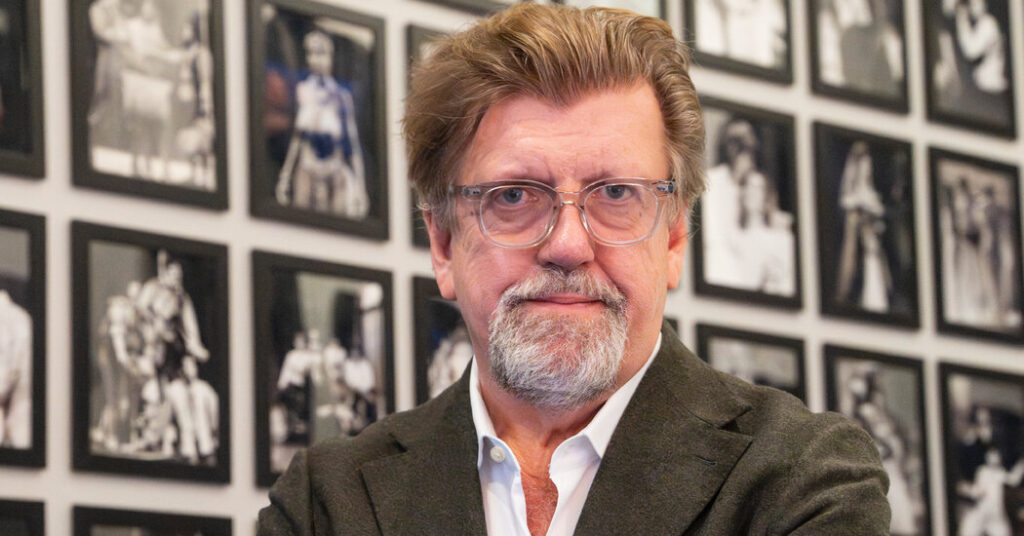
Oskar Eustis has been running theaters his entire adult life.
He co-founded one, called Red Wing, when he was 17. He has led companies in Zurich (Das Labor), San Francisco (Eureka), Los Angeles (Mark Taper Forum), and Providence (Trinity Rep). And, for the last 21 years, he has been the artistic director of the Public Theater in New York, stewarding Free Shakespeare in the Park, nurturing “Hamilton” and becoming one of the most influential figures in the American theater.
Now, he says, he is ready to do something else. On Wednesday, he will announce that he plans to step down from his position at the Public on July 31, 2028, which is his 70th birthday. His departure will signal a transition — in what direction, no one can be sure — not only for the Public, but also for theater in New York, where Eustis is among the last of a group of long-serving artistic directors who for decades oversaw the city’s biggest nonprofits.
The Public, the birthplace of “A Chorus Line” and “Hair,” is one of the country’s most storied theaters. And it has a big footprint: the recently renovated Delacorte Theater in Central Park, the six stages at the former Astor Library in Lower Manhattan, a spiffy new set of rehearsal studios and a mobile program that tours Shakespeare plays around the city.
The organization — which presents classic and contemporary work, plays and musicals — has a big budget ($55 million) and a sizable staff (134 people). Eustis is also one of the nation’s highest paid theater leaders, with a salary of $898,000 and benefits.
“This is guy who is a superhero of the American theater,” said Luis A. Miranda Jr., the chairman of the Public’s board. “I picture him with a cape.”
Miranda, the father of the “Hamilton” creator Lin-Manuel Miranda, said the theater’s board would soon begin a search for a new artistic director who can “continue taking the Public to the next level.”
Eustis’s tenure has brought Pulitzer Prizes for “Hamilton” and “Sweat”; Tony Awards for “Hamilton,” “Fun Home” and a “Hair” revival; around 250 productions; and hundreds of millions of dollars of fund-raising.
His tenure has also, since the coronavirus pandemic, been turbulent. Employees and artists have agitated for higher wages, better work conditions and more diverse programming. As the costs of production have risen, the Public has increased its productions of work by other theater companies and laid off some employees.
Eustis still has two years on the job — plenty of time for storytelling on and offstage — but is already sounding reflective and candid. Here are edited excerpts from an interview.
Why are you stepping down?
It feels like it is time, both for me to make a transition to another phase and for the Public to make a transition to a different leadership. I will have succeeded, if everything goes as we currently plan, in stabilizing the theater as a robust place where it is no longer in any danger when I pass it off.
The last few years have been rough?
I was thinking a lot more celebratory dinners and fireworks! I did not think remaking the business model in the midst of the greatest crisis in the history of the American theater was going to be my lot. But there we go — we make history, but we do not make it in conditions of our own choosing, as Karl Marx once said.
How would you assess the state of the Public?
Strong. We are back to filling our stages with excellent, mission-central work. The staff is strong. The thing that has changed is we have less freely disposable money than we did six years ago, and the adjustment I’ve had to make is that there is more presentation of work, as opposed to fully producing of work, than there was before the pandemic. And I have to go out and fundraise for individual projects. It’s not impossible; it just changes the job. And there are some good things that come of it: By having resident companies here, there’s a decentralization of the gate-keeping.
What has changed financially?
It’s unfortunately pretty simple. Costs have gone up between 50 and 75 percent, and income has, for us, stayed flat or decreased.
When you say the last few years have been challenging, are you referring primarily to finances?
Certainly since Covid, the finances became harder than at any point in the history of the nonprofit theater. Almost all theaters have done a real retreat into less programming and greater timidity. I’m happy to say that’s not true at the Public.
The other thing that happened was I went from, at least on the surface, being somebody who the field generally approved of and had a positive opinion of to somebody who was the subject of many many attacks, as did most artistic directors. The result of that is every other artistic director of my age was either forced out or quit because they couldn’t take it any more. Maybe we should get used to being criticized. But that was hard to take.
Has it settled down?
I have to recognize that I spent much of my career floating on a sea of flattery and praise that was probably completely undeserved, and that has not come back. And it’s probably OK. It’s good for my character. But certainly I do not feel the level of negativity that I felt between 2020 and 2024.
How are you thinking about the state of the theater?
The field is in a very tough moment. I think the American nonprofit theater movement is over. That doesn’t mean any individual theater is over. But every individual theater is having to make its own case and come up with its own business model. We’ve lost a lot of theaters, and we’re going to lose more. And most of the other theaters, whether they say it or not, will become more commercial.
How should a nonprofit theater be different?
The free expression of artists, able to say and promote their artistic visions regardless of whether they are popular in the marketplace, and the access of the audience to great art that binds them together, regardless of whether they can pay for it — those are the two things that the Public believes in and will continue to try and model.
And how are you feeling about the state of Broadway musicals?
When “Cabaret” lost its money, that felt to me like a turning point. A whole lot of investors went, “If a show that ran for that long with that much star power and that much buzz could lose all that money, what am I doing investing in musicals?” Going from four out of five shows losing their money to nine out of 10 shows losing their money was a qualitative shift. Now it’s Russian roulette.
What do you want to do for your last two years?
To fly that flag high of the value that a non-market-driven theater can offer to a city. And also demonstrate that the business model can work. Nobody gives a [expletive] if you fly values and you go bankrupt; you’re not an example of anything but failure. You’ve got to show that you can succeed with values.
The post Oskar Eustis, Theater Giant, Is Stepping Down. First, He Has Thoughts. appeared first on New York Times.