Times Insider explains who we are and what we do, and delivers behind-the-scenes insights into how our journalism comes together.
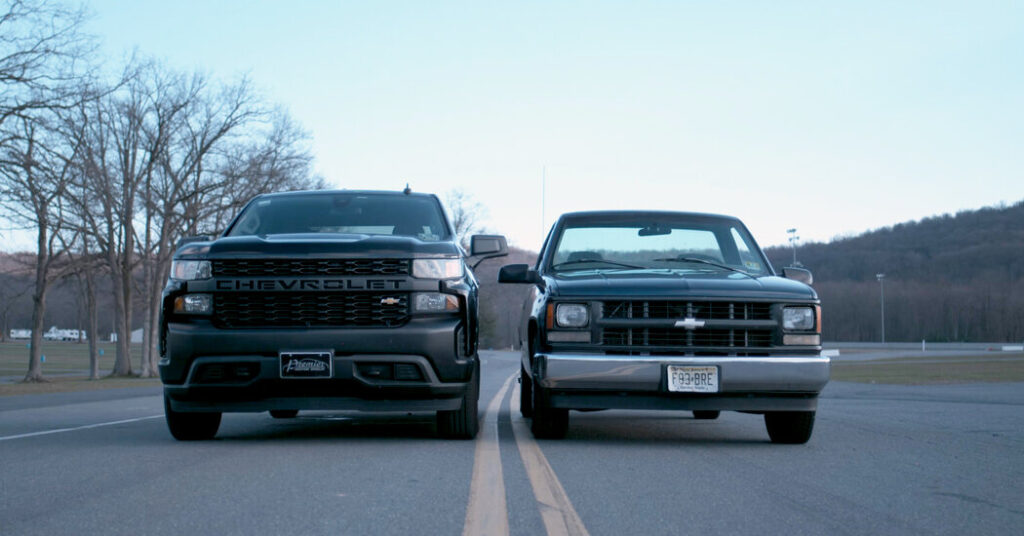
A few summers ago, as the investigative reporter Michael H. Keller was riding along in a police chief’s Chevy Silverado pickup truck for a story, he found himself fascinated by the large vehicle’s limited sightlines. He wasn’t the only one: Mr. Keller later came across social media posts that also noted increasingly tall vehicle hoods, even beyond police cars — particularly relative to the height of pedestrians.
Mr. Keller sensed there was a story on a potential connection between vehicle size and pedestrian deaths in the United States, especially because pedestrian fatality rates have surged in the country since 2009. But at the time, the research needed to explore such a connection was hard to find: There seemed to be no available data on hood heights.
A couple of years later, he tracked down an elusive data set on vehicle measurements by Expert AutoStats, and the Insurance Institute for Highway Safety published relevant research. The pieces started falling into place for a New York Times investigation, which was published last month. It revealed that vehicles in the United States had grown larger over the past quarter-century — and that, were that not the case, about 200 to 400 pedestrian deaths could have been prevented annually.
Tall vehicle hoods were only one part of the story: A-pillars, the supports on either side of the windshield, have also grown as vehicles have gotten larger, creating dangerous blind zones.
“I think once you learn to start thinking about the size of vehicles,” Mr. Keller said, “you start seeing it everywhere.”
A team of journalists collaborated on the reporting, including Mr. Keller; Danielle Ivory, an investigative reporter; Eli Murray, an investigative graphics editor; and Irineo Cabreros, an editor who works with statistical modeling. They talked to more than 200 people, including auto-industry experts; analyzed data sets; conducted extensive crash tests; and scanned pickups to create three-dimensional models to analyze sightlines.
In an interview, the members of the team behind the investigation shared additional insight into their reporting and what they hope readers take away from the analysis. These are edited excerpts from the conversation.
What challenges did you encounter during your investigation?
IRINEO CABREROS: There’s a great number of things that affect the fatality of a crash, and the data that we have at our disposal is limited in a lot of ways. And so we did our best to always err on the side of being conservative, potentially underestimating the increased fatality of these larger cars, because of the limitations.
When estimating excess annual deaths, we significantly narrowed the scope of crashes to the simplest ones — for instance, we only included crashes involving a single vehicle and a single pedestrian. In all, our various exclusion criteria removed about a quarter of the total pedestrian fatalities reported in a federal database. We also ignored crashes in parking lots, driveways or private roads, for which there is little reliable crash data.
Another critical modeling decision was whether to include travel speed as a predictor. Because of researcher concerns, we decided against quoting this larger effect, even though it would have been convenient to the thrust of our argument.
Data visualization plays a major role in the presentation of this investigation’s findings. How did you decide on the most effective ways to show your data?
MICHAEL H. KELLER: We’re talking about vehicle size, crash dynamics — things that are really hard to explain in words and really easy to understand with visuals. When we do an investigation, we try to look at the issue at multiple different altitudes. You zoom in to one example of a case paired with the visuals, and then also zoom out with the statistical work that Irineo did to understand the real total human cost of this.
ELI MURRAY: One of the things that was really important to me was how we could actually visualize blind zones. When we’re talking about risk to pedestrians, it would be nice to see the three-dimensional blind zones from a third-person perspective, to give you a sense of where the driver can’t see if you are a pedestrian.
DANIELLE IVORY: It’s also just much more effective to be able to show some of the concepts the crash reconstructionists were telling us about, like the mechanics of what happens to people when they get hit by a car with a low hood versus a vehicle with a tall hood.
We hear from two people in the article whose family members were hit and killed in pedestrian crashes involving a pickup truck and an S.U.V. Do you have a certain approach when it comes to interviewing people about their loved ones?
IVORY: I, frankly, think the hardest part of this job is talking to people about what is essentially the worst day of their life.
KELLER: Sometimes you reach out to people and they don’t want to talk to you, and that is totally fine. Very often, though, they do want the opportunity to tell the world about their loved one and tell their story so that other people won’t have to go through the same thing.
Have you found yourselves thinking about American cars and pedestrian safety differently after working on this project?
IVORY: I drive S.U.V.s myself. I have kids; we need space. Since I started reporting on this story, my driving has changed. I’m very cognizant that I’ve got these very large blind spots, and I make a conscious effort to look around my A-pillars, especially when I’m turning.
CABREROS: I have a young daughter who’s almost 4, and I certainly cross the road a lot more carefully now. She’s got a little song that we sing at every intersection.
Where do we go from here? What do you all hope will come out of this investigation?
IVORY: I do hope, at least, that people who read the story will just be more aware of their own driving and how they behave on the road. Researchers are continuing to study these issues as well. The Government Accountability Office published a report this week that says larger vehicles can pose greater risks to pedestrians and cyclists and recommended that the Department of Transportation take steps to address driver visibility problems.
MURRAY: That’s the big thing: Just be aware. Because it’s not obvious to you, as a driver, and it’s not obvious to you, as a pedestrian, that these blind zones exist and are so big.
KELLER: As journalists, you always hope that, by putting out more information, the system and society will take that into account in the future. I think part of the reason this was understudied was people weren’t collecting the data. So there’s a real opportunity to collect that information.
The post How Our Reporters Linked Big Vehicles to Pedestrian Deaths appeared first on New York Times.