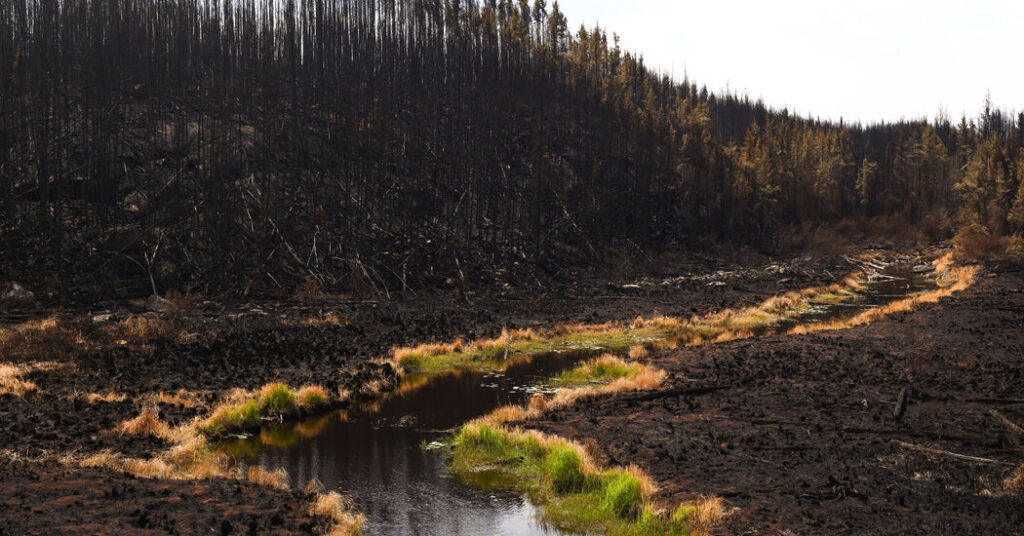
Floating in a bass boat on a dark lake, with fire balls erupting above the forest at her family’s northern Ontario lodge, was not how Amanda DeCorte expected to celebrate her 39th birthday.
A few hours earlier on the evening of July 13, there had been no official warnings that an inferno was barreling through the woods across the lake. As the sky turned from sunset orange to fire red, exploding propane tanks boomed. Just before midnight, Ms. DeCorte and seven family members took refuge on a boat — watching the blaze spread, sleeping in shifts and making panicked calls to local authorities.
“We absolutely were feeling abandoned,” Ms. DeCorte said. A phone call or visit from police or conservation officers would have helped soothe the family’s terror and could have helped them understand where the fire was heading, she said. Instead, they waited for it to die down somewhat, before making their way back to shore and driving south to the city of Thunder Bay. “Help never came,” she said.
Evacuees displaced this month by the wildfires in northwestern Ontario have been outraged by the lapse in communication from officials, stoking perennial grievances that these communities, home to many who work in mining, forestry, energy and agriculture, are ignored by political leaders in Toronto.
Nearly 200 of Canada’s 900 active wildfires are burning in Ontario, mainly in the remote region north of Thunder Bay, where roughly a dozen communities have been evacuated, displacing 1,800 people.
Rain and thunderstorms are forecast to move through the area on Thursday, carrying with them a risk of lightning strikes.
On Tuesday, 10 First Nations leaders, whose communities are in the fire zone, called for an independent public inquiry into the “operational dysfunction” of the wildfire evacuation effort in the north, and for the resignation of the assistant deputy minister responsible for fire operations, among others.
“Ontario took too long to act and it’s still refusing to take responsibility for what happened last week,” Lawrence Wanakamik, the chief of Whitesand First Nation, told evacuees gathered for a news conference at a hotel in Thunder Bay.
Chief Wanakamik said an elder in his community, Stella Wabason, 89, who struggled to breathe in the heavy smoke, had to be airlifted to the hospital. She died the next day.
The fires in Ontario have exposed the province’s clunky communication of critical information — like updates on the spread, perimeter and direction of the fire — that has left locals on their own to figure out if and when to flee.
“Our members barely escaped with the clothes on their back,” Helen Paavola, chief of Namaygoosisagagun First Nation, told the room, noting that the saving grace for her community was a phone call from a railway worker warning them that the fire was heading their way.
Premier Doug Ford has pushed back on accusations that authorities did not provide evacuees with ample notice, describing the fires as fast changing. “As you can imagine, we’re spread pretty thin across the province right now,” he told reporters last week.
The following day, the province said it would expand access to an emergency alert system to mayors, police and First Nations.
In small communities like Nolalu, about an hour’s drive west of Thunder Bay, just about everyone knows the volunteer fire chief’s phone number. There have been days when Sarah Shoemaker has fielded over 100 phone calls from residents desperate for information about the nearby wildfires.
“That’s kind of why we were taking such a proactive approach with putting information on our Facebook page, because we were just inundated with people asking questions,” she said.
British Columbia and Alberta, which have been more prone than Ontario to severe wildfires over the last five years, have established multiple channels for communicating with the public: posting daily wildfire updates on their social media pages, creating easy-to-use online dashboards and maps, and hosting daily briefings with wildfire officials at peak fire times.
It wasn’t always like that, said Greg Garrard, a professor at the University of British Columbia who is researching the effects of traditional and social media on wildfire communication. It took major rifts, including a confrontation between the police and residents at a blockaded area in southern British Columbia during a 2023 fire, for the government to change how it communicates, he said.
Messaging on social media has become the way residents exchange information about fires, particularly during the devastating 2016 fire in Fort McMurray, Alberta.
“It’s incredible that nobody died in that fire, and in fact, it was Facebook that saved people,” Mr. Garrard said.
But complaints about social media surface with every major weather event in Canada, where it can be used to message but not share links to timely information published by news outlets, which have been banned from platforms like Facebook and Instagram in Canada since August 2023. The news ban was the company’s response to a federal law that ordered big tech companies, including Meta and Google, to pay news organizations for using their content.
The post ‘Help Never Came.’ Canadian Wildfire Evacuees Want to Know Why. appeared first on New York Times.