When Laura Beth moved to Coweta County, Ga., in 2023, she was drawn to her new home’s rural location––it was far from any major roads or highways and had sprawling open land behind it.
“Our last home, the surrounding area was becoming very overdeveloped. We had a distribution center less than a mile from our house, and it was just kind of this urban encroachment,” she says. “We knew about the land behind us, and [thought] the worst thing it could be was a subdivision, because who in their right mind would want to build anything out here?”
Then, at the start of 2025, she saw an article announcing that a new data center would be coming to her hometown. As she read it, a realization dawned on her. A hyperscale data center, spanning more than 4.9 million sq. ft., had been proposed—and was expected to run right through her backyard.
“I didn’t know who to reach out to, who to talk to, who could give me some more information,” she says. So she decided to start a Facebook group called “Stop Project Sail” to connect with her neighbors and discuss the proposed plan. More than 8,000 people have now joined the group, and have been organizing petition signings, installing yard signs, and mounting a legal fight against Coweta County and Atlas Development, the company behind the project.
“The Board’s responsibility is to serve the entire community, thoughtfully considering all feedback as decisions are weighed that affect Coweta County’s more than 160,000 residents and its long-term future.The Board values the principles of democracy and recognizes the importance of our citizens speaking up on all issues that affect our County,” Coweta County Administrator Michael Fouts said in a statement to TIME. “The Board ultimately voted in favor, 3-2, of Project Sail, with those who approved stating its long-term financial benefits it will provide to Coweta County.” Atlas Development did not respond to TIME’s request for comment ahead of publication.
How communities are fighting back against data center construction
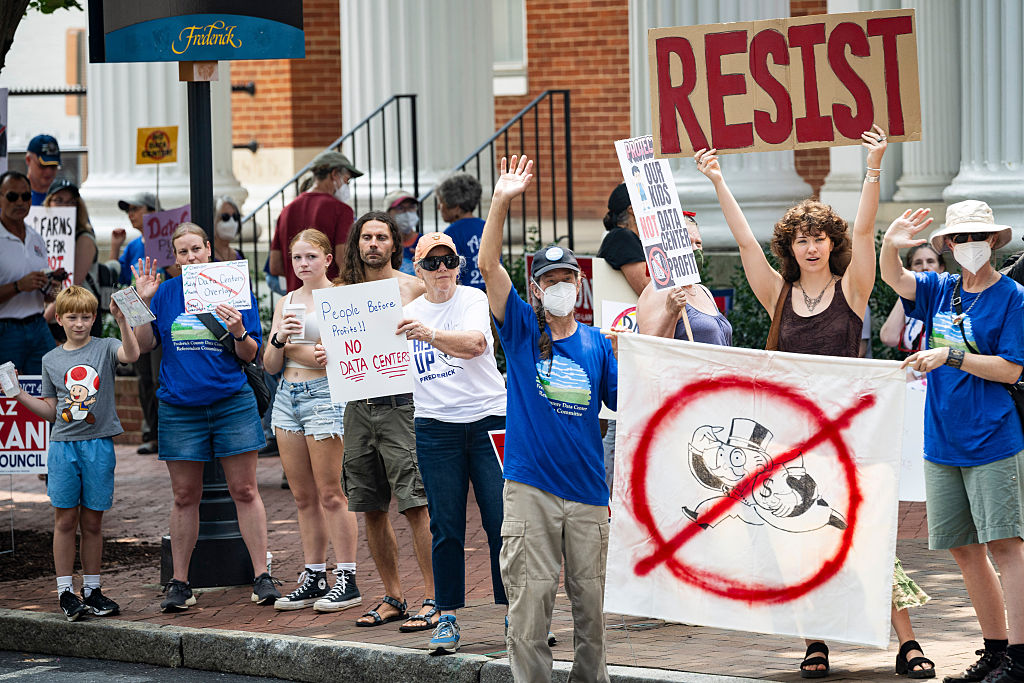
The Georgia town is not alone. If there’s one thing most Americans across the country agree on, it’s that they hate data centers. A June Reuters poll found that just a third of Americans approve of the pace of data-center construction, and only 14% are comfortable with a data center being built nearby. On July 18, a national day of protest against data centers saw 142 protests across 42 states.
Read more: The Growing Political Power of Anti-Data Center Activists
According to one count by The Information, more than 300 cities, towns, and counties—including Monterey Park, Calif., Dekalb County, Ga., and Jefferson County, Pa.—have placed bans or moratoriums on the construction of hyperscale data centers. In the first three months of 2026, 75 major projects worth more than $130 billion were delayed or canceled in part due to organized local opposition. And on July 14, New York governor Kathy Hochul signed an executive order to create the nation’s first moratorium on new hyperscale data centers, while several other states, including Pennsylvania, Michigan, and South Carolina are considering similar pauses.
Why data centers are straining local water and power supplies
Data centers have long been used to store and process our digital information—whether that be photos in the cloud or the videos we stream online. But the rise of hyperscale data centers in recent years—which are higher performing and often used to power AI—began to change things.
“We’ve been aware of data center development as early as 2010, but they were much smaller in scale,” says John Farner, executive director of land and water at the Lincoln Institute of Land Policy, a non-profit which has been researching the land and water use of data centers over the last few years. “What we’re seeing now, especially with the advent of hyperscale data centers, is that they’re much larger, much more powerful. They’re much more resource intensive.”
More than 160 new AI data centers have popped up across the U.S. in the past three years—a 70% increase from the last three year period, according to a Bloomberg News analysis. In many instances, they’ve landed in communities with high competition for scarce water resources. A mid-sized data center consumes as much water as a small town, while larger ones require up to 5 million gallons of water every day—as much as a city of 50,000 people. They also consume massive amounts of electricity. Data centers accounted for 4% of total U.S. electricity use in 2024, and their energy demand is expected to more than double by 2030. In many cases, the additional electricity costs are passed on to nearby residents; in states with a high concentration of data centers electricity prices have increased by up to 267% over the last five years.
Steve Swope, another Coweta County resident, relies on wellwater, and is concerned that the construction of the data center could damage septic tanks or leak into the groundwater. “Our wells will either run dry or they’ll become polluted and caked with sediment and mud,” he says.
Residents in other rural areas around the country have already reported that nearby data centers are making well water undrinkable. When Meta began construction on a $750 million data center in nearby Newton County, Ga. in 2018, the construction damaged local wells, caused municipal water prices to soar, and could cause the county to face a water deficit by 2030, according to reporting from the New York Times. Meta said that according to a study it commissioned, its data center project was unlikely to have impacted the water supply.
Soon after Project Sail was approved, four more data centers were proposed in Coweta County. In May, Coweta County approved a data center moratorium on any future projects, but residents say it’s too little, too late.
“It’s kind of like, well, the horses are all out of the barn, let’s be sure to close the door now,” says Swope.
The fight has left Beth and her family in limbo. They bought their home intending it to be a fixer-upper—the house is drafty, the windows need replacing. But they’re hesitant to invest in a home they’re not sure they’ll stay in. “The unknown drives this cycle of [asking] do we move? I don’t really want to move. Where do we move to?” she says. “They’re everywhere. We’d want to move somewhere that also has a little bit of land, but all of that is that threat. We feel like there’s no safe place to move.”
But, as of now, remaining put comes with its own set of problems. “If we stay here, this is going to be in our backyard.”
The post Community Backlash to AI Data Centers Is Growing Across the U.S. appeared first on TIME.