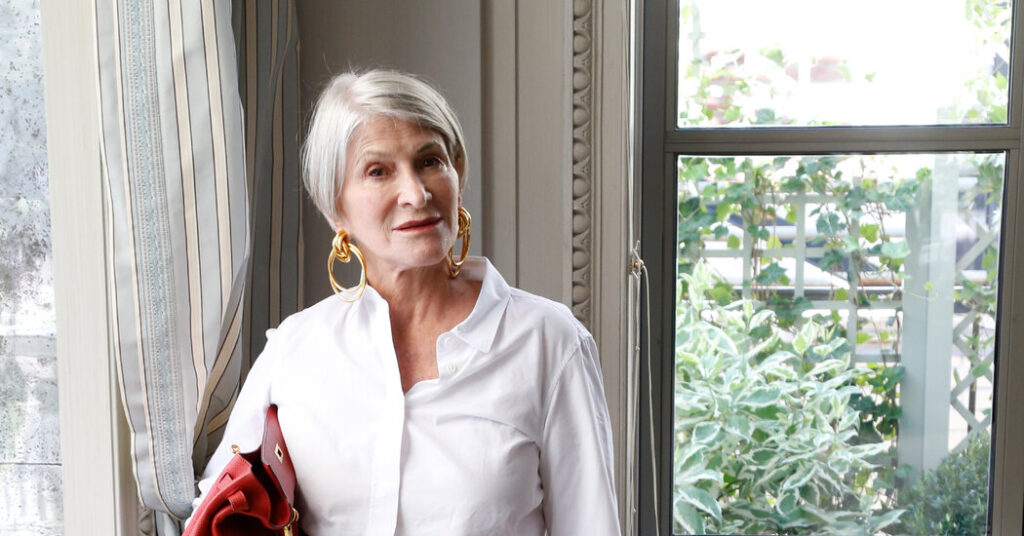
Bobbi Queen, a veteran editor at Women’s Wear Daily, the once-formidable arbiter of fashion, who championed young designers like Perry Ellis, Willi Smith, Giorgio Sant’Angelo and Donna Karan, and whose singular style made her an avatar of chic generations before the internet atomized that role into a million bland “influencers,” died on July 3 at her home in Manhattan. She was 84.
The cause of death was a heart attack, her daughter, Pilar Queen, said.
Ms. Queen joined Women’s Wear in the early 1970s, at a pivotal moment. The magazine’s mercurial publisher, John Fairchild, had spent the previous decade transforming his family’s half-century-old, dowdy trade publication into what would become known, without irony, as the fashion bible. Under his watch, it was a buzzy must-read as much for its fashion reporting — with the help of editors like Ms. Queen, the magazine made stars of designers, especially Americans — as its society coverage.
It was Mr. Fairchild who was credited, perhaps apocryphally, with coining the phrase “the ladies who lunch” to describe the cohort of wealthy women like Pat Buckley and Nan Kempner whose clothing choices and favored luncheon spots — La Côte Basque, for example — were reported on as extensively as the Watergate hearings.
It was a decade when society writ large was in transition, and the gains of second-wave feminism were being realized. Women were entering the work force in droves, and designers like Mr. Ellis and Ms. Karan were dressing them in clothes that reflected their new status, with pieces that were both looser and more body conscious, both slouchy and tight.
The sexual revolution was giving way to a physical revolution — first published in 1981, “Jane Fonda’s Workout Book” would go on to sell two million copies — and that affected fashion, too. Ms. Queen covered figures like Norma Kamali, whose designs showcased women’s newly muscular bodies.
In 1975, she introduced her readers to the Skimp, essentially a minidress, after Halston made one in Ultrasuede for $260 (more than $1,700 today) and department stores like Saks Fifth Avenue followed suit, offering their own versions in T-shirt fabric for $11. Saks, she reported, sold two thousand in a month, and noted Halston’s approval: “You have to be quite a rich girl to have a $260 Skimp,” he told her.
The next year, she wrote about the fad for super-tight jeans, describing the correct method for trying on one of the best sellers at the French Jean store on East 60th Street in Manhattan. It “required the woman to lie down on the car bed under the mirrored ceiling,” she said, “and the assistance of two or three salespeople to zip her into the right size jeans.” (Note the 1970s details: Car bed! Mirrored ceiling! And there were photos.)
“Your eyes should bulge when you first get these on,” the store’s owner told her.
In 1978, she profiled Ms. Kamali — who was pairing big shoulders with body-hugging T-shirt and sweatshirt fabric in jumpsuits and evening wear, among other innovations — when she opened her flagship store on West 56th Street. Ms. Queen’s story beat a Kamali profile by John Duka, the fashion critic for The New York Times, by two weeks. In those days, that was considered quite a coup.
“Bobbi came from a time when fashion was a little more exclusive, when it was not on everybody’s algorithm,” Ruth La Ferla, a former style reporter for The Times who worked at Women’s Wear in the mid-1980s, said in an interview. “She was of a generation of editors who had enormous influence, because they had a captive audience and because they themselves were inventive and sure of their authority. She was among the last of a breed.”
Ms. La Ferla continued: “I would watch her walk into the office every day, and I would study her. She pulled off things you wouldn’t believe: a matador jacket that she made look normal; violet jellies, but with a trail of Chanel chains around her neck. She had a kind of high bohemian style, but she could fit in a boardroom if she had to.”
“If you were interested in fashion,” she added, “there were very few people to model your style on, and she was one.”
Ms. Queen was not a power broker; she didn’t have that ambition. Nor was she a fashion nun, to use the industry vernacular for those singularly fixated on fashion.
“She was passionate, but she wasn’t pious,” said Ben Brantley, the former chief theater critic for The Times, who was the chief fashion critic for Women’s Wear, among other roles, starting in the late ’70s. “She didn’t take the vows.”
Yet designers hung on her words, and her critiques could alter a collection. A review from Ms. Queen could make or break a career. After her death, Ralph Rucci recalled her post-mortem phone calls after a show, as he told Women’s Wear: “The clothes were great,” she might say. “But where are you going with that hair?”
Ms. Queen was the first to cover Ms. Karan when the designer went out on her own in 1984. “Never, ever give anything to anyone before Women’s Wear,” Ms. Queen told Patti Cohen, the former executive vice president of global marketing and communications at Ms. Karan’s company.
Each decade she would find new talents to promote, including Vera Wang, the bridal designer, and Mark Badgley and James Mischka of Badgley Mischka, known for their sexy party dresses and evening gowns.
“We first entered Bobbi’s orbit when we were at our first jobs,” Mr. Badgley told Women’s Wear. “James was working at WilliWear” — the company that sold Mr. Smith’s spirited sportswear line — “and Mark was at Donna Karan.”
Ms. Queen, he added, “terrified everybody, especially the design teams. The earth literally trembled when Bobbi came to see the collections.”
She became one of their staunchest supporters. Later, they designed her daughter’s wedding dress.
“Bobbi was an original thinker,” Yeohlee Teng, one of the many designers Ms. Queen championed, said in an interview. “She always spoke her mind. She was of that first generation of women that spoke up.”
Bridget Foley, Women’s Wear’s former executive editor, described Ms. Queen as “a unique mash-up of regal carriage, stalwart opinion, sharp wit and antithetical self-deprecation.”
Ms. Foley added: “We used to have this routine, when dissecting the relative merits of a dress. ‘Love it,’ one of us would start. And then, ‘Well, I’d love it if the sleeve were narrower.’ ‘Yes, and the neckline, straighter.’ ‘And the print, more subtle.’ ‘Yes, with a lean sleeve, straight neckline and quiet pattern, it would be fabulous.’ Bobbi would then cut off the conversation with, ‘If my grandmother had wheels, she’d be a streetcar.’”
Barbara Sela Queen was born on Feb. 22, 1942, in the Hollis neighborhood of Queens, and grew up in Lakewood, N.J. Her mother, Beatrice (Mallow) Queen, was a schoolteacher; her father, Alvin Queen, was an insurance broker.
She attended Boston University for a year and then transferred to the Tobé-Coburn School for Fashion Careers in Manhattan. After graduating, she worked as a buyer for Gimbels, the department store.
By the early 1970s, she was at Women’s Wear, working through all the fashion categories like the stations of the cross: She served, variously, as the evening-wear editor, the inner-wear (that would be underwear) editor, the ready-to-wear editor and the fur editor. These were hard-core beats, and Women’s Wear editors covered them as assiduously, and with the same granular expertise, as political reporters covering Congress.
She retired in 2015. In addition to her daughter, she is survived by three grandchildren; a sister, Lisa Queen; and a brother, Eric.
She was a single mother, and the staff at Women’s Wear became her daughter’s second family. “I was raised in that office,” Pilar Queen said. “I was Bobbi’s sidekick.”
For a time, they lived in a one-bedroom apartment on the Upper West Side. “I slept in the living room behind two screens,” Pilar Queen said. “I yearned for a wall.”
It was outside that apartment that Ms. Queen was mugged, an experience that became an indelible part of her biography.
“It has ascended to the vaporous regions of myth, but she was pretty consistent in the details,” Mr. Brantley said. “She was standing on the corner with a cherished bag — I can’t remember what it was — and a man came by and tore it out of her hands. She screamed like the whistle in ‘Sweeney Todd,’ and everyone came running. When the police asked for a description of the mugger, she was extremely clear: ‘He had on twill pants with about a quarter-inch cuff, a jacket with a slight crease in it and a broadcloth shirt that wasn’t ironed.’”
Mr. Brantley added: “At Women’s Wear, we were trained to see something for 15 seconds on the runway and commit it to memory, but I don’t think anyone applied that skill as practically as Bobbi.”
She didn’t get the handbag back, he noted, “but she got a great anecdote, which was almost as valuable.”
The post Bobbi Queen, Fashion Arbiter Who Nurtured Stars, Dies at 84 appeared first on New York Times.