There is nothing more human than good taste, since there’s no way to define it. It’s mysterious. But you know it when you see it.
You probably won’t find it at the clothing company Edikted, a hit among teenagers. Edikted relies on algorithms to design its products: It monitors customers’ social media activity and internet searches, factors in Hailey Bieber’s latest outfits and spits out 300 styles a month made cheaply in China. After it reached $460 million in sales in 2025, one of its founders boasted to The Wall Street Journal, “We’re more like a data company than a fashion company.”
This model has proved so potent for the fast-fashion giant Shein, which aims to go public this fall at a valuation of over $40 billion, that it recently gobbled up the popular millennial brand Everlane. Fast fashion and mall brands used to look to the runways for inspiration. Now, much of their output has been slopified by back-end data and internet searches.
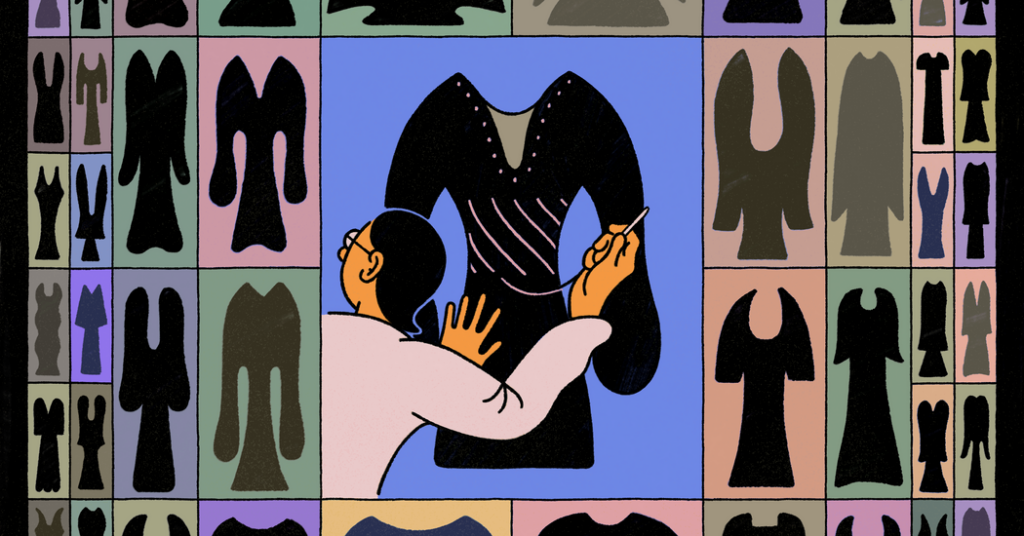
The rise of the algorithm-designer and the fall of independent brands represent the latest stage of the financialization of fashion, the triumph of money over art and craft. We may wear skinny jeans one decade and wide ones the next, but the elevation of corporations over designers has been the industry overarching trend over the past 40 years, and it has gradually killed creative design at all price points. Fashion slop is the logical next step in the evolution of ready-to-wear clothing.
Decades ago, the world of fashion was smaller and feistier, dominated by eccentric, visionary designers trying to express themselves. Sure, they wanted to make money, but many were also trying to change the world by changing how people dressed. The idea was to create something all new and excitingly “now.”
These were not marketing-department drones. They were characters. Halston partied at Studio 54 until 4 or 5 a.m. then arrived at his office around noon to start work. In Paris, Karl Lagerfeld was locked in a feud with Yves Saint Laurent over their shared love interest, the French socialite Jacques de Bascher, but also over their differing ideas of design. Mr. Saint Laurent approached fashion as a high form of art, while Mr. Lagerfeld treated clothes as wearable goods. (The rivalry dragged on for decades. “People buy your dresses to be happy, not to know about the dramas of a crying alcoholic,” Mr. Lagerfeld said of Mr. Saint Laurent after his last show in 2002. “The problem with Karl,” Mr. Saint Laurent countered, “is that he has terrible taste.”) The idea of a fashion brand representing a cult of personality — and customers being dared to identify with one along with their purchases — gets lost during the age of algorithms, where brands are just brands, not people.
In those pre-social-media days, designers’ fiery personalities would spill into their collections, for better or for worse. In 2000, John Galliano showed his infamous “homeless chic” couture collection. Alexander McQueen’s “Highland Rape” show of torn dresses shocked the industry in 1995. Rei Kawakubo’s spring 1997 line, known as “lumps and bumps,” remains one of the most significant collections of the century because it rejected traditional sex appeal, distorting and reimagining a woman’s form.
It would be impossible to defend “homeless chic” or “Highland Rape.” Or Mr. Lagerfeld’s disdain for fat bodies, a part of his personal brand, or Mr. Galliano’s antisemitic tirades, which cost him his job at Dior. But as fashion becomes more consolidated and homogenized (Mr. Galliano’s new gig is for the retailer Zara), it hasn’t seemed to figure out how to provoke and shake up aesthetics and culture, creating crazes that people open their wallets to be part of. Instead, it has aggregated brands into groups, streamlined costs and raised prices while customers trawl for the old stuff on The RealReal and Fashionphile.
Fashion started becoming more corporate in the 1980s, and by the aughts, it had transformed into a battle to see which conglomerate could command the highest share price. Private equity began snapping up fashion brands and cutting costs with hopes of selling them at a profit in three to five years. In an industry that’s driven by taste, not just efficiency, that hasn’t always worked.
Everlane was worth $600 million when a private equity firm, L Catterton, invested in it in 2020. Soon after, one of Everlane’s founders left the company, and L Catterton installed a new one. Everlane was already struggling during Covid, but the loss of its original creative vision didn’t help. Customers evaporated. Saddled with $90 million in debt, L Catterton decided in May to offload the brand to Shein. It was essentially a fire sale.
The French brand A.P.C., known for well-made, unfussy closet staples, has a similar story. Founded in 1987, it presented a logo-less alternative to ’80s excess, and it used quality materials, such as selvage denim. In 2023, it sold a majority stake to, again, L Catterton, which claimed it could scale the business fivefold. Instead, L Catterton has reshuffled A.P.C.’s leadership, and no singular creative ethos has entered the conversation. Its sales have slumped.
When brands consolidate, their identities blur. Versace has seemed creatively lost since its 2018 sale to a multinational holding company. Rag & Bone used to be a darling of New York Fashion Week, fusing British tailoring with a downtown New York sensibility. In 2023, its remaining co-founder stepped down shortly before Guess and a management firm that also owns Toys “R” Us bought the brand. Its new owners signed deals with its existing licensees to design Rag & Bone eyewear, watches and small leather goods, iterating the brand at a distance from its original vision.
In the first “The Devil Wears Prada” movie, Miranda Priestly gives a lecture about the lineage of Andy’s “lumpy blue sweater.” Its shade of blue was popularized in a 2002 Oscar de la Renta collection of gowns, made its way through the collections of eight other designers and ended up in “some tragic Casual Corner where you, no doubt, fished it out of some clearance bin,” she tells Andy. “That blue represents millions of dollars and countless jobs.”
These days that sweater might come to Andy via a private-equity-backed brand that uses an A.I. predictive model and a quickie factory in China, with few humans involved at all.
Amy Odell is the author of the Back Row newsletter and “Anna: The Biography.”
The Times is committed to publishing a diversity of letters to the editor. We’d like to hear what you think about this or any of our articles. Here are some tips. And here’s our email: [email protected].
Follow the New York Times Opinion section on Facebook, Instagram, TikTok, Bluesky, WhatsApp and Threads.
The post The Rise of Fashion Slop appeared first on New York Times.