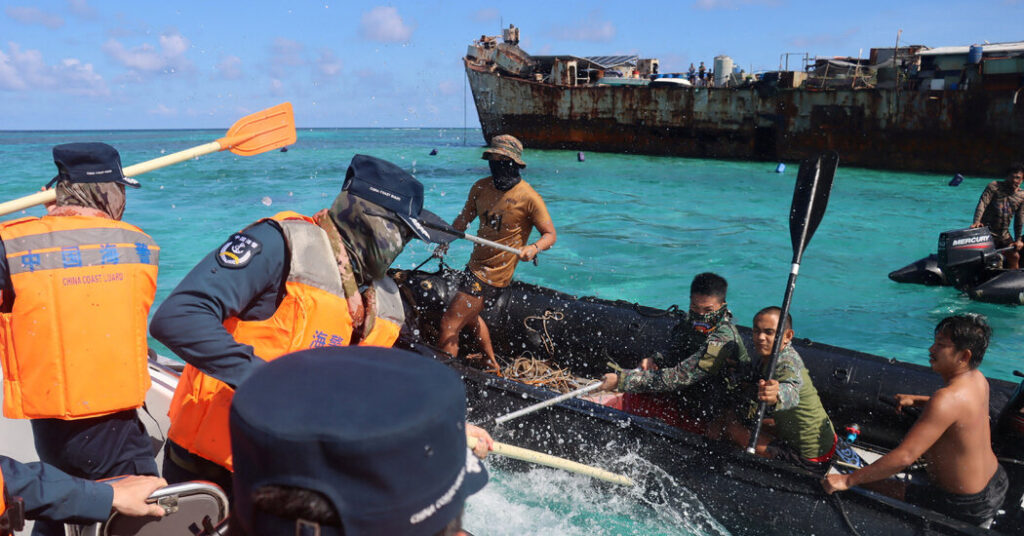
The Philippine military accused China’s coast guard of injuring one of its sailors in a scuffle that broke out on Monday in the South China Sea, where the two countries have been locked in a decades-long territorial dispute.
The episode began when an inflatable Chinese coast guard boat approached the Sierra Madre, a beached World War II-era warship that the Philippines uses as a military outpost in a disputed reef, and lashed out at the Philippine sailors who approached in a boat to chase them away, the Armed Forces of the Philippines said in a statement.
The statement added that a Philippine sailor had been struck on the head with a wooden baton in the ensuing struggle, necessitating medical care.
The Philippines’ Department of National Defense decried the incident as another act of “harassment” by the Chinese coast guard that added to a “pattern of provocative and hostile behavior,” in a statement of Monday. “We simply cannot trust this belligerent neighbor.”
The Chinese coast guard has disputed that version of events, saying that the Philippine sailors rammed their patrol boat first before attacking its personnel with “oars, long sticks, and other tools.”
Accusing the Philippines of spreading propaganda, China’s foreign ministry said it had summoned the Philippine ambassador in Beijing over the incident, according to a statement published by state media on Tuesday. President Ferdinand Marcos Jr. of the Philippines has done the same to China’s ambassador in Manila.
While several countries have longstanding territorial claims in the South China Sea, the dispute between China and the Philippines, a U.S. treaty ally, has been the most fraught.
Tensions in the region have steadily increased in recent years, with the Philippines denouncing the encroachment of Chinese vessels, which they say have used water cannons or lasers to harass Philippine sailors in the area. In another incident at the Second Thomas Shoal — where the Sierra Madre is beached — in 2024, a Filipino soldier lost a finger after a Chinese boat rammed his vessel.
The latest flare-up came just before the start of a series of high-level diplomatic meetings hosted by the Association of Southeast Asian Nations in Manila, where, among other agenda items like the wars in Myanmar and Iran, negotiations to ease tensions in the South China Sea are expected to continue. The gathering, which will conclude Thursday, is being attended by both Secretary of State Marco Rubio and China’s foreign minister, Wang Yi.
The Philippines, the current chair of the 11-member ASEAN, has made establishing a legally binding code of conduct to prevent escalations in the South China Sea a key priority for its tenure, which concludes at the end of this year. The code was proposed decades ago and Philippine officials have voiced optimism about recent progress. But intractable differences have loomed.
Chief among them is the landmark ruling by an international tribunal that dismissed most of China’s sweeping territorial claims in the South China Sea in 2016, including those on the area marked by the Sierra Madre. While there was no mechanism for enforcing the ruling, it was widely regarded as a major victory for the Philippines, which currently sees it as a legal base line for any maritime code of conduct. China, which refused to participate in the arbitration, has steadfastly rejected it.
The decision provided fodder for another dispute earlier this month, when, in response to the Philippines’ commemoration of its 10th anniversary, Chinese state media posted a video depicting the Philippines as a monkey doing the bidding of Japan and the United States.
While the United States does not have any territorial claims of its own in the South China Sea, it conducts regular joint military drills there with the Philippines, with which it has a mutual defense treaty. Beijing has denounced U.S. involvement as a major source of tensions in the region.
The U.S. State Department criticized what it called “dangerous and aggressive actions” by China in a statement on the incident on Monday.
In an opinion article published by Philippine media outlets ahead of the ASEAN meeting, Mr. Rubio reiterated U.S. support for the 2016 ruling, writing that “we will honor our obligations to the Philippines and other allies as they confront new and coercive threats to our shared interests.” But he stopped short of singling out China by name.
Jason Gutierrez contributed reporting from Manila. Ruoxin Zhang contributed research.
The post Philippines Says Sailor Was Injured in Skirmish With Chinese Coast Guard appeared first on New York Times.