Lindsey Cormack is an associate professor of political science at Stevens Institute of Technology, where Kacey DiPasquale is a student.
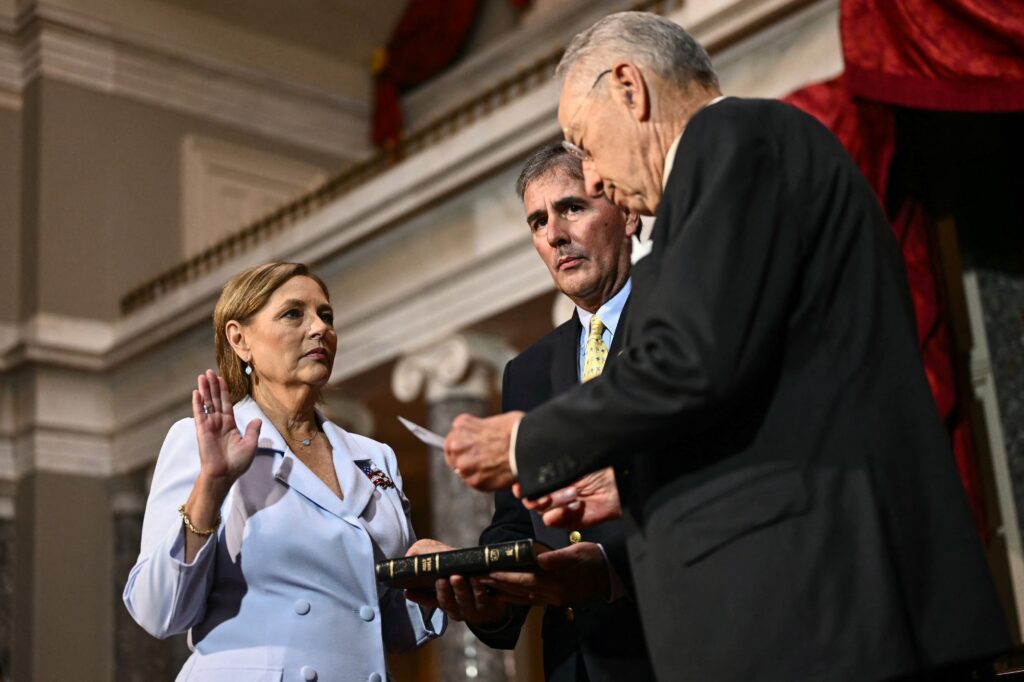
When South Carolina Gov. Henry McMaster (R) named Darline Graham to temporarily fill the Senate seat left by the death of her brother, Lindsey Graham, the appointment made history. Darline Graham became the first sibling of a deceased senator ever appointed to fill a vacancy and the first woman to represent South Carolina in the U.S. Senate.
On Monday, the new senator announced she intends to seek election to a full term. Regardless of whether her campaign is ultimately successful, her appointment already belongs to a long, sometimes forgotten pattern in American history.
Since 1926, 121 senators have died in office. Unlike House vacancies, which Article I of the Constitution requires to be filled through elections, the 17th Amendment, ratified in 1913, permits states to authorize governors to fill Senate vacancies with temporary appointments.
For governors, filling a vacancy after a senator’s death often reflects a search for a noncontroversial candidate who can provide stability during moments of loss until voters can elect a permanent successor. When John McCain, the Republican senator from Arizona, died in 2018, he was replaced by former senator Jon Kyl, also a Republican, who declined to run in the ensuing special election. In West Virginia, Democratic senator Carte Goodwin, appointed after Democrat Robert Byrd’s death in 2010, likewise held the seat only briefly.
But a handful of vacancies have been filled by family members, and until last week, every one of them was a widow.
At least six women have been appointed to Senate seats after the deaths of their husbands, with a seventh depending on whether one includes Jean Carnahan of Missouri. She was the wife of Gov. Mel Carnahan (D), who died in a plane crash, along with their son and an aide, in 2000, three weeks before the election for the Senate seat he was seeking. He won the election posthumously, and his wife was appointed to fill his seat. She lost a special election in 2002 to fill the remainder of the term.
The first instance of a widow replacing a senator who died in office was in 1931. After Thaddeus Caraway, a Democrat from Arkansas, died in 1931, Gov. Harvey Parnell (D) appointed his widow, Hattie, to complete his term. She then won the subsequent special election, becoming the first woman elected to the Senate and serving for more than 13 years. She was also the first woman to preside over the Senate and the first woman to chair a Senate committee. Her portrait now hangs near the doors leading into the Senate Chamber.
Other widows had shorter tenures, including Democrat Rose McConnell Long, who replaced her husband, Huey Long, after his assassination in 1935. She then won a special election to serve the remainder of the term but did not seek reelection. And the Senate never even convened during Republican Vera Bushfield’s three-month tenure as senator of South Dakota after her husband, Harlan Bushfield, died in 1948.
The widows’ appointments reflect a broader reality about American political history. Long before women could vote, run for office or hold formal positions of power, many were deeply involved in governing alongside their office-holding husbands. They advised campaigns, managed political correspondence, cultivated relationships with constituents and often became indispensable partners in legislative careers.
A lawmaker’s wife also knows the senator’s staff, the donors, the party leaders and the senator’s policy priorities. Particularly throughout much of the 20th century, many senators’ wives served as unofficial political advisers and confidantes. A widow could reassure constituents that the office would continue functioning as it had been because she usually knew how it had worked.
There is also a human element in filling a Senate vacancy after an unexpected death. Appointing a grieving spouse can avoid inflaming intraparty rivalries while extending a measure of grace to a family that suffered a public loss. Most of these women were understood to be caretakers of the office, preserving stability until voters could choose the next senator.
Darline Graham’s appointment breaks with the historical pattern of appointing widows but keeps its spirit. Her brother never married, so a spouse was not an option. Even as she runs for election to the seat, she can still deliver the same stability that widows have in the past — while making some history of her own.
The post Darline Graham already made history appeared first on Washington Post.