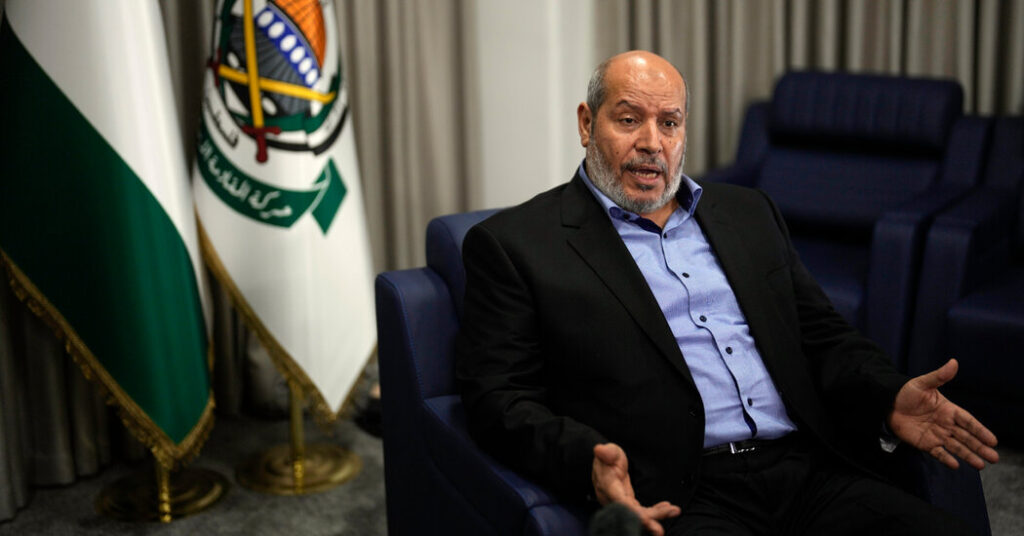
Hamas said on Monday that it had elected Khalil al-Hayya, who steered the cease-fire and hostage talks with Israel during the Gaza war, as its new political chief after a nearly two-year leadership vacuum.
After months of delays and internal deliberations, top Hamas members elected Mr. al-Hayya in a tight race against Khaled Meshal, one of the group’s former leaders, Mahmoud Mardawi, a Hamas official, said in a phone interview.
Mr. al-Hayya, 65, previously served as the deputy to Yahya Sinwar, the Hamas leader who masterminded the Oct. 7, 2023, attacks on Israel. About 1,200 people were killed in the Hamas-led assault and 250 were taken hostage, according to the Israeli authorities.
The subsequent Israeli military campaign devastated the Gaza Strip, killing more than 70,000 people, according to Gaza health officials. Their count does not distinguish between civilians and combatants, although it includes thousands of children.
Mr. al-Hayya’s elevation comes after months of deadlocked talks between Hamas, the Trump administration and Israel over the next steps in the October cease-fire that was supposed to end the war.
More than nine months later, the U.S.-brokered truce’s full promise has yet to be realized. Hamas has not agreed to disarm, Israeli forces continue to bomb Gaza on a near-daily basis and many Gazans are still living in squalid tent camps or the rubble of half-destroyed homes.
The simmering violence has affected Mr. al-Hayya personally: An Israeli airstrike in Gaza in early May killed one of his sons, Azzam al-Hayya. Hamas’s armed wing later claimed his son as a member.
Mr. al-Hayya left Gaza in the months before the Oct. 7 attacks in an attempt to coordinate the Hamas assault with the group’s allies and backers abroad, including a senior Iranian commander, according to internal Hamas documents obtained by The New York Times.
He then oversaw Hamas’s wartime negotiations with Israel for roughly two years, frequently demanding an end to the war in exchange for freeing Israeli hostages. Mr. al-Hayya regularly shuttled between Qatar and Egypt, which served as mediators.
Hamas has not appointed a political chief since 2024, when Israel killed two in rapid succession. Ismail Haniyeh was assassinated by Israel in Tehran, the Iranian capital, in July 2024. Mr. Sinwar, his successor, was fatally shot in a firefight with Israeli soldiers in southern Gaza months later.
In the intervening period, the group was represented by a five-man committee that included Mr. al-Hayya. But as chief negotiator, Mr. al-Hayya commanded a degree of public recognition that made him perhaps Hamas’s best-known leader outside Gaza.
Last September, Israel sought to assassinate Mr. al-Hayya, as well as other senior Hamas leaders, in an unprecedented Israeli bombing of a compound in the Gulf state of Qatar. Mr. al-Hayya survived, although one of his aides was killed in the attack.
Analysts say Mr. al-Hayya belongs to a faction within Hamas more aligned with Iran, while his opponent in the elections, Mr. Meshal, was closer to Sunni Arab states like Qatar.
Trump administration officials broke taboos on contact with Hamas to meet with Mr. al-Hayya on multiple occasions. Adam Boehler, Mr. Trump’s hostage envoy, met him in Qatar in an effort to free Edan Alexander, the last living U.S. citizen held hostage.
The post With Talks on Gaza Stalled, Hamas Appoints a New Leader appeared first on New York Times.