COOL MACHINE, by Colson Whitehead
“Cherish your old apartments and pause for a moment when you pass them,” Colson Whitehead wrote in “The Colossus of New York” (2003), his panoramic nonfiction book about the city that never sleeps, the big uneasy. “Pay tribute, for they are the caretakers for your reinventions.”
Ray Carney, the protagonist and through-line of Whitehead’s trilogy of Harlem crime novels — “Cool Machine” is the gleaming final installment — sometimes pauses to look up at apartments, too.
Ray is a Harlem furniture salesman who has owned his shop (its motto: “Nice furniture for nice people”) for a long time. He likes to wonder if, behind those windows a few flights up, one of his deluxe loungers is palliating someone’s burden or a family has gathered around one of his starter dinettes. He’s a softie and a family man when he’s not dipping a toe (or a leg) into the shadow economy and its savage discontents.
Ray’s glances skyward are nostalgia trips, of a sort. Once you’ve lived in this city long enough, Whitehead understands, every trip is a nostalgia trip.
“Cool Machine” can’t help but impart a nostalgic vibe, too. This isn’t because Whitehead’s prose is autumnal or tamped down but because the reader realizes that this is our last time around the block with this memorable set of misfits and nonconformists.
You’re not a writer, James Baldwin said, until you have a shelf. These days, Whitehead drags a long tail. He’s twice won the Pulitzer Prize, for “The Underground Railroad” (2016) and “The Nickel Boys” (2019), hardheaded yet existential novels that recover and humanize Black American experience and give it a good shake.
He’s written a dozen novels and books of nonfiction. My unorthodox favorite might be “John Henry Days” (2001), about big-city hack journalists stuck in West Virginia while covering the release of a new postage stamp. It’s packed with shrewd humor, and it contains what I sometimes think is the sentence of the century, a satirical nod to William Carlos Williams’s poem “The Red Wheelbarrow”: “So much depends upon a red pickup, filled with crackers.”
The first book in his crime trilogy was “Harlem Shuffle” (2021), set in the late 1950s and early ’60s. You could argue that, put most simply, it’s about Ray’s outrage after he was offered admission to an elite Harlem social club, then shaken down and crudely rejected. It’s a class sting, as well as a financial one.
It’s a heist novel, too. It’s about a crew that robs the Hotel Theresa, the “Waldorf of Harlem.” Ray’s cousin, Freddie, is on that crew, and he drags Ray in as the fence. The novel’s shifting backdrop includes the aftermath of the 1964 Harlem race riots.
Then came “Crook Manifesto” (2023), set in the 1970s. You could argue that, put most simply, the book is about Ray’s need to score Jackson 5 tickets for his daughter. He gets pulled back into the criminal life as the city convulses (arson, police corruption, countercultural warfare) around him.
The other primary characters in these novels include Elizabeth, Ray’s wife. She’s the moral center. She’s from the Black gentry and grew up on Harlem’s Striver’s Row. Her parents wonder why she stooped to marry a furniture peddler. Now Ray, Elizabeth and their children have their own place on Striver’s Row. Elizabeth works for a travel service that caters to Black customers, from the “Green Book” days through the rapacious ’80s, when she acquires a bougier Black clientele.
Then there’s Pepper, Ray’s longtime enforcer. (He’s this novel’s amoral center.) He’s quiet, strong, half-sinister, there when you need him and gone otherwise. He’s in his 60s now. He takes swigs from an ever-present bottle of Pepto Bismol and is despondent that his favorite bar is packed with yuppies and no longer serves Rheingold, his beer.
Pepper worries about this new generation, kids who had “never laid eyes on a WHITES ONLY sign, or a COLORED section.” Ray isn’t too fond of the graffiti that’s climbing the walls.
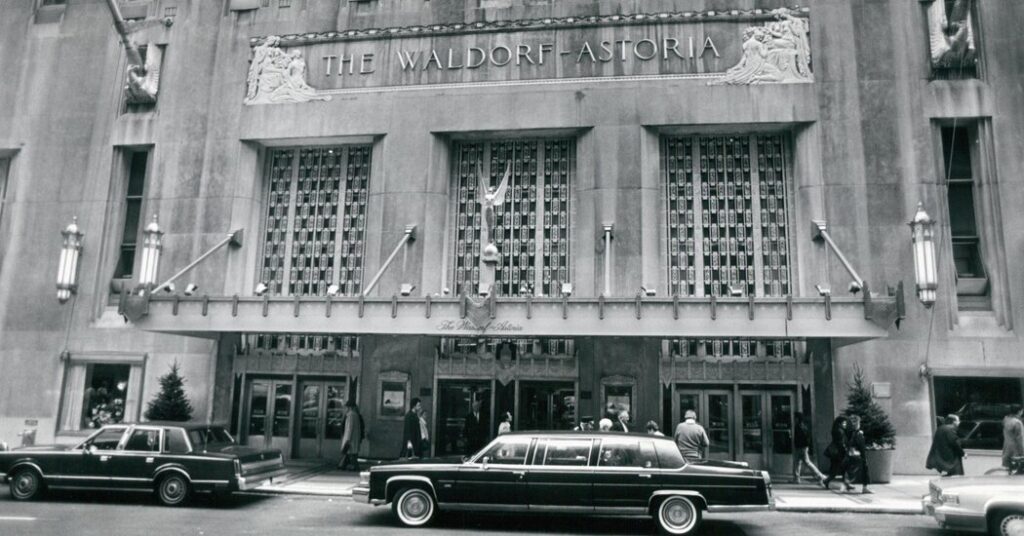
You can come to “Cool Machine” (the title refers to Ray) for the heists and beat-downs. Some cultural retribution is at hand. Plans are hatched to reclaim the gold medal Jesse Owens won at the 1936 Olympics before, in this telling, he was forced to sell it. This involves breaking into the real Waldorf Astoria hotel. Whitehead nails the pacing and the details: The writing about safes and safecracking clicks.
A prized African mask, seized by colonial armies, wants repatriation. Manhattan in the early ’80s is being wired for cable. One crew drives an 18-wheeler into deepest New Jersey to lift some of that oddly precious coaxial stuff. Whitehead isn’t much into descriptions of wet work, but one of the bad guys here likes to slice off men’s faces. There’s a recurring need, at least metaphorically, for a cleanup in Aisle 3.
The best reason to come to “Cool Machine,” and to the others in this series — you don’t need to pick them off in order, but I’d recommend it — is to drink in Whitehead’s intellectual breadth, his ambivalent irony, his moral seriousness and pinball verbal play.
These novels have been compared to Donald Westlake’s. A better point of comparison might be Saul Bellow. Whitehead is our Gen-X slacker Saul. He’s talky: He has an energetic, conversational voice and, like Bellow’s, his sentences are a rhythmic barrage. This is bodega realism. He deals out his cards as deftly as did Ricky Jay.
He doesn’t “waste” his gifts on a crime novel; he casually slips the genre’s boundaries, the way Pynchon does in his late novels. (There are affinities between Whitehead and Pynchon, too, but I will leave that topic to the professoriate.)
The furniture writing in “Cool Machine,” for example, is superb: as alert and profound as the real estate writing by Richard Ford, Whitehead’s onetime antagonist, in his Frank Bascome novels. Retail experience, Ray thinks, has made him a better criminal. Let us pause to thank the gods for novels that are not about writers.
The cultural commentary is playful and urbane. One thief reads “Catch-22” for an evening class and can’t believe white readers are shocked to learn that the system doesn’t work. Ray likes Andy Rooney’s books because Rooney is a “whiny old fart,” just like himself. We get into linguistics. Pepper wonders why there isn’t “a nice, short word for a good place to dump a body.”
Though it’s never pretentious, the lit talk reminded me a bit of “Death Wish,” the 1974 Charles Bronson vigilante thriller. Bronson’s character keeps well-stocked bookshelves and reads Harper’s before going out to waste the nearest miscreant in sight.
The movie talk is good. Hitchcock’s “The Birds” is considered in terms of integration paranoia. Why do white men so love “The Searchers?” Here’s a summary of “American Graffiti” you won’t find in TV Guide: “teenagers cruising around before a Klan rally.”
The music talk is better. Whitehead links the blackout of 1977 to the invention of rap: all those stolen turntables. There is a spiky disquisition on the song “Little Johnny Jewel,” by the band Television — a song about “finding the secret haven underneath it all.” That idea taps into this novel’s themes. One mohawked thief takes the song’s initials — L.J. — for her street moniker.
Most saliently, this is a heavyweight New York novel. Whitehead cracks the city open like a crab and pulls out the meat. The metropolis is broke; Ed Koch is mightily lampooned; the Lower East Side is beginning to gentrify. Whitehead clocks the grimy urban realities (“Yellow-white foam ringed the shore like a crust of dried pus”) while remaining open to IMAX vistas of wonderment.
When Ray and Elizabeth visit the Twin Towers for a celebratory meal at Windows on the World (“they gave us a white person table”), he looks down and, in a moment that might be set to Duke Ellington’s big-band version of “Rhapsody in Blue”:
The skyline turned itself on one switch at a time, the million lights in the million buildings, in the rowhouses and prewars and corporate megastructures, heckling the deathless stars above.
Whitehead dispenses aphorisms as if he’s Salt Bae standing over a porterhouse: “Everybody needs a place where they can get up to no good”; “Sometimes the circle of life is a triple-decker on rye”; “Religion was the oldest of the long cons”; “They never write about drug deals gone right, you notice that?”
Sometimes these aphorisms have a kicker, like the fourth panel in a “Doonesbury” strip or the tiny penguins that crack wise at the bottom of the late Pat Oliphant’s political cartoons. Hence: “Everyone should fake their death at least once. It’s clarifying.” Or: “The last thing you want is to be tied to a dead body without a face. Especially on a Thursday.”
Whitehead’s prose contains, to borrow an image from his former Village Voice colleague Robert Christgau’s memoir, extra wontons.
I realize I sound gung-ho, and I am. Yet “Cool Machine” does have its horse latitudes. On Page 161 of my copy I wrote in the margins, “snoozin’ here.” The pace picked back up. The Ray Carney books are not “great” novels as we have traditionally understood that term, but they offer pleasures that Whitehead’s more canonical novels do not. They are entertainments of a high order.
“Cool Machine” allows you to view the full scale of this jitterbug trilogy. Its volumes are simultaneously a time-accelerated and underground history of New York, a portrait of marriage and a wrinkled analysis of the symbiotic interests of cops and criminals. Also, they leave you smiling. “Are you a mass murderer?” one character is asked. His response: “What’s mass?”
Walking through Harlem, where I live, I like to imagine Ray looking up at the windows. “The only permanent tenants,” he thinks, “were hustle and impermanence.”
COOL MACHINE | By Colson Whitehead | Doubleday | 352 pp. | $30
The post With His Latest, Colson Whitehead Pulls Off Another Score appeared first on New York Times.