THE LOST FOUNDER: James Wilson and the Forgotten Fight for a People’s Constitution, by Jesse Wegman
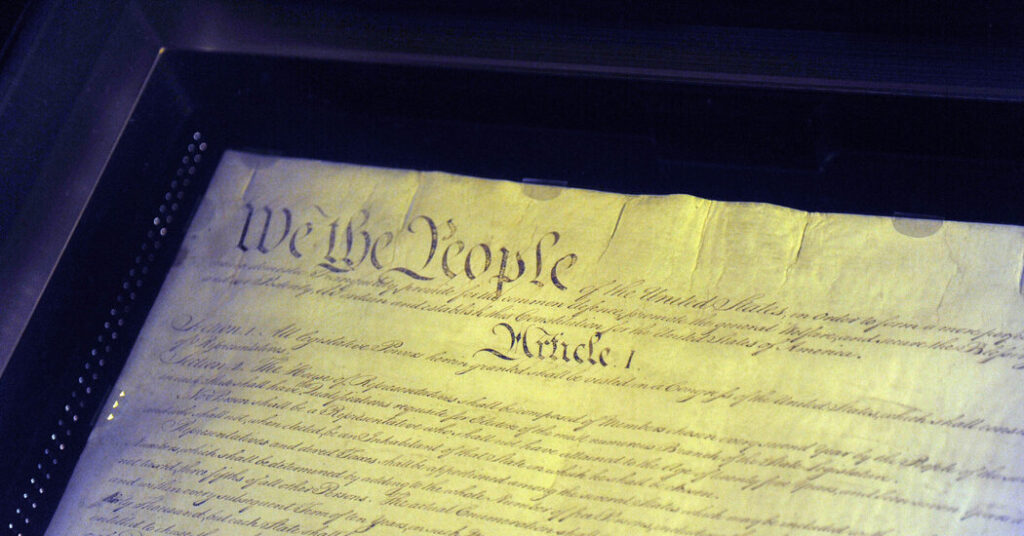
The opening words of the Constitution of the United States — words that have been celebrated across the centuries as the lifeblood of democratic governance — owe their existence to a man few Americans today have ever heard of. His name was James Wilson, and in the summer of 1787 he wrote “We the People” into his draft — the first full draft — of the Constitution.
A decade later, while serving as a justice of the Supreme Court, Wilson was on the run. Addicted to land speculation and deeply in debt, Wilson spent the final months of his life as a fugitive, hiding from creditors in a tavern in North Carolina, hundreds of miles from home. When he died, stricken by malaria in 1798, almost no one noticed.
Amid the deluge of books intended to commemorate America’s 250th birthday, more than a few highlight so-called lost founders. The journalist Scott S. Greenberger’s “The Forsaken Founder” details the life of the brash, peg-legged Gouverneur Morris, a New York senator and constitutional co-author who fought to abolish slavery long before the Civil War. And the political scientist Danielle Allen’s “Radical Duke” tells the surprising story of the third Duke of Richmond, an improbable aristocratic patron of the anti-monarchical rabble-rouser Thomas Paine.
But, as the former New York Times journalist Jesse Wegman suggests in his riveting new biography, “The Lost Founder,” few people had as profound an impact and have been as profoundly forgotten as Wilson. Wilsonville, Pa., the only town named for Wilson, was established by the man himself in 1794 as a site for manufacturing rope and cloth. Flooded by the Pennsylvania Power and Light Company in the 1920s, it now lies under the waters of Lake Wallenpaupack.
To many of his peers, Wilson was an extremist. His belief that everyday people should vote directly for consequential things, like the presidency of the United States, often put him at odds with better remembered founders like James Madison and John Adams.
The turbulent history of popular sovereignty concerned many of the first architects of the United States. So too did recent events. In 1786, during what is known as Shays’s Rebellion, the people of western Massachusetts, besieged by economic hardship and angry at the unresponsiveness of their state government, tried to overthrow it. “The evils we experience,” the Constitutional Convention delegate Elbridge Gerry concluded several months later, “flow from the excess of democracy.”
The Connecticut delegate Roger Sherman felt the same way. “The people,” he said, “should have as little to do as may be about the government.” To survive, such voices contended, the fledgling American republic needed layers of separation between the nation’s citizenry and the highest offices in the land. Thus, under the original Constitution of 1787, state legislatures — not the people of the states themselves — were tasked with electing the two senators who represented them.
Wilson, for his part, saw all this as rubbish. No mere gesture or rhetorical flourish, “We the People” captured the essence of Wilson’s political convictions: his lifelong commitment to what Abraham Lincoln would later call a government of, by and for the people. Indeed, what would become a hallmark of American law in the 20th century — the principle of “one person, one vote” — originated with Wilson.
And yet when his preference for a directly elected president was rejected during the convention’s early deliberations, he stepped back, held his nose and (in one of those arresting ironies of history) proposed the first version of what is arguably the most serious inhibitor of democratic action in the United States today: the Electoral College.
Wegman first encountered Wilson while writing “Let the People Pick the President,” a passionate case for abolishing the Electoral College. But in discovering Wilson as its (reluctant) originator, he came face to face with another, perhaps more profound, feature of American government: compromise.
In many respects, Wilson’s democratic egalitarianism seems only natural. Born in the impoverished countryside of the Scottish Lowlands in 1742, Wilson attended St. Andrews on a scholarship and, later, the University of Glasgow, where he studied under the greatest minds of the Scottish Enlightenment, learning from men like Thomas Reid, who argued that all people, no matter their background or status, had the ability to arrive at equally correct moral judgments.
This was radical for the mid-18th century, but Wilson had reason to be receptive. Forced to take his meals apart from students whose families could pay tuition, he glimpsed early on the unfairness that often proceeded from accidents of birth. He also experienced the potential of education to remedy them. When he departed for the Colonies in 1765, amid rising imperial tensions, Wilson’s intelligence and scholarly training led him to a legal apprenticeship in Pennsylvania and eventually to the Philadelphia convention hall where he and his more patrician colleagues would shape a new government.
But not all the facts of Wilson’s life would seem to reinforce his democratic sympathies. During the Revolutionary War, Wilson was accused of insufficient loyalty to the Patriot cause and attacked by an angry mob. A decade later, during a celebration of Pennsylvania’s vote to ratify the Constitution, a group of anti-Federalists orchestrated a violent riot to oppose him and his Federalist allies. The people, it turns out, weren’t always on his side, and they let him know it.
Yet Wilson never wavered. He was, “by a long shot,” in Wegman’s words, “the most democratic of all the founders.” He never seemed to feel that “there might be such a thing as too much democracy,” and never appeared to “fully comprehend the darker sides and rougher edges of humanity — including his own.”
When he became a Supreme Court justice in 1789, after begging George Washington for the more lucrative job of chief justice, it was partly because he needed cash to fund his ill-advised real estate acquisitions. And although he was increasingly absent from the bench as his land dealings spiraled out of control, he was relentless in pushing the country toward democracy, reminding his fellow Americans that their nation had “citizens, but no subjects.”
At the heart of Wilson’s democratic vision for his country was an abiding commitment to human equality, the limits and complexity of which Wegman handles deftly. Wilson defended the intellectual capabilities of women, writing, “I prefer the conversation of a fine woman to that of a philosopher.” At the same time, he did not denounce slavery during the Constitutional Convention and likely held at least one enslaved man as a household servant.
Along with the first words of the preamble to the Constitution, Wilson may have inspired the aspirational equality expressed in the most famous line of the Declaration of Independence — “We hold these truths to be self-evident, that all men are created equal.” In 1774, Wilson, by then a highly regarded lawyer, published a pamphlet in which he declared that “all men are, by nature, equal and free: No one has a right to any authority over another without his consent.”
This essay helped cement Wilson’s reputation as a man, as John Adams later put it, of “Fortitude, Rectitude, and Abilities.” And it made a particularly strong impression on Thomas Jefferson, who copied out portions of Wilson’s pamphlet into his commonplace book for future reference.
But does one insistently democratic founder, even one who helped craft the country’s most important documents, make the founding of the United States a democratic project?
Many of Wilson’s contemporaries would have balked at the idea. As the historian Thomas F. Madden shows in his lively and capacious history, “The Fall of Republics,” the men who huddled together in the Pennsylvania State House knew their experiment in representative government was not the first. Their libraries were brimming with examples — from the factious city-states of ancient Greece to the demagogues of pre-imperial Rome — that stoked their fears about the potential for what Madden calls a “tyranny of the people.”
In the late 1780s, worried that the American experiment would end before it truly began, John Adams undertook a survey of history’s most notable republics in his “Defence of the Constitutions of Government of the United States of America.” America, Adams believed, should strive to become, in Madden’s words, a “balanced republic” immune to “the radicalism and chaos of unfettered democracy.”
The delegates took Adams’s warnings to heart. They knew the world was watching — and, for the most part, expecting them to fail. In the mid-1780s, for example, despite entreaties from Adams, Jefferson and Benjamin Franklin, the Venetian Senate — a body that represented the oldest republic in the world — refused to establish diplomatic relations with the United States.
The Venetians had “more than a millennium of experience with statecraft,” Madden writes, and were skeptical that the American government would endure. But past experience was no predictor of future success. The Venetian Republic fell the following decade, destroyed by the spite and might of Napoleon, who would soon usurp and suppress his own country’s experiment with democracy.
Popular rule hasn’t always been as popular as it is today. Wilson is forgotten, in part, because so few of his generation were as persuaded as he was of the necessity of truly democratic governance. Yet even the founders who disagreed most vehemently with Wilson knew that their constitutional undertaking was, in essence, incomplete — a project to be perfected and improved in the centuries ahead.
America’s present political system is under strain. Yet, as Wegman and Madden ably demonstrate, it is a system built for shock. The Constitution, to be sure, was the product of men who had their gazes fixed squarely on the past, men raised on the writings of ancient thinkers, like Polybius and Cicero, who favored republican government, though they feared the crowd. But it was not only — and perhaps not even chiefly — that. It was also the product of a forward-facing vision, however imperfect, however aspirational, of what the United States could become: a durable democracy built on “We the People.”
THE LOST FOUNDER: James Wilson and the Forgotten Fight for a People’s Constitution | By Jesse Wegman | Celadon | 369 pp. | $30
The post Was America Supposed to Be a Democracy? appeared first on New York Times.