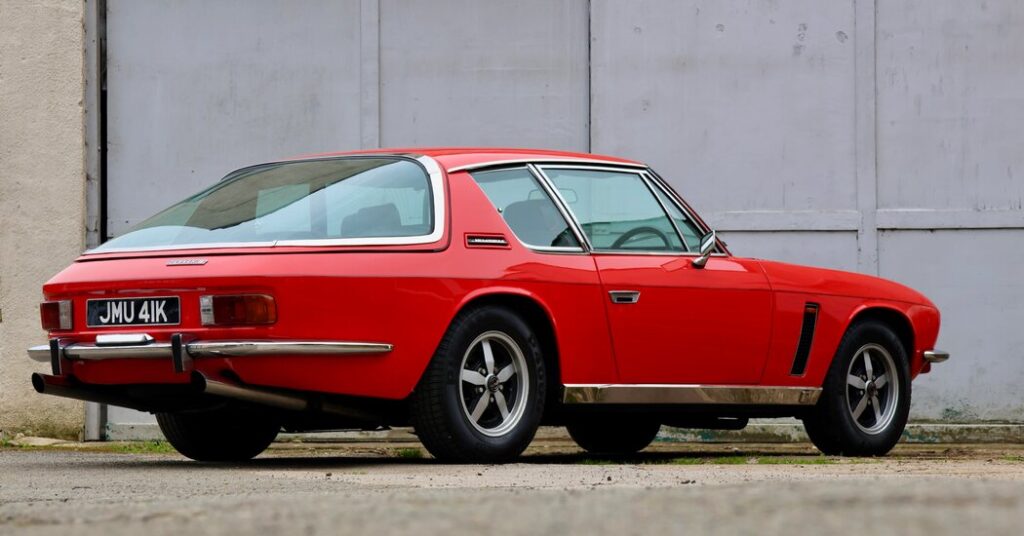
Only about 6,000 Jensen Interceptors were built in West Bromwich, England, from 1966-1976. A who’s who of 1970s celebrities, including Tony Curtis, Bing Crosby and the Led Zeppelin drummer John Bonham, owned the car. Interceptors also appeared in movies and TV shows, like the original “Gone in 60 Seconds” and “Dynasty.”
“The Interceptor was Hollywood’s new toy in the ’70s, a real gentleman’s express,” said Joseph Molina, a retired public relations executive from Los Angeles, who once owned the car.
It was luxurious, fast and had a design that showed up in period cars like the Porsche 924 and 944. It’s still noteworthy 50 years later.
“The rear hatch was its true design calling card,” said Mr. Molina, who had Kjell Qvale, the last owner of Jensen Motors, as a client of his firm. “Distinctive and utterly audacious, it’s why there have been so many attempts to resurrect the car. I think Cadillac has looked to the past to spin its future with this design cue on the Celestiq,” which also has a large, all-glass hatch.
Cadillac denies the association.
When Jensen Motors shut down in 1976, the Hollywood crowd moved on, and many Interceptors fell into disrepair. The stylish English luxury car seemed destined to have a legacy to last a lunchtime.
The English have always excelled at producing grand touring cars like the Interceptor. Called GT for short, these kinds of cars are stylish, powerful, 2+2 coupes (two doors, and two seats front and back) designed to cross continents effortlessly and then look spectacular in the valet parking of a five-star hotel.
While Aston Martin’s DBS Coupe of the late 1960s might be the archetype of the traditional, muscular British GT, its less-famous competitor, the Interceptor had all of the essential GT attributes, and one that the Aston Martin didn’t: a powerful Chrysler V8 that was much easier to service than the exotic Aston Martin engine.
The Interceptor was styled by the Italian design house Touring Superleggera, but it was built using traditional British methods that included hand-finished, meticulously painted bodies and interiors trimmed in polished wood and lots of leather — six full cow hides, according to a period brochure. It cost about $14,700 when new in 1974, or about $100,000 now. A 1974 model recently sold on Bring a Trailer for $28,000.
The Interceptor was powered by a 383-cubic-inch or a 440-cubic-inch Chrysler V8. The car was low and wide, and that wraparound glass hatch finished off a unique fastback roofline.
In the years since Jensen Motors closed, several attempts have been made to revive the Interceptor. For a car that has been gone for a half century it stubbornly refuses to fade away.
“The Interceptor was the product of the midcentury, space-race era of design,” said Patrick Fleming, chairman of Cropredy Bridge Cars, an English company that specializes in the restoration of Jensen Interceptors. “The owners of Jensen Motors were looking for a futuristic design, and they went to the Italian firm of Touring to get it.”
As a result, Mr. Fleming said, the car looked as good today as it did in 1966.
He said it still stops people in their tracks. “Its recognition is high in the U.K. where it remains a dream car and a point of national pride, marrying the best of three cultures: Italian style, American power and British craftsmanship,” Mr. Fleming said.
Jensen’s demise has often been attributed to a combination of the fuel crisis of the 1970s and the Interceptor’s low gas mileage. According to Bruce Qvale, a son of Kjell, the reality of the company’s demise was a bit more complicated. In a recent phone interview, he attributed it to extremely fractious labor relations, stringent safety and emissions regulations in the United States (which was Jensen’s largest market) and the lack of sales success for Jensen’s lower-priced model, the Jensen-Healey.
Daniel Crowley, a retired aerospace executive, collects Interceptors. He saw his first one in 1978 while working as an 18-year-old waiter at a Houston club. Eight years later, he bought his first Interceptor, a 1974 model, followed by a second, a 1972, a year later.
“I got into a rather bad accident in one of them, but I was able to walk away,” he said. “They’re pretty strong cars. My solution was to cut away the damaged part and make one good car out of the two. I still own that one.”
Mr. Crowley said not many people recognized the cars when he drove them around, but the design still spoke to people.
“I think that if a car makes it past its first decade and still looks good, it has a lifetime lease on beauty,” he said.
Jeff Qvale, another son of Kjell, is making the latest attempt to revive the Interceptor. Rather than building new versions of the old car, the project would build a modern car inspired by the old Interceptor.
“The specifics of car No. 1 are being finalized now using some of the design cues of the original,” he said. “We’ll build one to see if there’s any demand. We’d like it to be a modern interpretation of the classic Jensen four-seater GT.” He described it as a passion project born from his love of the original car.
The Interceptor’s style continues to resonate with other designers. Aaron Pizzuti is a design consultant who teaches a course in A.I. automotive design at the College for Creative Studies in Detroit. While he’s only seen an Interceptor in the flesh twice, the car left a lasting impression.
“I can close my eyes and easily visualize all of the elements from the shark fin C-pillar to the trademark giant glass rear hatch,” he said. “It’s a design that remains capable of attracting attention, while not being too avant-garde. Its iconic proportions look obviously premium.”
He recently created a sketch of an updated Interceptor as the basis for a lesson.
“The similarity between the Interceptor and new cars like the Celestiq is certainly there,” he said. “They may not have had one up on the board when they were doing the design work, but they have timeless elements in common, they’re both trying to convey the same thing. Like the Jensen, the Celestiq is a very sexy car.”
The post The Car Hollywood Loved 50 Years Ago appeared first on New York Times.