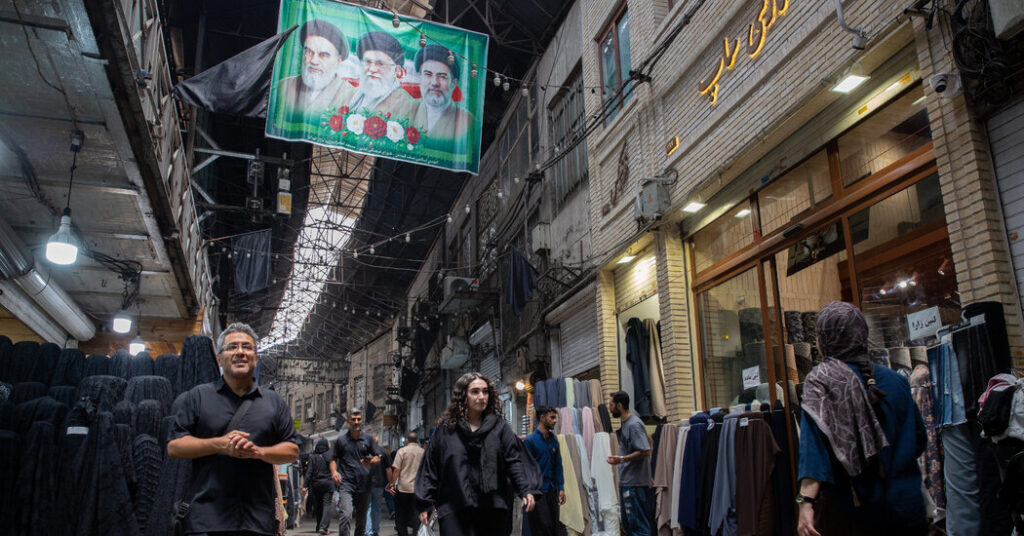
After more than a week of strikes that unraveled an ill-fated cease-fire, the conflict between the United States and Iran stands on a knife’s edge. Now is the time, analysts say, to find a way to draw down an exponentially destructive confrontation — or risk provoking a war that cascades beyond what they may be able to contain.
And though the dangers of escalation are growing, analysts say, neither side can really afford it, either economically or politically at home.
Over the past few days, Tehran and Washington have dealt blows that quickly went beyond battering military targets and have gradually raised the stakes of their renewed war.
Both sides have struck water and desalination plants that risk depriving tens of thousands of power and water supplies during the deadly Gulf summer heat. Traffic through the vital Strait of Hormuz is once again blocked both by Tehran and Washington, while the U.S. has reinstated a blockade of Iranian ports.
U.S. strikes have heavily bombarded roads and infrastructure in southern Iran, killing and trapping civilians, while raising anxieties it is preparing the ground for a potential invasion in the area.
Iran’s strikes on U.S. forces in Jordan have now killed two U.S. soldiers and wounded dozens, bringing the human cost of war much closer to home for Americans while puncturing the Trump administration’s projection of complete military dominance.
“This is the wake up moment for both sides,” said Ellie Geranmayeh, an Iran expert at the European Council on Foreign Relations. “They either take the diplomatic off ramp now or risk allowing the war to spiral beyond managed escalation.”
As both sides’ targets expand, so does the war’s potential geographic reach.
The growing tit-for-tat of infrastructure strikes in Iran and Arab Gulf countries could quickly devastate civilian populations in the region. Iran has already warned that if it is hit badly enough, it will gun for Gulf installations critical to international energy supplies.
U.S.-allied Saudi Arabia struck an airport held by Iran-aligned Houthi rebels in Sanaa, Yemen, last week. That has increased the likelihood, Ms. Geranmayeh said, of Tehran calling on its Yemeni allies to block the crucial Red Sea shipping lane, Bab al-Mandab. Such a move would quickly compound risks to the global economy.
The costs of accelerating the conflict are high for both sides.
Both the Trump administration and Iran’s new hard-line leadership face all of the same economic and political risks that compelled their warring governments only a month earlier to sign a vaguely worded “memorandum of understanding,” which aimed to negotiate an end to the conflict.
As then, the havoc the war has wreaked on the global economy since the initial U.S.-Israeli attack on Iran last February has yet to abate. Expanding the unpopular war further risks damaging President Trump’s Republican allies in the upcoming midterm elections.
Iran’s economy was so dire before the war that it sparked nationwide protests that were suppressed in a deadly crackdown. Now, battered by wide-scale destruction, it faces a dangerous economic reckoning that is worsened by the U.S. blockade on its ships.
The very factors that make escalation so dangerous for Washington and Tehran may also be what is pushing them to riskier attacks, as they seek to increase the pressure on each other.
“The conflict has now become a contest against time and a war of endurance,” wrote Hamidreza Azizi, an Iranian security expert at the German Institute for International and Security Affairs, on social media. “The decisive question will be whether Iran’s deteriorating economic and infrastructural conditions outpace the rise in energy prices driven by instability in the Strait of Hormuz, or vice versa.”
Discontent over the human and economic cost of war is starting to be more palpable in Iran. On Saturday, 268 prominent Iranians, including academics, politicians, athletes, clerics and trade unionists, signed a “No to war” petition — a risky move at a time the government, backed by a fiercely pro-war hard-line base, has continued to crack down fiercely on dissent.
“The government will have a very difficult time convincing people that they should continue fighting this war at the cost of Iran’s destruction,” said Omid Memarian, an Iran analyst at DAWN, a Washington-based Middle East research institute. “So time is ticking for them too.”
That sense of time slipping away is likely what encouraged Iran to launch the attacks on ships that began the latest spiral, said Farzan Sabet, an Iran analyst at the Geneva Graduate Institute in Switzerland, not with the aim of expanding the war, but to take advantage of strategic gains while they have them.
“They saw their leverage in terms of being able to control the strait quickly decline,” he said, as the United States encouraged ships to navigate the waterway beyond Iranian oversight during the cease-fire.
These attacks should be seen as Iranian efforts to “keep themselves relevant at the likely negotiating table” more than to signal that they aim to win militarily, Mr. Memarian said. And they could easily backfire.
The strikes on U.S. targets in Jordan, for example, have not only caused heavy casualties and damage to helicopters and equipment. They have very publicly underlined that Tehran retains the ability to strike back and sometimes outmaneuver a far more powerful U.S. military.
The possibility that such attacks trigger public anger in the United States, or simply enrage the mercurial Mr. Trump, Mr. Memarian said, has now “clearly put Trump in a position where he is more likely to escalate militarily.”
At the same time, with the economic and political stakes so high, Mr. Trump has few palatable options for escalation.
Between now and early to mid-August, Mr. Sabet said, the Trump administration is likely to try to weaken Iran’s leaders militarily, or to destroy Iran’s ability to control traffic in the Strait of Hormuz through asymmetric attacks. Yet, he said, there was little sign the United States could succeed in doing that.
“I am skeptical of any one-off U.S. escalation being able to dramatically change Iran’s calculus,” he said. “It would have to be something truly earth-shattering,” he said.
One approach that could achieve that effect would be a U.S. ground invasion, most likely on a southern island near the strait. Many Iranians have viewed the intense U.S. strikes on the country’s south as a potential precursor to such a campaign.
Ms. Geranmayeh, the European Council analyst, said the risks that previously made the Trump administration leery of that option — from the potential for heavy casualties to the possibility of prolonged occupation — are even bigger now. U.S. troops would face new disadvantages like intense summer heat, and Iranian forces that by now have spent months preparing for such an offensive.
If Mr. Trump was considering such a campaign, it would likely come after the midterm elections, Mr. Sabet argued, when the political risk for him is lower.
The coming days remain precarious nonetheless. With Iran eager to project its military power, every strike risks a miscalculation that could deepen the war instead of hastening negotiations, said Mr. Memarian of DAWN, the Washington-based research institute.
“I think it’s going to get much worse before it gets better,” he said.
Sanam Mahoozi contributed reporting.
The post Tehran and Washington Face a ‘Wake Up Moment’ Over the War appeared first on New York Times.