EAST RUTHERFORD, N.J. — This summer’s World Cup was so good, nobody wanted it to end.
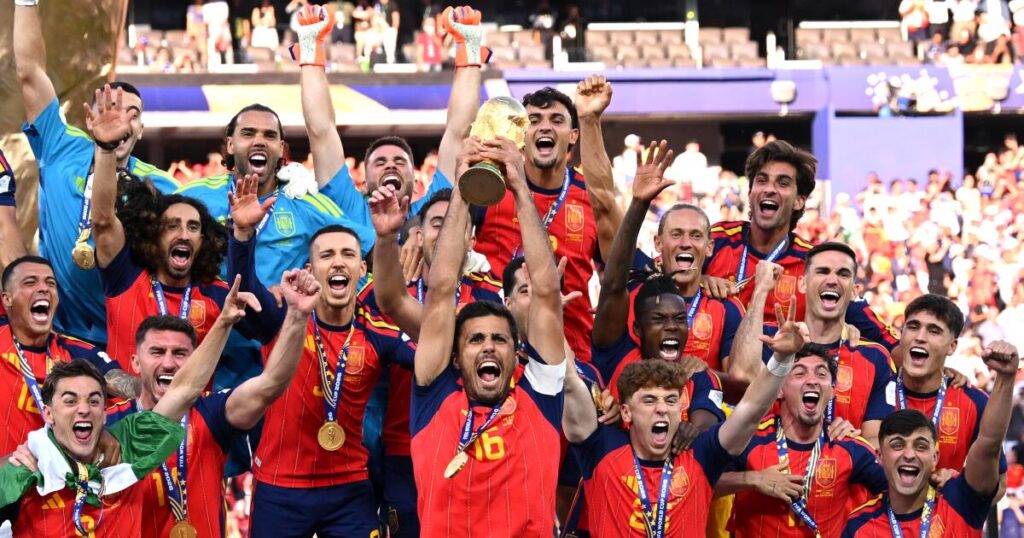
So Spain and Argentina played on and on in Sunday’s final, through 90 minutes of regulation then through a 15-minute extra period before Ferran Torres gave Spain the only goal it would need to claim the title with a 1-0 victory over Argentina at a sold-out MetLife Stadium.
It was an epic finish to an epic tournament, one that set records for everything from attendance and TV viewers to games played and goals scored. And it was almost certainly the last World Cup for Argentine captain Lionel Messi, 39, who finished his record-setting sixth tournament as the all-time leader in games (34), assists (12) and goal contributions (33).
His parting gift was a silver medal, a handshake from President Trump and a hug from the King of Spain. But none of those were the prize he wanted most, so when he left the stage after receiving his medal, he broke down in tears.
A swarming Spanish defense made him little more than a spectator for most of the match. So while Argentina came into the final leading the tournament in goals per game, it also became the first team to go 90 minutes without a single shot in a World Cup final. It was outshot 20-2 for the game and Spanish keeper Unai Simón, who gave up just one goal in eight matches, was not forced to make a save in registering his seventh clean sheet.
He was named the outstanding keeper of the tournament.
That allowed Torres, who started just once in the tournament, to become the hero.
“Honestly, I can’t believe it. I just am trying to enjoy it, but I don’t know what’s happening,” he said. “I didn’t think too much. I just saw the ball coming to me and I just shot with the power of all the Spanish people.”
Rodri, Spain’s captain and the anchor of the team’s smothering defense, was equally stunned.
“I’m in shock,” he said. “I cannot express [my feelings] in words. I’m like in a cloud.”
For Rodri, who also led Spain to a European Championship two years ago, Sunday’s victory capped a personal two-year struggle to return from a ruptured anterior cruciate ligament he sustained in 2024, a month before he hobbled on stage with crutches to receive the award as the world’s best player.
“It’s been a really tough time,” said the midfielder, who broke the World Cup record for completed passes in the tournament with 692. “I just want new generations to see my example as an opportunity to when you go down, you can rise again. This is my philosophy my entire life.
“Sometimes things go well, things go wrong. But always the positive.”
The only goal came seconds into the second extra-time period, with defender Pedro Porro sending a long cross to the left post for Nico Williams, who headed it back into the center of the box for Torres, a second-half substitute who buried the left-footed volley to give Spain its second World Cup title.
Torres, who entered the game just past the hour mark, is just the fifth man to come off the bench and score in a World Cup final and the first since Germany’s Mario Gotze, whose extra-time goal beat Argentina in 2014. Williams, who got the assist, was also a late-game substitute.
“We are world champions. I am very proud,” Luis de la Fuente, Spain’s coach, said through an interpreter after his team ran its unbeaten streak to a record 38 games.
“I’m very happy for my players. We’ve won in all the categories,” he continued. “We’ve grown together. We reached this stage today thanks to their talent, to their attitude, to their comportment, to their values and to the huge footballing talent.”
The goal ruined a super-human effort by Argentine keeper Emiliano Martínez, who made 11 saves while playing with a fractured right ring finger that will require surgery. That’s two more saves than he had over the rest of the tournament.
But the moment that may have sealed Argentina’s fate came in the final minutes of second-half stoppage time when Enzo Fernández clattered into Spanish center back Pau Cubarsí at midfield, flipping him head over heels. Fernández had been booked minutes earlier for dissent and the second yellow card led to his expulsion, forcing Argentina to finish shorthanded.
Spain wasted little time exploiting the advantage and appeared to have scored six minutes into extra time when Nico Williams banged in the rebound of a Martínez save, only to have Slovakian referee Slavko Vincic wave it off, ruling that Spain’s Mikel Merino had fouled Argentine defender Nicolás Otamendi in the build-up to the goal.
The 80,663-strong crowd, matching the second largest crowd of the tournament’s 104 games, booed President Trump when he appeared on a video board during the national anthem and again when he walked onto the pitch for the postgame awards ceremony.
During the victory ceremony after the final of last summer’s Club World Cup, played at the same stadium, Trump remained on the podium to celebrate with Chelsea’s players and was seen on TV pocketing one of the winners’ medals. So after Trump joined FIFA President Gianni Infantino presenting the World Cup trophy to Rodri — who was also named the outstanding player of the tournament — the Spanish captain motioned to Trump to move to the left side of the stage. As Spain lifted the trophy, Infantino lured the president off the podium and away from the celebration.
When Argentina, which entered the game as the reigning World Cup champions, gave the trophy back to Spain it likely marked a passing of the torch. Argentina has played in three of the last four World Cup finals, but its starting lineup Sunday averaged just over 30 years of age, making it the second-oldest to ever play in a final behind the 11 Brazil used to win in 1962. And it got a bit older when Otamendi, 38, came on for 34-year-old Lisandro Martínez, who left with an apparent injury just before the end of the first half.
Spain, meanwhile, had the sixth-youngest roster of the 48 teams. Two of La Roja’s starters — teenagers Cubarsí and wunderkind Lamine Yamal — hadn’t even been born when Messi made his World Cup debut in 2006.
“The way this team has matured, it built every day,” said Rodri, the third-oldest starter on the team despite being just 30. “We faced different opponents. Of course, lots of European opponents. But different moments and different types of games and we managed to play all of them.
“We grew in this sense and this generation is making history for our country.”
A history that De la Fuente said is just beginning.
“This team has a long way to go,” he said. “We are already thinking to what is next, what is coming up.”
Sports Editor Iliana Limón Romero and staff writers Jad El Reda and Eduard Cauich contributed to this report.
The post Spain’s youth movement dethrones aging Argentina in thrilling World Cup final appeared first on Los Angeles Times.