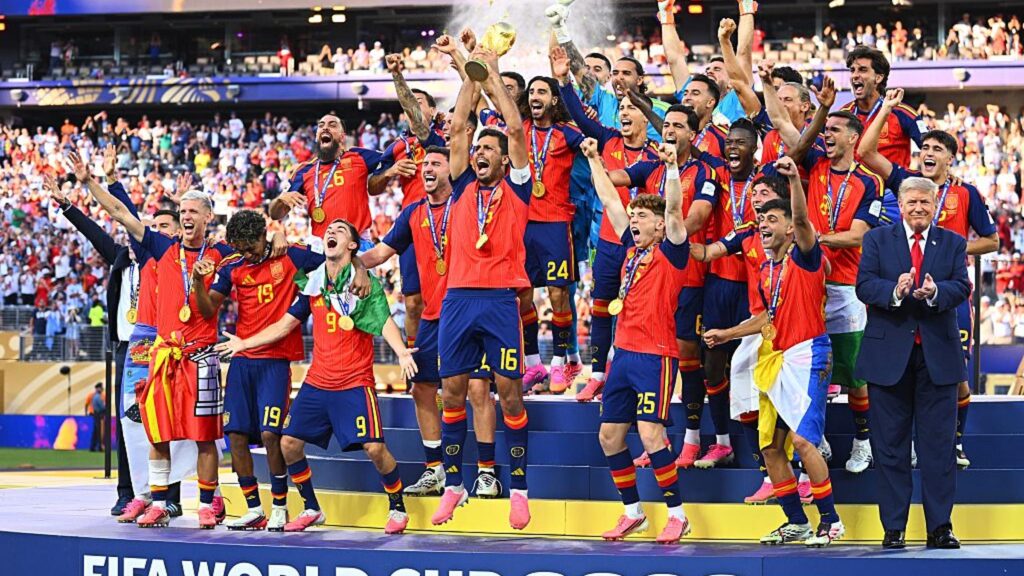
After the final whistle blew, and Spain won its second-ever men’s World Cup, closing out a 39-day North American soccer extravaganza, a handful of Spanish bench players ran to mob Ferran Torres, the substitute who scored the game-winning extra-time goal. Nico Williams, who assisted on Torres’ decider, and Lamine Yamal, now the third-youngest player ever to start in a World Cup final (and to win it), embraced on the New York New Jersey Stadium grass, before laying next to each other, on their backs, exhausted. (Yamal’s teammate Pau Cubarsí, named the best young player of the World Cup, is the fourth-youngest player to start and win a final). Marc Cucurella, the energetic defender with the huge curly hairdo we’ve grown so familiar with this summer, blew kisses into the crowd. Rodri, the Spanish captain and lynchpin, winner of the Golden Ball as best player in the tournament, placed both hands on his head, in joyous disbelief.
Justice just feels so good.
The World Cup final didn’t produce the sort of classic game fitting for an event that has served up so many delicious moments. But the result, a 1-0 extra-time victory for Spain over Argentina, felt like the only acceptable result. La Roja dominated the final in every conceivable manner. Spain had possession of the ball for 65% of the game, and connected on 842 passes to Argentina’s 458. Spain outshot Argentina, 20-2. La Albiceleste did not attempt a single shot in regulation; not a single Argentine shot met the target all game. (Spain’s goalkeeper, by the way, is named Unai Simón. You may not have heard his name much Sunday, but he still won the Golden Glove as the best keeper in the tournament.)
And yet, going into the second half of extra time, with Argentina down a man because of a second yellow card given to midfielder Enzo Fernández, the score remained 0-0. Argentine keeper Emiliano Martínez set a new record for most saves in a men’s World Cup Final, with 11, including a few diving stops that kept Argentina alive. Still, if the game finished 0-0, and Argentina won in a penalty shootout a game they had no business winning, that result could have set soccer back to the dark ages—in the U.S. at least. Every cranky American who still can’t get over the game’s lack of scoring, and rules that allow a crapshoot penalty-kick scenario to crown a quadrennial World Cup champion, would have fresh reason to gripe.
Thankfully, 33 seconds into the second half of extra time, Pedro Porro lofted a cross to Williams, who came on in the 75th minute for a spark. Williams brilliantly headed the pass back to Torres, his fellow sub, to knock in the game-winner. Argentina battled shorthanded, but the Porro-Williams-Torres connection was enough for Spain to lift the trophy; that trio will be toasted from Barcelona to Seville for decades.
President Donald Trump, one of the bold-faced dignitaries on hand—along with Mick Jagger, Jay-Z, Beyoncé, Timothée Chalamet, Matt Damon, Tom Cruise, Madonna, Victor Wembenyama, and the rest—presented with FIFA President Gianni Infantino the World Cup trophy to Spain. Infantino has been accused by some soccer fans of favoring Argentina throughout the tournament, while Trump, who lingered a bit too long in the championship photo, as his custom, has been at odds with Spain, recently calling the country “a horror show” and its leaders “bad people.”
On the pitch on Sunday, however, there was no denying that the Spanish players were the best.
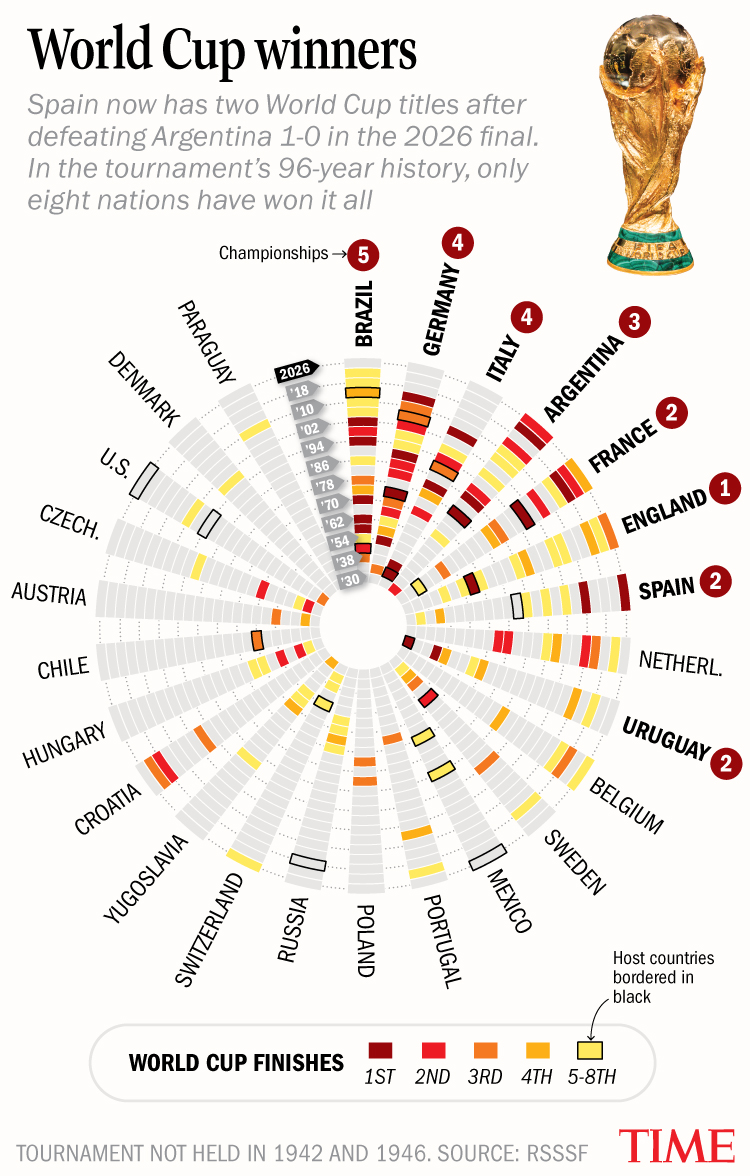
Still, Spain’s run to the World Cup title was impressive—the team conceded just a single goal all tournament long—but it won’t go down as spectacular. Analogizing global soccer teams to American champions—to contextualize the game for U.S. audiences who don’t follow soccer regularly—can admittedly come across as facile. But try one more on, please, for size. Spain is like the 1998 New York Yankees, one of the all-time winningest baseball teams propelled by a charismatic young star, Derek Jeter, and a host of other notable players who shined as a collective unit. Yamal, who only finished the World Cup with one goal, is Spain’s Jeter: he’s surrounded by fantastic talent who don’t quite rate as household names.
So the legacy of this 2026 World Cup will likely extend far beyond Spain’s victories. Three co-host countries—the U.S., Mexico, and Canada—coordinated in a politically heated environment to pull off a logistically tricky task. Stadiums were packed—80,663 people attended the final—and audiences were hooked, as the 2026 World Cup will go down as the most-attended and most-watched soccer tournament in history.
The event wasn’t all roses, for sure. The U.S. President, for example, inserted himself into on-field soccer business: the stunning reversal of Folarin Balogun’s red card, following a phone call between Trump and Infantino, and the U.S. team’s surprise collapse the next day against Belgium in the Round of 16, left a bad taste. Iran said it got a raw deal from a host country with which it is at war. Technological precision impeded the potential of inspiring victories from the likes of Iran, Croatia, and Egypt. Ticket prices were consistently absurd.
But more than any of this, we’re more likely to hold on to Norway’s Viking Row, Scotland’s enthusiastic Tartan Army, and the legit appreciation from foreign visitors of American customs like Texas BBQ and humungous stores. American cities scattered across the nation hosted World Cup base camps: the Algerian team and Lawrence, Kans., forged a delightful bond. Cape Verde, the smallest country ever to reach a World Cup knockout stage, played Cinderella: its 40-year-old goalkeeper, Vozinha, saved 7 shots against Spain and 8 against Argentina, the two World Cup finalists, and gained an enormous worldwide following as a result.
Kylian Mbappé finished with 10 goals—good enough to earn the Golden Boot as the top scorer in the tournament— including two in the wildly entertaining third place game on Saturday, which England won 6-4 over France. He now holds the all-time record for World Cup goals. Erling Haaland led Norway to its best World Cup finish ever, as America fell hard for the Striking Viking and vice versa. Haaland came home with a “Whiskey Racoon” he purchased in Dallas, and called Americans “kind of hilarious.”
And if this was Lionel Messi’s last World Cup—don’t put it past him to keep going—he exited like a legend. At 39 and already a World Cup champion, Messi scored his first-ever World Cup hat trick, finished with eight goals and four assists in the tournament, and keyed incredible comebacks against Egypt in the round of 16 and England in the semis.
Yes, in the final, Messi was mighty quiet. In extra time, he tried to get things going for his side: Messi dribbled toward the target, but while a cross against England found a teammate for a goal, against Spain it was deflected. Off a short corner kick, he lofted a ball in that sailed over the net. And in the final seconds, a desperate Argentina turned to Messi to deliver a long ball into the box from midfield, and create something, anything. But Simón, the Spanish goalie, was able to catch Messi’s soft ball with ease.
Argentina was done. Afterwards, Messi sat for a few minutes, alone, on the pitch, watching Spain celebrate, then looking away.
Even GOATs have their off days. So the final belonged to Spain. The 2026 tournament, meanwhile, truly belonged to the world. We’ll miss it.
The post Spain Finish Off a World Cup to Remember appeared first on TIME.