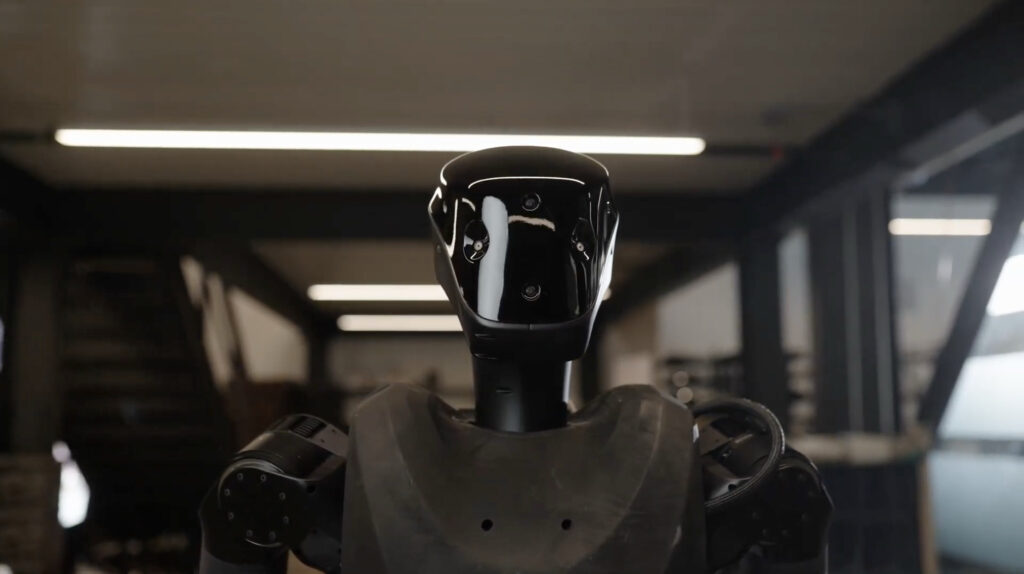
Looking for his next business, San Francisco entrepreneur Sankaet Pathak sought an idea that might change the future. He settled on building humanlike robots with weapons.
In May, his company, Foundation, released footage of its sleek Phantom robot loading a mortar. In the video, the robot moves gingerly — but Pathak says he can envision a future of autonomous weapons, with robots making quick decisions on the battlefield.
The launch of Foundation in 2024 was a radical step, given many in the industry’s long-standing opposition to letting autonomous devices decide where to attack without human sign-off and promises by other leading robot companies not to arm their creations.
But Pathak is part of an increasingly vocal group of Silicon Valley founders, investors and national security experts who see autonomous weapons not as the nightmarish killer robots of science fiction, but as a vital new frontier in military technology. Robots, in their view, could hone the military’s precision in combat, protecting civilians and friendly troops alike, and enable the United States to deter foreign adversaries.
“You cannot just always have this perspective of we’re not going to weaponize robots because no one else shares that,” Pathak said. “China doesn’t share that. Russia doesn’t share it.”
The rapidly improving capabilities of artificial intelligence — coupled with a push by the Trump administration to deploy new technology at the Pentagon — have made the once theoretical debate increasingly urgent. The military has boasted about how it has used AI tools to dramatically increase the pace of its strikes in Iran, and it already employs highly automated systems to defend against missile attacks.
The next step would be drones and robots that are initially activated by a human but that would then be free to pick and attack individual targets.
The Senate is considering a sweeping national security bill that would encourage the use of autonomous military systems, while trying to impose guardrails on the technology. The Defense Department, under an order from President Donald Trump, is in the midst of updating its policies on how to deploy AI-powered weapons that can kill.
The Pentagon did not respond to a request for comment. But in talks at the United Nations this year, American officials warned against global standards that might hamper innovation, saying that AI and automation can “make the use of force more precise and accurate.”
“Human judgment and control in armed conflict are often flawed, even when legally compliant, and the group should not develop a standard that stigmatizes innovation and hampers technological progress,” a U.S. official said, according to archived video.
To many critics, the rapid push represents one of the most dangerous applications of AI. Religious leaders, diplomats and human rights groups — along with many leading roboticists and artificial intelligence researchers — see a far darker future in which war spirals out of control.
Pope Leo XIV and U.N. Secretary General António Guterres have both recently spoken out against the development of autonomous weapons. This month Guterres called for the systems to be banned under international law, saying the idea of robots taking human lives was “morally repugnant.”
“Some decisions must remain forever human,” Guterres said in a speech in Geneva. “None more than taking a human life.”
The debate poses profound moral questions and hinges in many cases on a handful of loaded words like “appropriate” or “meaningful” that would define how much control and accountability remains with human commanders. Then there are a set of practical questions about the reliability of AI systems.
At the U.N., governments have debated a potential treaty to ban or limit autonomous weapons for over a decade, and the Pentagon has funded research on the ethics of robotic soldiers even longer. But the issue took on new urgency this spring, when Dario Amodei, the chief executive of AI firm Anthropic, sought guarantees from the Pentagon that his company’s system would not be used to power fully autonomous weapons.
The company said its AI model, Claude, was not yet reliable enough to make life-and-death decisions. Amodei himself has warned of a potential future in which swarms of AI-powered drones form an unbeatable army or are used to trail every civilian.
Trump officials demanded the freedom to use Claude for “any lawful purpose” and branded Anthropic a risk to national security.
Other leading firms, including OpenAI, agreed to keep working with the military. OpenAI said it had secured protections against its system being used in autonomous weapons. In a set of principles published this month, it said it would not support the use of its technology in systems that use force “without appropriate levels of human authorization and human-defined operational parameters.” (The Washington Post has a content partnership with OpenAI.)
The situation has created turmoil in the AI industry, where many researchers are opposed to their technology being employed in conflict. It prompted a wave of protests and a handful of resignations — including that of a top OpenAI robotics expert. Last week, protesters left body bags outside OpenAI’s San Francisco office in a demonstration against its work with the Pentagon.
In the wake of the fight between Anthropic and the Pentagon, Senate Democrats pushed to include limits on killer robots in a major annual defense bill.
“The Pentagon is moving toward deploying incredibly powerful AI technology without commonsense guardrails in place, which could have catastrophic consequences that make all of us less safe,” said Sen. Kirsten Gillibrand (D-New York) in a statement.
The Senate Armed Services Committee rejected the strictest limits proposed by Gillibrand. The bill now calls on the Defense Department to “maximize” the use of AI and autonomous systems but ensure that responsibility for using force remains with human commanders.
The Trump administration has placed the emphasis on speeding the adoption of AI-powered military systems, with the Pentagon working to rewrite a Biden-era internal policy on autonomous weapons. Last month, Trump directed officials in a national security memorandum to “account for the rapidly evolving capabilities of AI systems,” blaming past presidents for making it too difficult for troops to get their hands on cutting-edge technology.
“Under my Administration, the United States can and will responsibly accelerate the use of AI across intelligence and warfighting domains in line with American values,” Trump wrote.
To Pathak, it makes little sense to limit how to deploy this emerging technology.
“Our goal is to protect innocent people and make the world more prosperous and peaceful,” he said. “You don’t get there by getting bogged down by arbitrary lines you draw. You get there in my opinion by being strong.”
After trying his hand in financial services — his previous business collapsed into bankruptcy — Pathak launched Foundation. Its name alludes to science fiction author Isaac Asimov, who laid down three golden laws for how robots should behave in the 1940s. Asimov’s first rule required robots not to harm humans or allow them to be hurt by failing to act.
Pathak is focused on the second half of that principle, arguing that armed robots will eventually be able to help protect humans. The company, which has the backing of the president’s son Eric Trump, says it holds a $24 million contract with the Pentagon and has tested its robots in Ukraine.
Pathak envisions giving Foundation’s armed robots increasing autonomy, tapering the level of human involvement in situations where speed is of the essence, like when a robot has less than a minute to act but could save lives.
Already, the American military relies on highly automated weaponry to knock out incoming missiles, using systems like the ship-based cannons known as the Close-In Weapon System.
Michael Horowitz, who served as a defense official during the Biden administration, said many of the objections to autonomous weapons fail to take into account the reality of the technology already in use by modern militaries. Horowitz said the U.S. military would employ more advanced autonomous weapons in circumstances where commanders had made the decision to use force and had legal clearance.
“The last point of human responsibility changes, but human responsibility never goes away, at least according to Pentagon policy,” he said.
But many others in the industry have promised not to turn robots into killing machines. After founding Clearpath Robotics in 2009, Canadian engineer Ryan Gariepy saw the era of armed robots on the horizon. Five years later, he led his company to become the first in the industry to join an international campaign against autonomous weapons.
To help people get a grasp of the stakes of letting AI make life-and-death decisions, Gariepy poses a less weighty question: Would they let a robot manage all their email correspondence?
“The technology is not ready yet,” he said. “They fail in unexpected ways.”
The post Silicon Valley is embracing armed robots. Washington is making room. appeared first on Washington Post.