“Hiroshima-like” was the way Dave Stone, a 52-year-old entertainment industry executive, described the aftermath of the California fire in Altadena in January 2025.
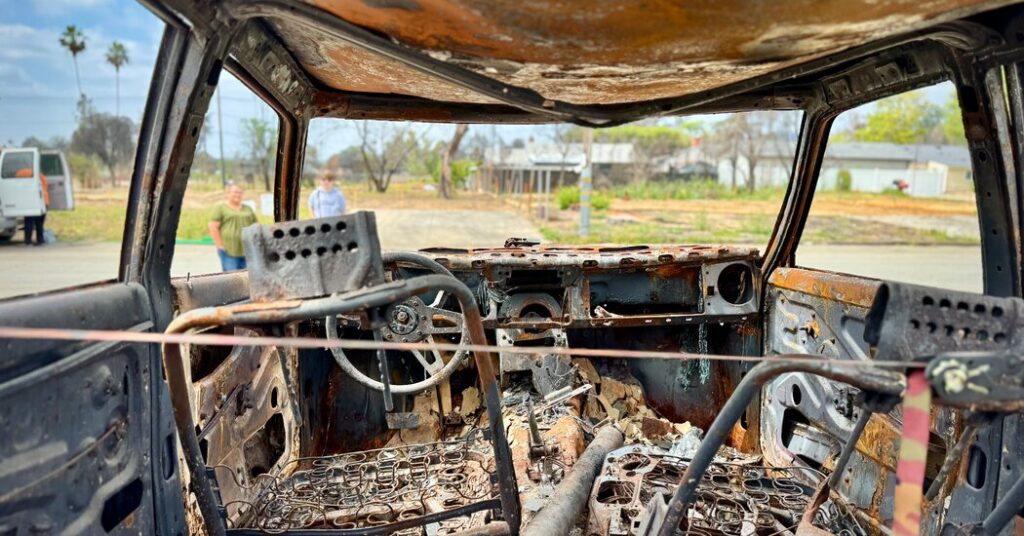
The fire, which was part of the Eaton blaze, left a huge swath of the once charming part of unincorporated Los Angeles County with little more than brick chimneys, rubble and burned-out cars. Thousands of burned-out cars.
In the context of the Eaton disaster that claimed 19 lives and destroyed thousands of structures, it might seem frivolous to give ruined cars more than a passing mention. But this is Southern California, a center of North American car culture. So it is not surprising that for a subset of fire survivors, the city’s love of cars played an outsized role in the recovery process.
“Cars were one of the ways people bonded and dealt with the trauma” Mr. Stone said, and they were also a means to quickly get back some semblance of life before the fire, in far less time than it took to rebuild a house or a business.
His house survived the fire. As soon as it was safe, he began documenting the aftermath, starting an evocative and deeply emotional Instagram feed, which developed a devoted following. Citing survivor’s guilt and love of his neighborhood, Mr. Stone used his newfound reach on social media to build a community of Altadena car enthusiast survivors.
In the rare cases when it was possible, members of the informal group restored burned cars. When it wasn’t possible, they held fund-raisers and helped locate replacement cars for each other. Some sentimental owners retained the burned-out hulks of their cars and others even turned the wreckage into art.
To comprehend this, it helps to understand the Southern California car culture.
“In L.A., you spend so much time in your car, sometimes it’s your only partner, you get a sentimental attachment to your car, sometimes it’s the only thing you have for therapy,” said Hipolito Cisneros, an Altadena survivor.
His 1972 Datsun 510 was the first car that he owned.
“I saved my checks from a summer job, and I bought it in the summer of 1992 for $625,” Mr. Cisneros said. “I drove it all through high school, and it was stolen while I was at football practice during my senior year. When I recovered it from the police impound lot, it was missing its carburetors and lights, so we tied a rope to it and towed it back home. Later, I bought the missing parts and got him running again. He was my buddy, he meant so much to me. I tried to go back for him during the evacuation, but he was already engulfed, along with my home, small business and memories.”
About two months after the fire, Mr. Stone started a small car meet for friends who were Altadena survivors at a local coffee shop. Mr. Cisneros started attending. The meet has since grown to over 200 cars.
Mr. Cisneros described it as therapy, where survivors could talk about things other than cars, like the process of rebuilding homes and dealing with insurers. Inevitably though, discussions would return to the cars. For those considering a restoration, it became an opportunity to network, and Mr. Stone acted as a frequent go-between.
“I had people come to me and say, ‘I think I can restore my car.’ ‘Oh, well you should know Ken Sakamoto, who does body work,’” Mr. Stone said.
More often than not, he said, the news was not good. Metal body panels were generally too warped or too compromised to ever be fixed. When replacement was the only option, the group of survivors combed social media and side streets all over California to find cars that were as close as possible to ones that had been destroyed.
Mr. Stone organized numerous fund-raisers to facilitate this.
“We either set up a GoFundMe or sold T-shirts,” Mr. Stone said. The shirts were emblazoned with the phrase “NOT EV.” The shirts were emblazoned with the phrase “NOT EV.” It wasn’t a jab against electric vehicles, but rather a local nod to the E.P.A.’s practice of spray painting “NOT EV” on internal combustion cars damaged in the fire as an indicator that there was no lithium battery inside.
As a result of these fund-raising efforts, a 1972 Datsun 510 will reside under Mr. Cisneros’ carport when his house is rebuilt. The community located and bought the replacement car in Eureka, Calif. Mr. Cisneros still has the remains of his original car, which is stored at a friend’s house. He couldn’t bear to part with it.
Restorations of fire cars have been rare. The effort involved is heroic and expensive, generally exceeding the value of the finished car. Salvador Rivas is a co-owner of Pasadena Classic Car, a restoration shop south of Altadena. He has restored two fire cars, a 1957 Chevrolet Bel Air and a 1972 Chevrolet C10 pickup truck. The C10 now looks like new. Over seven months, warped metal was straightened, glossy paint was applied and a new interior installed.
“We wanted to bring something back to life and show what we can do,” he said.
The final cost was well into six-figures, likely exceeding the value of the truck. Mr. Rivas’s approach to the Bel Air was entirely different.
“I normally like shiny glossy paint, but for the Bel Air, I decided to leave it the way we found it,” he said.
That meant applying a protective clear coat over the burn damage and even the “NOT EV” designation.
“The car looks like it went to hell and came back,” Mr. Rivas said.
For years, Kevin Koeper had his eye on a 1962 Porsche 356 that sat under a tarp in Altadena. It was similar to a car his father had owned. Mr. Koeper even left a note on the old Porsche asking the owner to consider selling it to him. He never got a response until after the car had burned.
The owner was desperate to move the car off his property because it was impeding his rebuilding efforts. Mr. Koeper bought the car. Ironically, his earlier note offering to buy the car was still inside. Like Mr. Rivas, he plans to restore the car mechanically while leaving the exterior as found.
“If I paint it, it’s just another restored 356,” Mr. Koeper said. “If I leave it, suddenly the car becomes a representation of the community, a memorial that shows something good can happen from something devastating.”
Like turning the cars into art. Ben Tuna is a second-generation stained-glass artist. Rather than restoring fire-damaged cars, he puts stained-glass into some of the irreparable ones. He sources the glass from salvaged church demolitions in areas including Illinois and Germany.
He’s turned the glass panels into mosaics and fitted the pieces into the empty window openings of the cars. He said he found a connection between the cars and the resurrection themes in the stained glass.
“I really believe that art has the power to restore hope and inject some humanity into what is a fairly cutthroat city,” he said of Los Angeles.
That sense of renewed humanity may partially account for the actions of Mr. Stone.
“I had survivor’s guilt,” he said. “My heart broke for the people who had lost everything, and I wondered why I didn’t do more to save other people’s property even though I know I was busy trying to save mine. Nature hates a vacuum though, and what was I going to fill that hole with? Fill it with connectivity. Build a community around a tragedy.”
The post Last Year’s California Fires Destroyed Many Cars. Their Owners Are Still Recovering. appeared first on New York Times.