“Nobody ever wins a fight.” Dalton, the philosophical bouncer played by Patrick Swayze in the 1989 cult classic “Road House,” offers these words of wisdom when he checks himself into the hospital with a knife wound. He knows whereof he speaks.
When it comes to the Dance of the Dragons, it seems Dalton is right. In this week’s episode of “House of the Dragon,” the war is not going well — not for the Blacks; not for the Greens; not for gold cloaks, white-armored kingsguard or blue-eyed princes; not for anyone. Knowing that the dragons are all long vanished by the events of “Game of Thrones” has given us a clue about the end result already, but right now, it truly does feel as if nobody were going to win this war.
That’s OK by Ser Criston. The kingsguard commander and hand of the king gives up hope when his enemies, led by the canny young Lord Oscar Tully (Archie Barnes) and the aged Lord Roderick Dustin (Tommy Flanagan), beat them at their own guerrilla warfare game, complete with burned bridges and booby traps that gruesomely maim the Greens’ horses.
After leading his surviving men on a death march that recalls “Apocalypse Now” or “Aguirre,” Criston, his face and clothing streaked with camouflage paint, announces to his despairing comrade Ser Gwayne Hightower that he intends to mount a suicidal attack on the Blacks’ superior forces. Tired of a conflict in which his accomplishments as “the realm’s greatest warrior” are dwarfed by dragons that leave footprints bigger than a human body, tired of service to lords and ladies who discard him when he is no longer useful, Criston intends to die his own man.
Well, mostly his own man. His heart still belongs to someone else. “They will sing songs of it,” he says of his “glorious” impending death, “and Queen Alicent herself will hear them.”
She will if she’s lucky. Alicent spends this episode desperately trying to figure out how she and her daughter, Queen Helaena, will survive when Queen Rhaenyra discovers that Helaena is pregnant with a potential rival for the throne. When Grand Maester Orwyle provides them with an abortifacient tea, Helaena refuses to drink it, and Alicent is forced to quaff it herself to avoid the suspicion of Lady Mysaria.
But the so-called White Worm did not become mistress of whisperers for nothing. She personally stops Alicent and Helaena from escaping the Red Keep while dressed as maids. Alicent tells Mysaria that her beloved Rhaenyra will ultimately turn to Daemon over her (Alicent ought to know!), and seemingly convinces the spymaster not to reveal the escape attempt.
Their fortunes improve with feline intervention. By now the Red Keep is crawling with the cats that Rhaenyra and Alyn of Hull brought in to deal with the rat problem, and one such animal reveals a hidden passage behind the wall of their room. But the passage leads to a brick wall, and when the cat knocks over Helaena’s lantern, the two women are literally left in the dark.
Alicent’s sons are faring little better. Aegon has finally found the limits of Lord Larys’s tolerance for his incessant whining. Larys gives him a vicious dressing down, saying Aegon has squandered every privilege he was given. “You could have risen to greatness, but you trampled your birthright in the mud,” he says. “You were a terrible king, but worse than that, you are a terrible man.”
I was genuinely surprised Aegon didn’t stab Larys to death with that dragon’s scale he’s been hanging on to. Perhaps he realized his unlikely, unhappy rescuer was right.
Things turn around somewhat for Aegon back in camp. There, he and Larys discover that Tyland Lannister survived the Battle of the Gullet after being tossed overboard by Sharako Lohar. Now the lord of Casterly Rock and one of the few people who know where the crown’s money is hidden, he can fund their escape to Essos. True, Janos, the soldier who runs the camp, discovers Aegon’s crown, but his glee over the discovery is short-lived: Aegon murders him as Larys watches, with an unmistakable “There he goes again” look on his face.
Aegon’s younger brother Aemond, meanwhile, is the realm’s most wanted man. (Including by Aegon, who vows to kill him.) The witch Alys Rivers fends off some bounty hunters, but when others attempt to sexually assault her, Aemond springs into action, suddenly well enough to wield a sword and kill all the attackers single-handedly. Though he has no idea who, or what, Alys really is, he knows she has treated him with a kindness and attention Alicent never showed him. When she cradles his head against her chest to comfort him after a nightmare, he even calls her “Mother.” Considering what we’ve watched Aemond do with his real mother this season, that’s an … interesting word choice.
Daeron, the youngest of Alicent’s three sons, is at the mercy of an even more dubious parental figure. Alicent’s cousin Lord Ormund is so mercurial that it constitutes a kind of emotional abuse. He blows up when Daeron beats him at the chess-like board game Cyvasse … then chides the anxious boy for apologizing for victory.
Meanwhile, coins with Daeron’s face are being used by Ormund to pay for a violent insurgency in King’s Landing, as unseen assassins maim and murder members of the city watch in broad daylight. This lends ammo to Daemon in his feud with Mysaria over whether their meager money should be spent on the gold cloaks or the small folk.
Eventually the killings become too numerous to ignore. Rhaenyra taunts Daemon for what she perceives to be his cowardice in prioritizing the city watch over the hunt for Aemond, which he has left to his daughter Baela and her uncle Alyn of Hull. (The two appear to be forming a love connection, in the grand incestuous Valyrian style.) But Rhaenyra finally agrees that she should have paid their security force more attention (and money). This further marginalizes Mysaria on a small council now stacked with nobles who look down on her as a commoner and former prostitute. (Perhaps she keeps Alicent’s secret because she may need a backup plan if she falls out of the Black council’s favor completely.)
The charismatic Daemon rallies the troops even though they’re not being paid, filling their heads with dreams of global conquest. That does them no good against Ormund’s assassins, who kill several gold cloaks, including their commander, Ser Luthor, inside their own headquarters. Then the killers mutilate and artfully arrange the corpses around a table, “Hannibal”-style, writing “A FEAST FOR TRAITORS” on the wall in blood. Even the gleefully violent Daemon is shocked by the butchery.
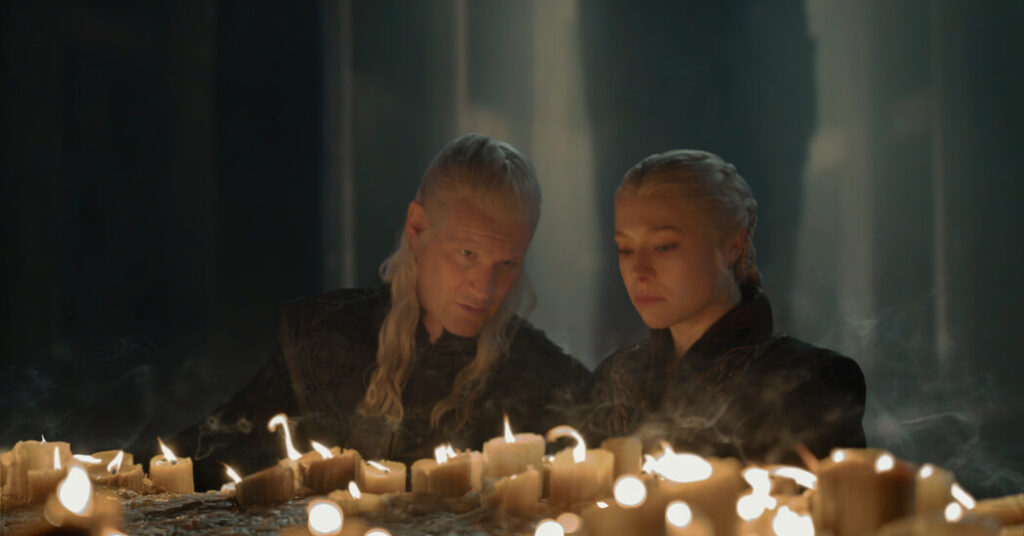
Rhaenyra is right to believe there is a mastermind behind the violence in the city, as Daemon confirms by torturing one of Lord Ormund’s agents. What worries me is the way she talks about it, by the candlelight of the Great Sept of Baelor. Wailing at the unfairness of the gods, who chose her to rule and then place obstacle after obstacle in her path, she sounds both grandiose and self-pitying.
“Something stirs against me,” she says in High Valyrian. “Something crouched, something formless. I feel the dread of it. A cold presentiment.” Presentiment, or paranoia? An autocrat at war with external enemies is bad enough. An autocrat who is fixated on phantasmagorical enemies within as well … that is how empires fall.
The post ‘House of the Dragon’ Season 3, Episode 5 Recap: Under Pressure appeared first on New York Times.