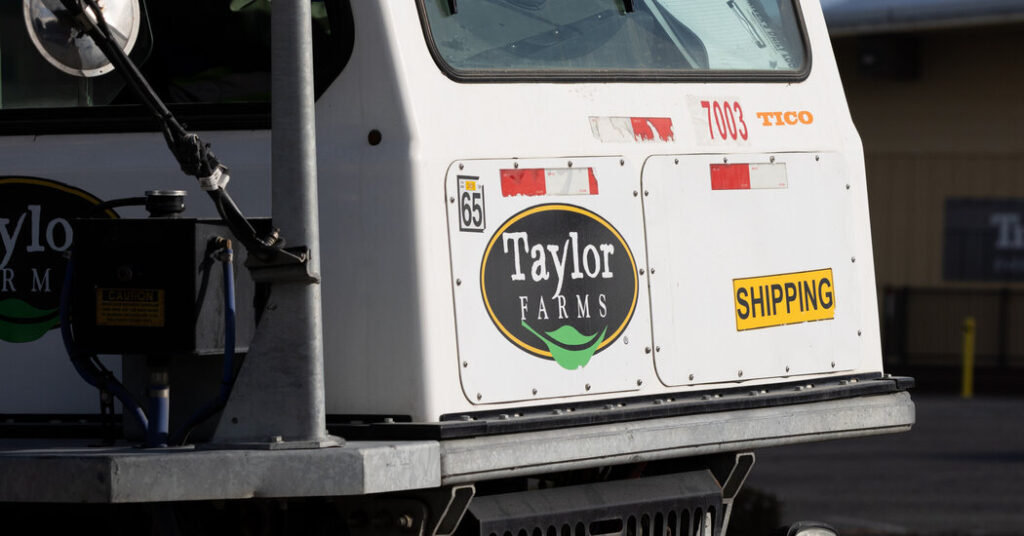
The Food and Drug Administration said on Monday that strong evidence still tied Taylor Farms to the continuing cyclospora outbreak, despite the agency’s retraction on Sunday of what it had said was a positive test of a lettuce sample for the parasite.
The announcement followed days of confusion for consumers after Taylor Farms voluntarily recalled iceberg lettuce from 27 states, but did not offer more information about how people would be able to tell whether they had bought the contaminated product. The F.D.A.’s retraction of the test result only enhanced the uncertainty.
Such a “flip-flop” in messaging was unusual for the agency, said Susan Mayne, a former top F.D.A. official who is now an adjunct professor of epidemiology at Yale’s School of Public Health. In her more than eight years at the F.D.A., Dr. Mayne said, she could not recall a time when such a reversal had happened.
That said, cyclospora is “one of the most difficult pathogens to detect in agricultural products,” said Kalmia Kniel, a microbiologist at the University of Delaware who conducts research on the parasite.
False positives are common in tests for cyclospora, she said, because there are often so few oocysts, or eggs, present in food samples, and other compounds in the food itself may interfere with the test. The test may also pick up DNA from other microbes that are similar to cyclospora, she said.
It is also possible that the F.D.A. tested a part of the lettuce batch where the parasite was not present, said John Guzewich, who worked on food-borne disease outbreaks at the F.D.A. from 1997 to 2011.
Cyclospora only grows in human hosts, and testing human feces is the most accurate way to find it, said Felicia Wu, a professor of food safety, toxicology and risk assessment at Michigan State University.
But investigating the source of an outbreak requires that investigators search for evidence of the parasite in food and water samples. The test the F.D.A. uses to do that is a polymerase chain reaction (or P.C.R.), which is “the best” scientists have to test food samples for the parasite, despite it not being “100 percent,” said Keith R. Schneider, a professor of food safety at the University of Florida.
Testing food samples for a pathogen is just one part of an outbreak investigation, Dr. Mayne said. Investigators also interview sick patients to identify what they ate and drank during the days and weeks before they became ill, and then look for the common denominator (lettuce, in this case). They then try to trace the food in question back to a supplier or grower.
With the current cyclospora outbreak, Dr. Mayne said, this investigators have a “robust” amount of this type of evidence linking the cases to Taylor Farms’ lettuce.
Sometimes investigators never get a positive test result for a pathogen in a food they believed caused an outbreak, Dr. Mayne said.
It is possible that the products that caused the illnesses in the current outbreak are “long gone,” having already been eaten or thrown away, Dr. Schneider said. And going back to where the lettuce was grown to try to get a positive test from the plants themselves or from water samples, may not yield anything because the field has likely already “been harvested and plowed under, as farmers prepare for the next crop to be planted,” he said.
Taylor Farms said in a statement on Sunday that the F.D.A. had “not identified a single positive product test result for cyclospora.” But based on the information provided by the F.D.A., the company has recalled all of the iceberg lettuce it sourced from central Mexico.
The F.D.A. said the investigation was still going on and that the agency was continuing to collect and analyze product samples. For now, lettuce remains the primary culprit.
If Taylor Farms lettuce is in fact the main cause of the outbreak, cases should begin to plateau shortly, with rising numbers now representing older cases that have already resolved, said Donald Schaffner, chair of the department of food science at Rutgers University.
But some experts said the contradictory messages risk further undermining faith in the public health system.
“The big concern I have about the flip-flop is also the impact it has on trust,” Dr. Mayne said. “Changing such an important determination certainly raises questions,” she said. That “is most unfortunate.”
The post Despite ‘False Positive’ Test, Taylor Farms Is Still Focus of Cyclospora Investigation appeared first on New York Times.