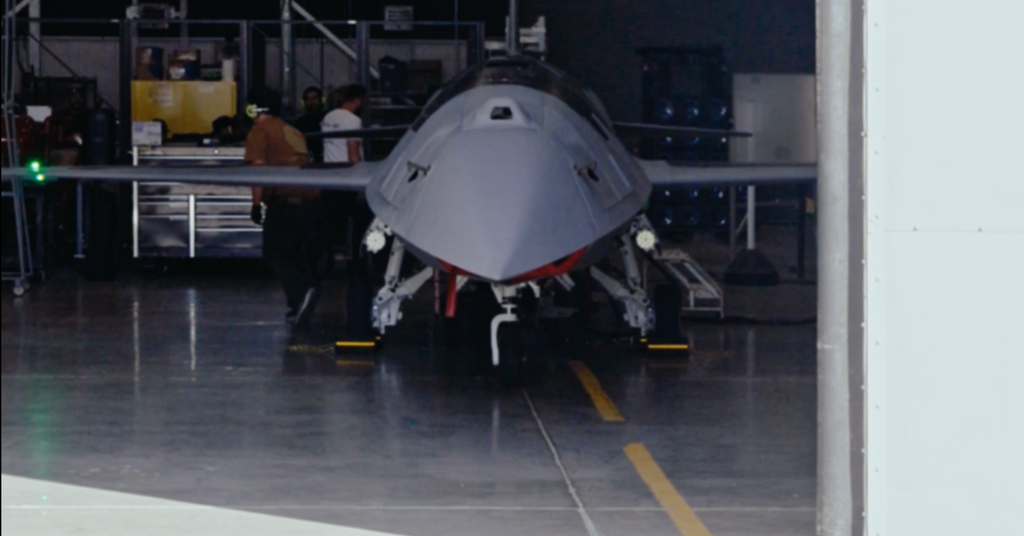
On a clear afternoon this month, high above the Mojave Desert, an A.I.-powered drone launched a missile in a test that could reshape modern warfare.
Since the dawn of the jet age, the U.S. military has used the isolation over this stretch of sand to push secret, experimental aircraft to their aerodynamic and technological limits. It’s doing the same today: fine-tuning machines capable of engaging in aerial combat with barely any human intervention. These drones’ flight is controlled not by a pilot, not by human remote control, but entirely by onboard software. It’s a historic advancement in drone technology that aims to incorporate artificial intelligence into everyday war-fighting.
Today’s conflicts are increasingly defined by unmanned weapons, delivering destruction over battlefields in Ukraine, Iran and Sudan. But in almost all these cases, there is a human operator sitting somewhere, steering each robot toward its target.
The two types of next-generation drones being tested over Southern California today, built for the Air Force by Anduril and General Atomics Aeronautical Systems, can fly entirely on their own. They make hundreds of split-second decisions to maneuver, evade and attack enemy targets, based upon countless hours of flight data and computer processing. A human is involved at just a few key moments in their flight: to program the drone’s mission, to start and stop it and to decide whether or not it should launch a weapon. Late last year, the companies’ drones flew for the first time. Anduril fired its first missile two weeks ago, and General Atomics says it is not far behind.
The Air Force program is part of a sweeping overhaul in how the American military prepares for war. Defense Secretary Pete Hegseth said in January that he intends to make the military “an ‘A.I. first’ warfighting force across all domains.” Throughout the Pentagon, Uncle Sam-style recruitment posters with Mr. Hegseth’s likeness declaring “I want YOU to use A.I.” are plastered on the walls. His department has requested $54.6 billion in next year’s budget for the Defense Autonomous Warfare Group, or DAWG, a body recently set up to coordinate all autonomous weapons programs across U.S. forces.
The United States isn’t alone in this pursuit. Around the world, and particularly in China and Russia, an arms race is emerging to mass-produce autonomous, A.I.-operated war machines. President Vladimir Putin of Russia declared in 2017 that whoever leads in A.I. “will become the ruler of the world.” President Xi Jinping of China has poured billions of dollars into A.I. development for the country’s military. Prototypes of smaller, rudimentary A.I.-assisted weapons have already been reported in action in Ukraine, Libya, Azerbaijan and Gaza. In a few years, we could see swarms of self-guiding robots not only in the skies, but also at sea and on the ground.
As the world’s militaries race to weaponize artificial intelligence, the international community has failed to establish limits on its use. The United Nations has spent a decade deliberating how to restrict autonomous weapons — a rare instance of anticipating a global threat before it arrives. Yet these efforts have yielded no binding rules or codes of conduct.
Instead, global leaders are accelerating toward an era of automated warfare. The fear of body bags has been one of the greatest deterrents to conflict in history. Mass-produced, expendable robots do not carry the human or financial costs that have tempered the urge to go to war for centuries.
“Right now, we’re racing in the dark,” said Jack Shanahan, a retired Air Force lieutenant general and former director of the military’s Joint Artificial Intelligence Center. “No one is talking to one another about the technology their nations are developing, and there’s an incentive to rush it into the field. I do think, unfortunately, something may go horribly wrong before it gets better.”
It’s difficult to overstate how fundamentally drones have revolutionized modern conflict. After the Sept. 11 attacks, Congress handed the president unilateral authority to take military action against anyone and any nation he deemed responsible. Technology soon caught up with the mandate of nearly unconstrained presidential power. Successive commanders in chief opted for missile-firing remote-controlled drones as their weapon of choice in the new war on terror.
Humanitarian and civil rights groups have spent the intervening years criticizing combat drones for lowering the threshold of war, creating a means for pilots sitting in front of computer screens to kill people in faraway countries without putting Americans in harm’s way. Despite the outcry and untold thousands of civilians killed and injured, open-ended drone wars became politically acceptable to much of the American public after Sept. 11, not just in Iraq and Afghanistan, but also in Yemen, Pakistan, Somalia, Sudan, Syria, Nigeria and, most recently, Iran.
The Air Force’s Collaborative Combat Aircraft program, as the A.I. drone program is called, aims to have more than 150 robotic wingmen flying alongside manned fighter jets by the decade’s end. For now, the goal is for the drones to be able to fight other aircraft. But software engineers are already at work developing other types of missions that can be installed on the drones, just as you would swap one app for another on your smartphone. Soon, an autonomous drone could carry out bombing runs on ground targets, perform reconnaissance overflights, conduct electronic warfare to fry enemy air defenses or simply serve as a decoy to lure enemy fire away from piloted planes. “This is stuff that’s never been done before,” said Jason Levin, a senior engineering executive at Anduril.
The Pentagon believes the technology will make war more efficient, cost-effective and decisive. Analysts inside and outside the government argue that any military that wields automation and A.I. will be able to identify enemy weaknesses, process intelligence data and share it among troops faster than any army of humans possibly could, giving that military the upper hand in combat over adversaries.
During the war in Iran, for instance, an A.I. program condensed the time it took to identify and strike a target from days to minutes, resulting in 1,000 targets hit within the conflict’s first 24 hours. It remains an open question whether A.I. was involved in the U.S. airstrike on a school that killed at least 175 people, many of them children. If it was, it would be the highest-profile case of civilian killings involving the technology.
Turning over the bloody business of warfighting to self-thinking machines comes with obvious risk. Algorithms can be wrong, be corrupted or result in unintended consequences. And machines, of course, aren’t capable of making ethical choices. A military officer deciding to strike a target typically has years of training and combat experience. What if an A.I.-controlled drone flying a future mission misidentifies a passenger jet as an enemy plane and targets it? Is the military responsible for that failure? Or the defense firm that coded the software?
For now, the drones are built to keep humans engaged at key junctures to avoid such catastrophes. This makes them “semiautonomous,” according to Col. Timothy Helfrich, who oversees the C.C.A. program for the Air Force. In their current design, the final decision to approve a missile launch will come down to a human pilot, whom Colonel Helfrich referred to as a “quarterback.” That person will also manage the mission in real time with the option to abort if anything goes awry. But many worry this won’t always be the case. As the technology improves and becomes more reliable, the military’s incentive to shorten the “kill chain” — finding, locking on to and striking targets on the battlefield — could one day outweigh the imperative to supervise the drones’ work during a time of war.
Colonel Helfrich and other U.S. military leaders are quick to dismiss the idea that the handoff of war to machines is inevitable, citing the Defense Department policy on autonomous weapons, known as Directive 3000.09, that requires the involvement of a human to “exercise appropriate levels of human judgment over the use of force.” But while the directive defines what an autonomous weapon is and states that a rigorous senior review process is necessary before one is deployed, for now, there’s nothing stopping the design, development and production of these fully automated weapons.
With so many blinking warning signs, why is the military pressing ahead on such a short timeline? The Air Force sees autonomous drones as a low-cost way to address an immediate problem: its dwindling number of fighter jets. The service now has about 5,000 aircraft — fewer than at any point in its 79-year history — many of which aren’t battle-ready. As Beijing continues to add new antiaircraft missile batteries, fighter jets and its own autonomous drones, the United States understands the need to quickly replace its vulnerable Cold War-era warplanes. If it can build a large fleet of robotic drones at a fraction of the cost of current fighter jets, it can maintain its formidable presence across the globe for decades to come, the thinking goes.
The nearly $1 billion that the Air Force wants for the C.C.A. program next fiscal year is a pittance compared to the cost of high-end fighter jets, which war planners see as continuing to play a prominent role in retaining military dominance. The Air Force wants to integrate at least 1,000 autonomous drones, at an estimated cost of around $25 to $30 million apiece, into its operations, with the first handful produced next year.
One of the firms making drones for the program, General Atomics, based in Poway, Calif., has been selling drones to the U.S. military for decades. On a sweltering morning in July, its YFQ-42A Dark Merlin drone sat under a sand-colored shelter blotting out the Southern California sun. Beads of sweat dotted the brows of the General Atomics and Air Force maintenance crews at the remote airfield near Palmdale, Calif., as the temperature inched toward 100 degrees.
It’s not often you see military personnel working shoulder to shoulder with defense contractors on prototypes, but it’s one of the exceptions the Air Force is making on this project as it rushes to get the drones in the air. The quicker humans trust the machines, the quicker they can be assimilated into the battlefield. “The Air Force needs to have 100 percent assurance in the aircraft if they’re going to allow pilots’ lives to depend on it,” said Mike Atwood, head of advanced programs in General Atomics’ aeronautical unit.
Just a half-hour drive away across an expanse of high desert, at the foothills of the San Bernardino Mountains, lies the Victorville airport. Here, technicians were tinkering with the other drone in the program, the YFQ-44A Fury, built by Anduril. The software-centric upstart based in Costa Mesa, Calif., is eager to add the combat drone program to its growing list of lucrative Pentagon contracts. In May 2025, it partnered with Meta to build virtual reality devices for the U.S. Army. Two months later, it won a $100 million contract to build the Army’s command-and-control software. But it seeks a larger production contract from the military.
In a gamble rarely seen in the defense industry, the company has already constructed a one-million-square-foot production factory outside Columbus, Ohio, to mass-produce the YFQ-44A — with just a handful of confirmed U.S. military orders — in hopes that the company will either win a bigger Air Force contract or sell the drones to other governments. The if-we-build-it-they-will-come attitude runs counter to the ethos of larger weapons manufacturers, which typically shy away from investing without a guarantee of financial returns. “We want to move fast, and so does the Air Force,” said Mr. Levin, Anduril’s engineering executive. “We’re all willing to accept some risk if it means we’re making up for time on the schedule.”
The pressure to race ahead is palpable. China displayed several autonomous drones at a military parade in September, while Russia and Ukraine have actively fielded A.I.-assisted drones during the years they’ve been at war. France, Germany and Spain are moving ahead on their own robotic wingman programs amid Mr. Trump’s repeated public upbraiding of NATO. India, Israel, Australia and other nations already have A.I. military programs, as will many more nations that can afford it.
The looming challenge for the United States is how to fast-track this technology while balancing the safety and ethics issues with other nations. All weapons are subject to existing prohibitions and restrictions under international humanitarian law. But autonomous weapons raise novel concerns. Humanitarian groups say it’s morally bankrupt to hand over lethal action to machines, no matter how advanced. Can technology reliably differentiate adults from children, or soldiers with guns from TV journalists with camera equipment, or a truckload of fighters from a truckload of war-injured? Can it ascertain if someone is surrendering?
Questions like these prompted the International Committee of the Red Cross to call for new, binding prohibitions and restrictions on the development and use of these systems, calling it “an urgent humanitarian and legal priority.” That message has found a growing audience. In November, 156 countries signed a U.N. General Assembly resolution expressing deep concern over the risks of A.I.-enabled weapons, believing they could lead to unpredictable escalations of conflict. Not surprisingly, the United States, China and Russia were among the minority of countries that declined to support the resolution. On July 6, at the first Global Dialogue on A.I. Governance in Geneva, U.N. Secretary General António Guterres said: “Our institutions were built to govern machines that follow commands. They are not ready for machines that decide. And some lines, once crossed, cannot be uncrossed.”
Militaries have advanced the technology so quickly that it seems unlikely that an outright abolition of autonomous A.I. weapons is achievable. However, there are practical paths to create international red lines that will make them safer — for instance, barring such systems from independently selecting and firing on human targets. Another sensible mandate would be to ensure militaries have a human in the loop in any lethal operation to stop it if and when things go haywire. A third would be a prohibition on using the systems for any strike that put civilians or critical civilian infrastructure at risk.
Something must be done. The Trump administration has worked to roll back Biden-era guidelines for safety controls on A.I. development and use in the military. In February, it threatened to bar the tech start-up Anthropic from working with the military because the firm wouldn’t allow the Pentagon to have uncontrolled access to its A.I. software, specifically to control autonomous weapons. In June, Mr. Trump issued a National Security Presidential Memorandum that both seeks to accelerate A.I. adoption in federal agencies and orders the Defense Department to update its policy on autonomous weapons.
In Washington, there is growing recognition that the United States is as vulnerable to this budding technology as every other country. A bill introduced last month by Senator Mark Kelly of Arizona would turn the language of the Defense Department’s 3000.09 policy — which is a department guideline and subject to change — into federal law. Another bill introduced in June by Senator Kirsten Gillibrand of New York not only requires human oversight on conventional weapons that use A.I., but also ensures nuclear command and control does as well.
Congress should pass both, and the Trump administration should join the U.N. secretary general and the International Committee of the Red Cross in their calls for a new international treaty to be concluded by year’s end on autonomous weapons systems.
We’re not far from the day when one state’s autonomous weapons will be capable of shooting at its adversary’s autonomous weapons. And once that possibility exists, there is a very real risk that it could happen by mistake, or by misunderstanding. As in the doomsday nuclear scenarios of the Cold War, the world could find itself in an escalatory exchange that could quickly spiral out of control — but this time with limited human oversight.
The age of A.I. is already here. It’s up to humans to address how and when it can be used before machines dominate the battlefield.
The Times is committed to publishing a diversity of letters to the editor. We’d like to hear what you think about this or any of our articles. Here are some tips. And here’s our email: [email protected].
Follow the New York Times Opinion section on Facebook, Instagram, TikTok, Bluesky, WhatsApp and Threads.
The post A.I. Drones Are Coming. We Are Not Ready. appeared first on New York Times.