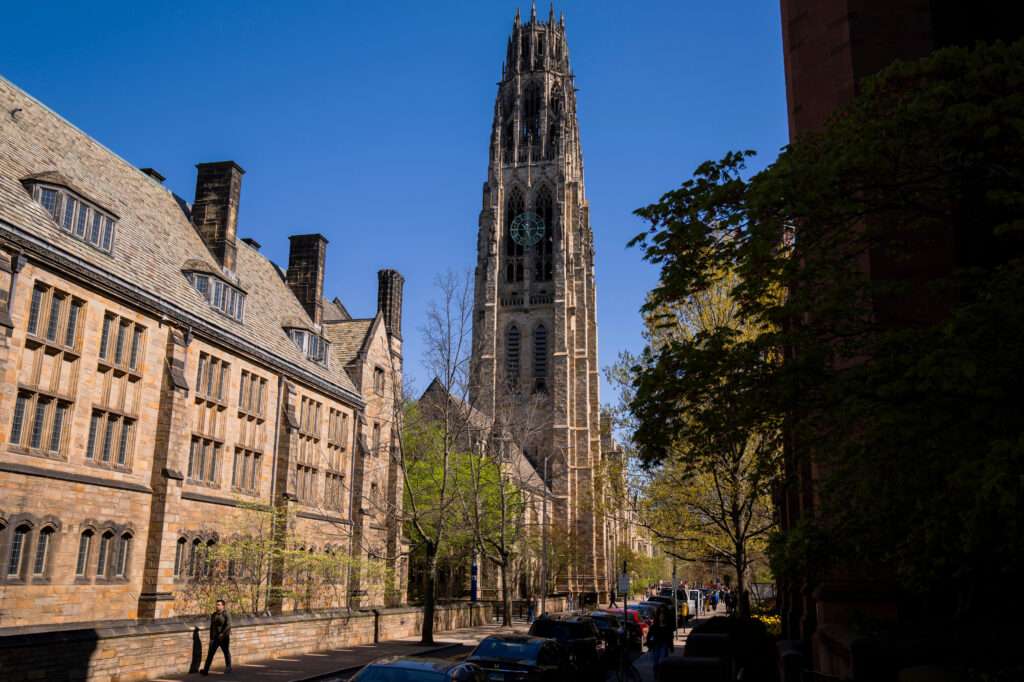
NEW HAVEN, Conn. — The Trump administration’s battle with American higher education is heating up at Yale University, with students, faculty and prominent alumni urging the university president not to give in to White House demands.
Those critics want the elite university to follow Harvard in fighting federal ultimatums. Yale has been accused of racial discrimination in medical school admissions.
University President Maurie McInnis publicly acknowledged last week that the school was in talks with the Justice Department, which concluded that Yale’s medical school discriminated based on race, favoring Black and Hispanic applicants over White and Asian ones. Critics say the department cherry-picked data and used flawed legal arguments, but the investigation expanded to Yale’s law school and undergraduate campus.
A campuswide email that McInnis sent Wednesday, also signed by the provost and vice provost, pointed to a key factor: a sweeping proposed rule from the White House Office of Management and Budget that would give political appointees more power over federal grant-making and give the Trump administration much more leverage to yank money from schools even if there is no proof of a university having done something wrong. McInnis said the rule could have a “profound and far-reaching impact” on research and scholarship at Yale and across the country.
Yale’s actions are being closely watched because of its prominence as an institution and because the scrutiny of medical school admissions is a new front in the Trump administration’s battle to force universities to comply with its ideological goals. Last year, multiple universities reached settlements with the administration in efforts to resolve investigations and restore research funding. What Yale chooses to do — like Harvard’s decisionto fight back with lawsuits last year — will carry tremendous weight nationally.
It would not be unusual for Yale to talk with Justice Department officials about the findings at the medical school, some professors said, but many faculty and others are concerned that the school is rushing to prematurely fold the law school and college into an agreement. At the law school, in particular, faculty have expressed alarm at the prospect of negotiating over unproven allegations.
“A settlement with this administration does not get them off your back,” said Muneer I. Ahmad, a professor at the law school and co-counsel to the university’s American Association of University Professors (AAUP) chapter.
A legal memo being circulated by attorneys for Yale’s AAUP chapter argues that the university has done nothing wrong and the administration’s contentions are weak, contradictory and flawed, said Gregg Gonsalves of the alumni group Stand Up for Yale. “So it’s strange to students, faculty, and alums: Why are you so eager to settle?”
Sen. Richard Blumenthal (D-Connecticut) said earlier this month he had learned that Yale had twice made offers without any demand, effectively “negotiating against itself.”
He said he had spoken with McInnis twice. He declined to share the details of those talks but said they left him with the impression that she was “not ready to fight.” He said he feared a deal would give the government undue influence over admissions policy, hiring and the content of courses.
A spokesperson for the White House referred questions to the Justice Department. The department did not respond to a request for comment.
A spokeswoman for the university said earlier this month, in response to a question about Blumenthal’s assertions: “It is Yale’s long-standing practice not to discuss the specifics of any ongoing legal matter. That said, we stand firm in the university’s commitment to students’ free expression, academic freedom, and Yale’s ability to determine who is admitted in accordance with the law.”
In her first message to campus last week, McInnis wrote that she was seeing speculation and misinformation spreading, and said federal law provides a process. It is standard and important for lawyers to see if they can resolve the issue without further legal action, she said. “Yale is currently engaged in this process of talking and listening.”
She outlined five fundamental principles — academic freedom, free expression, the ability to decide whom to admit and hire, advancing the school’s mission of research, education and scholarship. Yale makes all decisions, she wrote, “by prioritizing our responsibilities to our students, faculty, staff, and patients, as well as the university as a whole.”
The last year and a half have made clear that federal research grants — which for generations have fueled lifesaving cures and the national economy — are at risk when schools come under scrutiny. While court decisions have for now restored much of the funding frozen and canceled by the Trump administration, those rulings could be reversed as lawsuits make their way through the legal system.
Many university leaders across the country are additionally alarmed about the OMB proposal, which was announced at the end of May and is slated to take effect on Oct. 1. It would give political appointees more power over grant-making and allow terminations of funding midway through the research process. It would also lock in those changes across federal agencies with a binding resolution that would be more difficult to challenge in court.
It’s one more thing, Toby Smith, senior vice president for government relations and public policy for the Association of American Universities, said in an earlier interview about the OMB proposal, that is “likely to result in a great loss of scientific talent for the United States, and result in us missing a whole generation of new scientists.”
Trump administration officials have said they are adding oversight to ensure federal funds aren’t misused. But opponents said such a massive change could destroy the United States’ dominance in science.
At Yale, news of the legal negotiations have prompted a swift backlash. Student groups organized a phone bank with 60 volunteers, including incoming freshmen and a graduate from the class of 1970, to call trustees and administrators, and urge them to reject any deal that could compromise the university’s independence. Alumni groups petitioned the school to do the same, while Yale’s chapter of the AAUP considered legal options. Author Susan Choi, an alumna, spoke out.
At a town hall held on campus earlier this month, a broad coalition of critics — Connecticut lawmakers, Yale students, faculty, and alumni — packed into a classroom to assess what they see as a threat to the future of Yale.
“The reputational cost of settling at this moment is beyond dollars,” Blumenthal, a graduate of Yale Law School, said. “We are at a legacy-defining moment,” both for the institution and the leadership of Yale.
Alex Chen, the student body president, said he believes Yale has been conciliatory during this administration. “But the leopards have come for Yale. Appeasement’s not going to work.”
The students he represents are solidly opposed to any deal Yale would make with the Trump administration that resemble those at peer institutions, or give ground on students’ rights, he said. “We’ve seen what they took away at Columbia, Penn, Brown.”
The post Yale caught between Trump administration pressure and a campus that wants to fight appeared first on Washington Post.