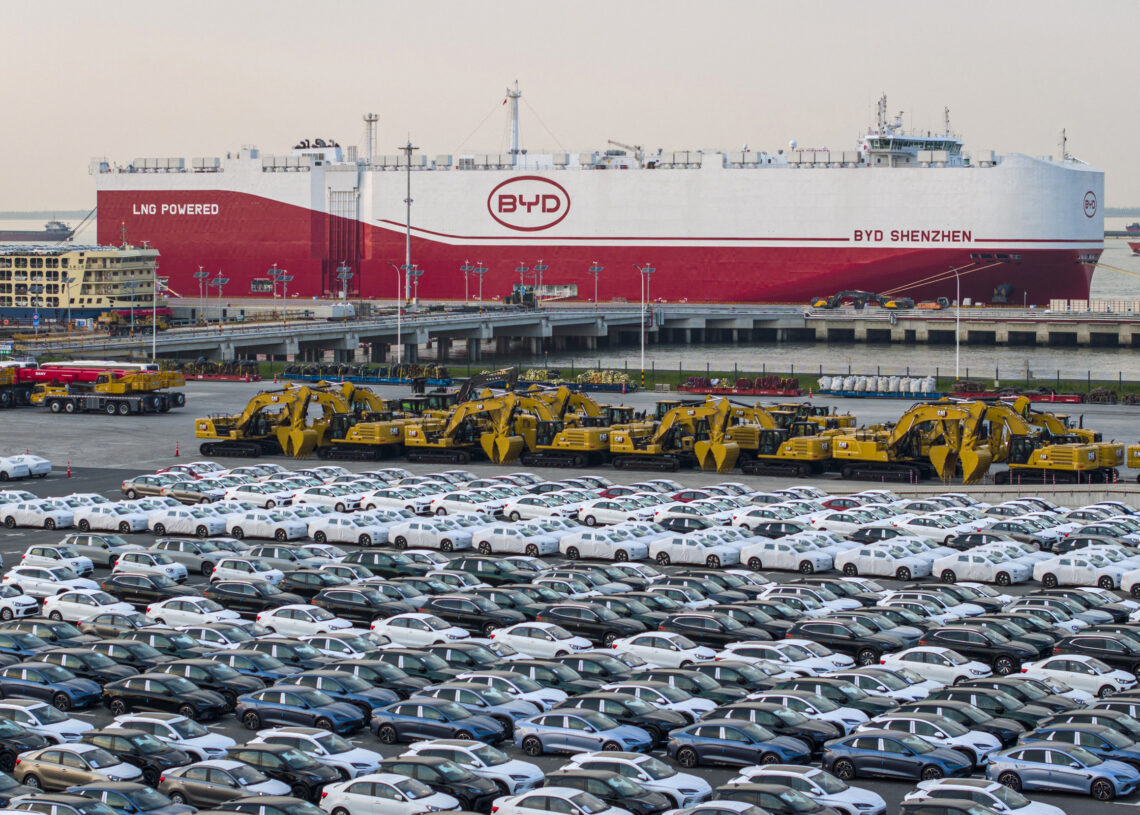
Twenty-five years ago, low-cost Chinese goods flooded the U.S. market, contributing to the loss of 3 million factory jobs and upending American politics, a phenomenon that came to be known as the “China Shock.”
Now a second China Shock is reverberating across Europe, Southeast Asia, Africa and Latin America, raising fears of greater deindustrialization and political tumult. On Friday, German Chancellor Friedrich Merz and French President Emmanuel Macron called for joint action to protect European industry against a rising tide of subsidized Chinese products.
Today’s Chinese export boom originated in Beijing’s response to the collapse several years ago of a property market bubble that erased $10 trillion in household wealth, according to KKR, a New York-based investment firm. Starting in 2020, Chinese authorities invested in additional manufacturing capacity to offset the real estate downturn and to develop advanced industries such as electric vehicles, lithium-ion batteries and solar power.
All those extra factories, however, produce more cars, flat-panel displays and machinery than Chinese consumers can afford. To keep millions of factory workers employed, Chinese manufacturers are looking abroad. Exports in the first half of the year rose 18 percent compared with the same period last year, according to the General Administration of Customs in Beijing.
“There’s been a huge increase in manufacturing capacity over the last five, six years. And not a lot of domestic demand growth to absorb that,” said Julian Evans-Pritchard, head of China economics for Capital Economics in Singapore.
China’s chokehold on global markets for a growing number of manufactured goods carries enormous social and political ramifications.
The first China Shock, which emerged after the country joined the World Trade Organization in 2001, displaced 2.4 million U.S. manufacturing jobs over the next decade, according to economists led by David Autor of MIT. Consumers benefited as inexpensive Chinese goods suppressed inflation. But aggrieved voters in factory towns across America helped deliver the White House to Donald Trump in 2016.
The new China Shock also features inexpensive products that quickly supplant domestic alternatives. But this time, the exports are high-tech items such as electric vehicles and semiconductors, not basic apparel, footwear and passenger car tires. And its harshest impact is hitting outside the United States, in places like Europe, where economic discontent is already bubbling.
“The United States stands out as a clear exception to this global pattern,” said an analysis by five Federal Reserve system economists published this spring.
Indeed, the United States, which bore the brunt of the first China Shock, thus far has blunted the impact of the latest export wave, largely with Trump’s controversial tariffs.
China’s first-half exports to the U.S. are basically flat this year compared with the same period in 2025, according to Chinese customs data. (U.S. figures, which often disagree with official Chinese data, show a drop of 30 percent in purchases from China through the first five months of the year.)
Still, many Chinese companies manage to escape U.S. tariffs by shipping their U.S.-bound goods via countries such as Vietnam or Mexico, where they undergo a bit of final processing that masks their country of origin. U.S. imports this year from Vietnam, Mexico, Thailand and Cambodia are all up significantly.
LC Sign, a maker of custom signs in Guangzhou, China, ships to North America, Europe and Australia, said Tony Zhu, the company’s head of marketing. The company has expanded its workforce to around 350 employees, up from 300 one year ago.
LC Sign’s U.S. sales dropped last year during the most intense phase of the U.S.-China trade war. But after Trump and Chinese President Xi Jinping reached a truce that reduced trade barriers, business improved.
“After the tariff situation stabilized, our presence returned to its previous levels,” Zhu said. “The deal our government struck with the American government over tariffs — that was a great help to us.”
Exporting is made easier by a Chinese currency that the International Monetary Fund says may be undervalued by up to 21 percent, which effectively puts Chinese merchandise on sale for foreign buyers.
Contrary to the early 2000s, when rising Chinese exports were matched by increased Chinese imports, China in recent years has tried to reduce its dependence on foreigners even as it counts on other nations to keep its manufacturers in business. Last year, for example, imports flatlined even as exports rose, according to Chinese customs data.
Today’s much larger Chinese economy is growing its share of world merchandise trade from an already dominant position. In 2000, China accounted for about 4 percent of global goods trade. Today, it represents 16 percent, according to the Fed analysis.
Treasury Secretary Scott Bessent has highlighted chronic imbalances in the global economy, urging Chinese officials to pivot from investing in industrial policy to supporting household consumption. The administration is expected to unveil additional tariffs this month designed to combat “structural excess capacity” on the part of China and other manufacturing nations.
“China’s current economic model is built on exporting its way out of its economic troubles. It’s an unsustainable model that is not only harming China but the entire world. China needs to change,” Bessent said last year.
His arguments echo those of his predecessor. In 2024, then-Treasury Secretary Janet L. Yellen traveled to Beijing to warn Chinese officials that “China is now simply too large for the rest of the world to absorb this enormous capacity.” One month later, President Joe Biden imposed 100 percent tariffs on Chinese electric vehicles to protect U.S. automakers from low-cost competition.
China’s export dominance reflects economic weakness as much as manufacturing strength. Second-quarter economic growth slowed to an annual rate of 4.3 percent, down from 5 percent in the first quarter, the National Bureau of Statistics said Wednesday — the weakest mark in more than three years.
Chinese government data is often distorted for political reasons, so the new figures probably overstate the economy’s health, economists said.
“The Chinese economy is absolutely in a weak spot right now. I’m not saying it’s a total disaster and the sky is falling or anything that dramatic, but this is more weakness than we’ve seen in recent years,” said Shehzad Qazi, chief operating officer for China Beige Book International, which compiles private-sector data from Chinese companies.
China’s housing bust continues to shadow economic growth. Real estate accounts for nearly 70 percent of Chinese household wealth, twice the U.S. share, according to Stanford University’s Center on China’s Economy and Institutions. With housing prices still falling six years after the bubble burst, many Chinese consumers remain reluctant to spend.
Xi has called for policies to support increased consumer spending. But so far, government policy continues to prioritize development of globally competitive technology industries. New proposals could emerge from a meeting this month of the Chinese Communist Party’s politburo, the top decision-making body.
“They know exactly what needs to be done and [they] want to do it, but the sense of urgency and the resolve is really not there,” said economist Eswar Prasad of Cornell University, a former head of the International Monetary Fund’s China unit.
Coordinated pressure from China’s trading partners, including the U.S., could help move Chinese authorities to modify their economic policies. Instead, Trump is preparing to welcome Xi to Washington for a state visit in September, while countries such as Britain and Canada have cut separate deals to maintain access to the Chinese market in return for allowing a limited rise in Chinese exports.
Europe, meanwhile, is struggling to confront the Chinese surge. Macron has made rebalancing the global economy a priority this year for France’s Group of 7 presidency. Merz, Germany’s leader, was reluctant to endorse protectionist measures but has warmed to the idea amid Germany’s continued industrial stagnation.
The European Union this month plans to reduce its tariff-free quota on steel imports. Member states are also considering a broader range of industrial subsidies and domestic content requirements to promote European manufacturing. The emergency measures supported by Macron and Merz are to be unveiled in September.
Germany, the continent’s traditional manufacturing power, is in the crosshairs of China’s export push.
Berlin traditionally has been wary of endorsing anti-China trade moves, fearing a loss of access to the Chinese market. In 2024, when the E.U. imposed tariffs on Chinese electric vehicles, Merz’s predecessor opposed the measure.
E.U. leaders expected the tariffs to reduce the number of cars arriving from China. Instead, Chinese exports surged, as China’s carmakers switched to hybrid models.
More than 1 million Chinese-made cars were imported into the E.U. last year, according to the European Automobile Manufacturers Association. Top German companies have lost ground at home to Chinese rivals while also losing market share in China. Volkswagen plans to close four car plants in Germany and cut 100,000 jobs as it retools to fight Chinese competition, according to German press reports.
Chinese carmakers already can produce roughly twice as many cars each year as they can sell in China and are adding capacity for an additional 5 million vehicles, according to economist Brad Setser of the Council on Foreign Relations. With Chinese consumers tapped out, Chinese carmakers are accelerating their move into foreign markets.
“There’s no money to be made, no real money to be made, selling into the extremely competitive and oversupplied Chinese market,” Setser said.
The post The U.S. saw the first ‘China Shock.’ Now the world gets the sequel. appeared first on Washington Post.