“I’m curious,” Rachael Benjamin began delicately at the outset of our first sibling therapy session in January, “what you wish you might be able to talk about with the other.”
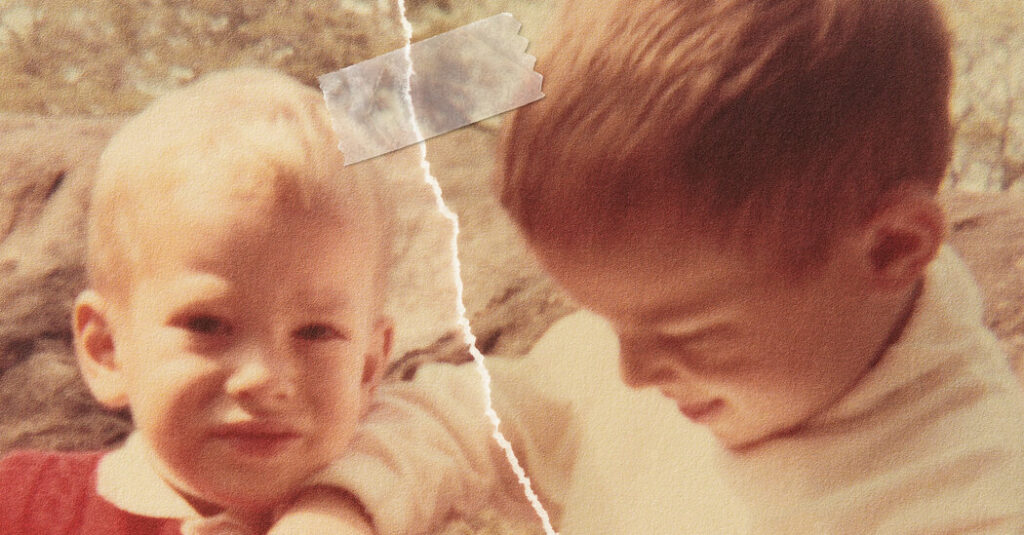
My brother, Bob, was at home in New Haven, Conn. Benjamin, a clinical social worker, was in her home office in Maplewood, N.J., and I was in Brooklyn. We were three faces in squares on our computer screens. Bob is 16 months younger than me; we have no other siblings. In our mid-60s, with our shaved heads, he and I looked similar on my laptop, a likeness that has varied in degree over the decades, creeping sometimes, jarringly, toward seeming twinhood. The side-by-side squares felt like a telling amount of intimacy between us, a cautious sort of closeness.
Weeks earlier, during a phone call, Bob asked what I was working on. I told him that I was interviewing therapists who are practicing in a way that’s becoming more common: seeing adult siblings together for counseling, siblings who hope to sort through stubborn issues, to heal old but open wounds.
“What about us?” he blurted out.
It was clear what he meant, and I was instantly uneasy, feeling a vague but unmistakable resistance. Why stir up trouble? Why venture into the past? Why court the perils of candor? We saw each other for Thanksgiving and Passover and a bit beyond that. His musicianship is the backbone of an annual singing party I host. Wouldn’t it be better to leave our pretty good relationship alone?
But gently he insisted.
Replying to Benjamin’s question, Bob said that we should start with religion. By blood, we are Jewish, and five of our Grandma Clara’s 11 siblings, along with their mother, were slaughtered in the Holocaust. Yet in his early 40s, Bob enrolled in an Anglican seminary. He is now the pastor of an Episcopalian church outside New Haven. Religion is a complex and tender topic between us.
I suggested two more subjects. The first, I told Benjamin, was raised by Bob as we interviewed potential therapists: that I treat him as a little brother. The dynamic, he implied, verges on toxic. The second was that I couldn’t imagine confiding in him about anything at all. I didn’t yet elaborate, but I felt that he was not entirely present when we talked. I felt there was a barrier, put up by Bob, to our becoming better friends, which I wanted even while the nascent attempt made me uncomfortable, as if there were something suspect about the wish, after decades of guarded interaction.
“Tell me about each of your roles, as older and younger brother,” Benjamin said. She asked me to begin.
I was surprised, I explained, when Bob brought up the big-little dynamic in the present tense. “I see it as past,” I said. “I can remember in childhood feeling threatened by Bob, feeling that I was going to do everything I could — not everything, I wasn’t going to murder him — to keep him down. Sibling rivalry for me was a Cain-and-Abel-sized set of emotions.”
“Wow,” she said almost inaudibly.
“But,” I went on, “that abated in our 30s. To the point of going away. To the point where I feel I am a supportive brother, older or not.”
“Bob, can you fill in — what your experience as the little brother has been?”
I studied his face with a thorough focus that the screen allows. His hazel eyes held a fragility I might not have absorbed so fully in person. “I definitely felt, as a kid, that I was being suppressed, that there was some antagonistic force coming from him,” he said. “I still feel that. What my wife has noticed is that when we’re together, I pull back from the self she knows.”
His voice was level, restrained. It was in my own voice that I heard emotion — a refusal — rising. Could he give an example, I asked, of my still having an oppressive effect?
He recounted a recent conversation among the two of us; his wife, Pam; and my longtime girlfriend, Georgia, who, after reminiscing about ice skating as a girl, asked Bob whether skating was part of his childhood. With Benjamin, Bob recalled that I answered for him, talked over him — and I realized I’d done exactly that. I’d described to Georgia an innocent, cherished memory: the mini makeshift rink Bob and I created as kids on a frozen swimming pool and the one-on-one hockey we played.
But in our session, he brought back more than his feeling of being silenced. “He was just bigger,” Bob said. “There was nothing I could do.” On that tiny rink, which was too confining for his greater speed and agility to be of much use, I bullied him. “Dan told it like we were having fun, but he recast the story.” His memory was utterly different from my own, and as I listened, my mind and body were flooded by the past, by the violence of our games, by my keen awareness, back then, that he was the better athlete regardless of his smaller size, by my knowledge, a few years further on, that he was better-looking, by a sense that we were locked in an undefined but dire competition and that I was always at risk of losing.
Yet even while I was more than willing to acknowledge my aggressive impulses toward him, in childhood and on through young adulthood, I recoiled at something that seeped from his words: how much the distant past mattered to him. Hockey games, with little wooden crates for goals, played when we were 10 and 11. More than 50 years had gone by. The mattering seemed excessive, and I wished he could be free of it. But I also felt a pull, the unwanted gravity of that past in myself.
“Each of you,” Benjamin said, “hold what has happened in your relationship; it lives in you internally. You have held each other in your minds. Some of which is unknown. We’re trying to make the unknown known. Each of you has had an incredible impact on the other.” We were there together, she emphasized, from the beginning.
“When I think about where I am,” Bob said, “I do wonder what role my relationship with my brother played.” During that first session, though he didn’t yet speak of music in any detail, his unreached dreams as a musician hovered near. Close within his virtual frame were some of the instruments he plays — guitars, mandolin, bass — and downstairs, I knew, was a piano he plays daily with riveting talent. “In the sort of withholding of myself,” he continued. “In how my life got derailed. I experience it in some unclear subtle way when we’re together. That I don’t feel this is all of the life I’m meant to have.”
Taking this in — the part he seemed to be assigning me — I didn’t reject his note of blame, not aloud, not to myself, not completely. But I did sense, even more than when we first decided to do this, that there was something reckless about our committing to therapy, that exposing fissures could lead to cracking, could open chasms.
Sibling therapy, Matt Lundquist said, is these days “in the zeitgeist.” Lundquist has been a therapist for 22 years and leads the New York City group practice where Benjamin is a clinician. He told me that in the last five or so years, he has seen a marked increase in the number of people requesting this form of counseling. The coronavirus pandemic made virtual sessions widespread, and this has allowed siblings to come together for therapy despite their geographical distances. I talked with more than a half-dozen therapists who work with adult sibling pairs or groups, and all said that the reasons for seeking out such therapy are sometimes merely practical, like how to handle the decline and dysfunction of aging parents, but that often the motive is a “pull toward healing and repair,” as Lundquist put it, “with someone you used to be in the back seat of the station wagon with.” It is a pull, he said, “sufficient to override all the very good reasons not to do it,” like the danger that the sessions will lead to more division.
Siblings have long tended to be peripheral or even absent figures in individual therapeutic work and in clinical thinking. This may trace back to Freud, explained Allison Katz, a therapist and psychoanalyst who was a co-chair of a daylong conference in New York for about 200 practitioners in May titled “O Sibling, Where Art Thou: Searching the Shadowy Terrain of Sibling Bonds and Horizontal Relationships.” Freud and his psychoanalytic descendants were much more interested in the “vertical,” Katz said; that is, in the repercussions of dynamics between parents and children. She told me that a “loyalty” to those original vertical concepts continues to hold sway among many therapists, even as Freud has been marginalized by some.
Katz spoke, too, about another kind of loyalty, that of clients to their parents. Only infrequently, she said, do individual clients bring up their siblings, and in this she sensed an avoidance borne of fealty to parents, a shielding of them. “Children unconsciously protect the family system,” she speculated, “well into adulthood. Most parents instinctively desire sibling harmony and wish to preserve the belief that they have parented fairly, without favoritism.” Unwittingly, grown children guard their parents’ illusions.
Lundquist and other therapists who work with siblings said they tend to draw from family systems theory, a framework that dates to the 1950s. It diverges from classic psychoanalytic ideas partly by putting more emphasis on the impact of intricate and broad family patterns than on Freudian theories about dominant inborn drives. With siblings on his screen, Lundquist sometimes visualizes a sheet of paper to one side of their faces, on which he sketches out his clients’ web of family dynamics as it emerges. He spoke of essential yet unmatching memories, of truth as forever elusive.
“Siblings,” Benjamin wrote in an email, “form their own system that both interacts with the overall nuclear family” and operates apart from it. Reading this, I thought about the corners that some siblings carve out — spaces loving or harmful — beyond the sightlines of parents. I thought about two sisters I know who were inseparable as children, constructing a private cosmos, and another pair, where the older sister shoved the younger down a flight of stairs. For the therapists I spoke with, childhood sibling relationships often reverberate throughout a lifetime, re-enacted, covertly or blatantly, between the siblings or within other interactions.
For Lundquist, sibling work has a special place among his range of clients. When siblings reach out, hoping “to remain in communion with each other” or “to fend off a deeper rupture,” he said, “I’m compelled by the fact that they don’t have to do this.” Without societal disapproval, siblings can drift into what he categorized as “de facto estrangement,” arising from disinterest or distrust, from childhood or adult enmity. They might connect just once a year at a family event. With a sibling “you can just not call back,” and “in terms of cultural repercussions you can get away with it.”
Keeping distance from a brother or a sister is common enough to be a kind of American norm. Research on adult siblings is scant, but in one large 2025 survey around one-quarter of American adults responded yes to the question, “Are you estranged from — that is, no longer have a relationship with” — a sibling? Less than half of these said they would consider reconciling.
Dena DiNardo, a psychologist whose practice, she estimates, includes eight or nine sessions with adult siblings each week, compared sibling therapy with couples’ work. There can be a resemblance, she remarked, between siblings and couples. “One person reaches for closeness, in ways that may or may not be appropriate, while the other shuts down. Sometimes they both want connection but are caught in old reactions.”
But one obvious and fundamental difference between siblings and couples, she said, is that “siblings go back to birth.” With siblings, the issues are so deeply embedded. “Walk back into your childhood home at 68 years,” she added, “and suddenly you’re 7 again. Same characters, same set, old lines waiting for you. Our nervous system remembers all of it. Those early years are where our core imprints live.”
In our initial sessions with Benjamin, Bob and I circled around the possibility that I had done harm in ill-defined yet undeniable ways. I alternately accepted and pushed back against this — and then at one point found myself repeating something our Grandma Clara said to me about my relationship with Bob decades ago. Her words have haunted me ever since, and I’d never spoken them to anyone.
We sat, Clara and I, at the kitchen table in her cramped Brooklyn apartment, not far from Coney Island. I was in my 20s. My visits were brief. Our conversations tended toward platitudes scattered between silences. She communicated through her cooking — knishes, stuffed cabbage, pineapple chicken. But this one evening, when I stood from the table ready to leave, Clara said suddenly: “You know, Bob has always loved you. But you don’t love your brother.”
Her quiet accusation was jolting. I replied that she was wrong. Too much time has passed for me to remember whether she said anything more. In any case, she didn’t need to. Bob was spiraling in those years. He severed himself from the family; for a period, no one knew how to find him. I wasn’t completely sorry that he was lost. I was the stable, sane, salary-earning son. I was triumphant.
Did I love him? With our grandmother’s door shut behind me, I pushed the question away. But starting around that time, coincidentally or not coincidentally at all, I grew fascinated by the sibling stories in the Bible. I was teaching high school English, and I took any opportunity to include those stories in my courses, from Cain’s murderous jealousy of Abel to the vindictiveness of Joseph’s jealous brothers, who sell Joseph into slavery.
Did those episodes offer me a kind of absolution? Did they reassure me that if Clara was right about my lack of love for Bob — if I harbored malign or metaphorically murderous feelings toward him — I fell well within archetypal patterns? I am still drawn to those dark sibling narratives, almost as if I belong within them.
At around the time of Clara’s accusation, Bob was diagnosed as manic depressive, or bipolar in today’s terms, and did two stints on locked psychiatric wards. His hospital records say that he was given to “flight of ideas” and “claims of special powers,” among them the “ability to read people’s minds and predict the future.”
One version of the story — the version that most psychiatrists would probably subscribe to after reading the records — is that he belonged right where he was, hospitalized temporarily, subdued during his first stay by heavy doses of Haldol, an antipsychotic, and told that he would need to take lithium, a mood stabilizer, for the rest of his life. But that is not Bob’s version. Grappling with that time, he allows that he was “in spiritual crisis,” but he rejects the diagnosis, the categorical and permanent aspects of psychiatry’s judgment. Our parents were terrified and latched onto the diagnosis and the promise of medication; I made my doubts clear about psychiatry’s verdict. I was aligned with him back then, even while, paradoxically, I felt an unarticulated sense of victory, dominance, comfort.
Time has proved the rejection justified. Bob stopped taking lithium after three years, because the drug caused a tremor in his hands that hindered him at the piano and because he felt that it put, in his words, “a blanket over my brain.” He didn’t replace the medication with any other. There was a period of severe struggle, of homelessness. But then he found work and a degree of artistic affirmation playing the piano for dance classes at the Radcliffe Dance Program in Cambridge, Mass., and he started dating Pam, an administrative assistant in the program, who would go on to a highly accomplished career as a modern dancer based in Montreal. There, he and Pam married, and he founded and directed a choir at a large church where Pam’s mother worshiped. This — and a deep sense of calling — steered him to seminary. He has served as a pastor in prisons (where he played guitar and led sex offenders, the least of the least, in song), at a life-care community (where he started a choir in the memory-care unit) and, for the past eight years, at the church outside New Haven.
In session, I brought up some of what Bob has done while at that church. He has opened the church doors on winter nights so homeless people can sleep within the sanctuary’s warmth. Collaborating with gun-buyback programs in the area, he has helped a retired bishop set up a small forge and anvil in front of police stations and molded turned-in weapons into gardening tools. On a locked psychiatric ward for young people around the age he was when he was locked up, I have watched him play pop hits and, overcoming their mistrust and the dulling side effects of their medications, stir the patients to sing with him.
But for him, the experience of being held behind a heavy, bolted steel door, of being given an unequivocal psychiatric label, of being forced to surrender agency, has never completely faded. It was too overwhelming to be sloughed off. It remains with him like a branding. And it is bound up with something he voiced in our early sessions: “the feeling of not accomplishing myself.”
This was more than a note of regret. The phrase tunneled to the core. The artistic dreams he’d harbored since he was young — as a musician; also as a singer and dancer — plagued him, because, he said, he’d never fully tried to make them real. I understood some of this before we began our therapy. But his phrase — “not accomplishing myself”— expressed something even stronger and more painful than I’d known.
And then there was the subject of blame. I’ve written about Bob before, in my book about psychiatry, “The Mind and the Moon.” And in our many conversations for that book, he focused on how our parents persuaded him to commit himself to the first of the two psych wards he spent time on. He remembered that our mother, panicked about the possibility of suicide that comes with bipolar disorder, told him when he tried to leave the ward after one night: “All that talk about being a musician, a singer, a dancer — that is a sign of your illness. If you leave here now, we’ll have to scrape you off the sidewalk.” When he recalled that period of his life — though he was understanding about our parents’ terror — our mother and father were overpowering and undermining forces.
But in our sessions, he focused on the role of our relationship in undercutting his confidence and ambition — not that I was as important as our parents, but that there was, that there still was, something corrosive between us. I replied that on the one hand, I’d been his ally during his hardest time. But on the other hand, I said, I was flashing back to something I did more than once, with our parents out of the house, when we were in our teens. I whipped his bedroom door with a belt, denting the wood over and over with the buckle. Our family had moved, not long before, from New York City to an isolated corner of Seattle, and I felt alone, trapped, and it was all too easy to take out my feelings, to assert control, upon him, imprisoning him in his room.
And then I brought up the long-buried accusation our grandmother made when we were in our 20s. I felt I was serving a compact to be honest; being in therapy seemed to obligate this moment of confession. Or maybe it didn’t obligate this, only lent me the chance to purge myself of a memory. I scarcely considered the hurt my words might cause.
“I want to know what you’re feeling,” Benjamin said to Bob.
He didn’t speak. Many seconds went by. I awaited something bleak.
“Well,” he said, his tone bordering on upbeat, “I’m feeling delighted that we’re having this conversation.” If our grandmother’s perception was even partly true, Bob went on, he must have been aware of my dearth of love and support. He spoke of it as an added factor beyond our parents maneuvering him onto a locked ward, where he was expected to capitulate to his diagnosis, to relinquish himself. Our grandmother’s words offered another layer in his understanding of himself back then. His voice held notes of release, as if this additional stark knowledge of the forces arrayed against him as a young man could somehow liberate him to finally fulfill his musical dreams. I was glad to hear this intimation of freedom, but I winced inwardly. I had my doubts that a better sense of such old personal history could lead him forward. Though I muzzled my thoughts, his belief in this struck me as misguided, a weakness, a hint of bottomless fragility, even as I rebuked myself for this reaction. I also felt shut out by what seemed his consuming obsession with redressing the past.
As our sessions progressed, I said I worried that Bob’s unrelenting ambition put an obstacle between us, that his desire, at age 64, to redeem the past by proving himself, at last, as an artist created a kind of wall around him. Writing this sentence now, I wonder if my saying this was an unconscious and insidious effort to subvert him, a resurfacing of primal rivalrous emotions that I wish were gone. Why should it concern me that he is driven to do more artistically — and at a higher level — than he does now, more than lead a band that plays at his church services, more than play sometimes for classes at a modern dance company in New York?
But Bob’s answer was an acknowledgment. “I have lots of relationships with parishioners and colleagues,” he said to Benjamin. “But really, if I’m 100 percent honest, other than that, except for Pam. …” He veered into mentioning the two deep bonds he’d made over the decades; one of these friends had died, and he’d lost touch with the other. “I come home, and I start practicing the piano or doing singing exercises. On Saturday, I do the same. Pam and I might go for a bike ride, and then I write my sermon or practice the piano. It doesn’t even come near the top of my priority list that I should have coffee with somebody or have a beer with somebody or ——”
“Call my brother,” Benjamin said.
“Or call my brother.”
“Daniel can’t compete with this ambition. But,” Benjamin asked, “is there room to let him in? Would there be room for sharing and being together, if the ambition takes a pause for 30 minutes?”
I added that if I shared something vulnerable with Bob, “the feeling would be of my words having to push through,” to permeate something that encases him, because his yearning to right the past cuts him off and means that he’s not exactly with me.
“There’s a self issue,” Bob agreed. “Like I’m not fully myself yet, so I can’t commit myself to a relationship with you. I don’t feel I’m done creating who I am, so it’s only a partial relationship.”
“How do we want to work on that?” Benjamin asked.
I wasn’t sure how successfully we could. Was his need too powerful and too entrenched?
Bob and I had agreed to talk once each week between sessions, as a way to broach things that our hours with Benjamin didn’t lend enough time for, and during one of these conversations I asked about the scope of his musical ambitions. I’d always been afraid to ask, because I assumed his goals were probably unrealistic: playing the piano or singing classical repertoire on top-tier stages. It was an acutely sensitive topic. As I laid out my question, I used the phrase “grand scale,” but he heard me say “grandiose.” The word resonated — loudly — with psychiatry’s and our parents’ past judgment of his psyche. Later, we talked through his pain over what he’d misheard, and I apologized for using the word “grand” at all.
About his current dreams, he said that he hoped to play for classes at an exalted ballet company. He wished to sing oratorio with small regional orchestras. This didn’t sound impossibly grand, let alone grandiose. It sounded, to me, beautiful that a talented 64-year-old man would be determined to overcome the past and pursue these unglamorous yet meaningful artistic desires. It occurred to me that if I met a stranger in late middle age who told me about his rigorous devotion to such dreams, I would want to write and celebrate his story.
This fleeting transposition of my brother into an imaginary stranger loosened the hold of an old narrative. The new version of the truth was lustrous and, in its moderation and humility, seemed to make my brother more reachable.
History, our own and well beyond, loomed heavily whenever we turned to our family’s Judaism and Bob’s Christianity. The subject was raised, by us, by Benjamin, repeatedly throughout our sessions. “How do you talk about religion together?” she asked. We delved in, danced away, delved again, dodged again. “What are the roadblocks to talking about it?” The topic was dangerous and inescapable.
Before Bob went to seminary, in addition to leading that choir in Montreal, he sang solos in a synagogue three blocks from the church. His music led to competing opportunities. One was to be trained as an Anglican priest; the other was to be trained as a cantor. The teachings of Jesus, the church music and, above all, an ineffable beckoning drew him in the direction of Christianity.
As he made his choice, he visited me and asked if I would be all right with it. I was moved by the sense of calling he expressed. I didn’t want to stand in the way of it. Only afterward did it sink in: His direction felt like a turning away, a betrayal, even a denial of our family’s past. This feeling persists side by side with my admiration for all he has done as a pastor.
“A roadblock is that I don’t feel that my decision to become a follower of Jesus,” Bob said, responding to Benjamin’s question, “in any way mitigates my Jewishness. I realize that’s not a very common perspective. And I guess I feel like if we had a conversation about that, it might be contentious, and I just don’t feel like dealing with it.” He touched on the reasons behind his choice: “If the house of worship is the principal place I do my music, then in a profound way, if you’re not singing Palestrina and Mozart, you’re missing out on some of the most beautiful music ever. And if you’re married to a synagogue, you are never going to talk about Jesus in the context of worship, and to me that’s life and death.”
“What is this bringing up in you?” Benjamin asked me.
“A lot.”
“A feeling,” she said, pushing for emotion more than thought as we entered this daunting terrain.
My body began to tighten, my voice to climb. The teachings of Jesus, I said, hold a love, a kindness that’s there in the Jewish Bible but not nearly “as plainly, poetically, explicitly.” Yet, I went on, “whenever I think about why I wouldn’t commit myself all the way to these beautiful preachings,” to “this amazing man,” and “say he was sent by God,” the answer is “No, no and no.” My voice was leaping. “I have to live in this space” — the Jewish space — partly because the relative I was closest to, after our grandmother, who lived across the street from Clara and whose warmth radiated through our lives, survived Auschwitz. “I feel like — Bob, you owe us more.”
“So you want to understand more,” Benjamin said.
“Yes. But if you’re asking for feeling, it’s in the you owe us more.”
There was a silence. I can hardly articulate what I meant, yet my meaning seemed understood: that his betrayal felt aggressive, both pointed and vast. In my mind, I recalled an image from his ordination. At the altar of an immense Anglican church in Montreal, with its towering arches, the bishop sat enthroned, draped in crimson and gold regalia and topped by a gold-embroidered miter, a tall crownlike headdress. Bob knelt before him. In session, had I let myself go, I might have described this and said, What the …? Had I let myself go, I might have lost myself to anger verging on rage, though at the ordination, at Bob’s request, I took part, stepping onto the chancel to read a poem he’d chosen.
“I want to give you guys guardrails,” Benjamin said. “With the messier bits, it’s so important to take them in and let them settle for a moment.”
She was cautioning us to go slowly. But it wasn’t Bob, only me, who seemed to need the warning. He didn’t rush to defend himself, or attack me in reaction to what was, in my words and voice, something close to an attack.
“I felt called, by love, to pursue a vocation in the church,” he said. He recounted a genealogy exercise during seminary that confronted him with the Holocaust deaths in our family. “I managed, even after I made the genealogy tree with all the black marks on it — I managed to put that aside.” Though he was troubled, he had decided, he told us, “I’m not going to think about it.” But he said that even before our sessions began, he had been reading about the history of Christian atrocities against Jews. “It’s almost unfathomable,” he said, “how the church latched onto, almost as a reason for being, that everything would be great if we just got rid of the Jews.”
He brought up the Prayer of Saint Chrysostom, which is often a part of Anglican services: “It’s a lovely prayer, but Saint Chrysostom was a wild hater of Judaism, and then there’s Martin Luther and his crazy hatred of Jews. And Christian communities exist without any reflection on this.”
It turned out that he’d been meeting with an Episcopalian spiritual adviser within his diocese, and that she had urged him to dwell on the meaning of his Jewish background. He talked about wrestling with the question of “what is my role as a Jewish person within the church. I’m finally admitting to myself how complicated this really is for me personally.”
“Is Daniel impacting this for you?” Benjamin asked.
“Yes.” He spoke to me. “Dan, I’m sure your Passover seders are an influence.” He mentioned a close friend of my son’s, a rabbi who has joined our seders, and my daughter, who went to rabbinical school for a year and then worked with an organization that draws young Jews to Shabbat dinners across the country. “And your keeping the memory of our family alive, in your heart but also in the photographs in your home.” He meant the framed pictures from a remote place, from a time before the Holocaust, of Clara, her siblings, her parents, on my shelves. “I’m a child of these people.”
“There’s no pinnacle, no mountaintop experience,” Danielle Magaldi, a psychologist I talked with, said about adult sibling therapy. Progress is likely to be modest rather than revelatory. As DiNardo put it, “How do I learn to accept that the kind of relationship I want won’t be the relationship I get?” Yet for Bob and me, as we neared what we decided would be our last session, our seventh, the progress sometimes felt more than modest. The burden of the past seemed to be lifting. Barriers seemed to be dissolving. There was more than a hint of liberation, of promise between us, a pledge to talk twice a month, to visit each other more often, to find out where more time together might take us.
For our final session, Bob suggested that we meet in person at Benjamin’s Manhattan office. We set a date when he was coming into the city anyway, to audition as a pianist for classes at a renowned ballet company. We had plenty still to discuss, to work through. Bob raised a recent moment when he’d sensed my reluctance about his joining Georgia and me at a dinner with two of our friends. He connected this to a much more painful episode from almost 40 years ago. For my part, I wanted to know whether his choice of Christianity was in any way a gesture of anger at our parents, who had put him on that psych ward and never believed that his dreams were more than delusions. I’d always suspected, I said, that his religious decision was unconsciously a way of dividing himself from, and lashing out at, our family. He said no, though he acknowledged that his eagerness to follow Pam to Montreal was very much about a geographical separation. His answer didn’t erase my suspicions. For both of us, the past wasn’t going anywhere.
Yet it seemed to have relinquished some of its power. It was possible to imagine exploring it without the subtle softening effect of Benjamin’s presence, her quiet voice asking without probing, eliciting without interpreting, steering us back to topics we might otherwise have touched on and then reflexively skirted. More than anything, perhaps, she simply offered us a space, virtual though it mostly was, to attempt what I hope we both genuinely wish for amid all that lingers: to be closer. Were our efforts successful? Will we slide back into habitual cautious distance, into Bob’s wariness of my oppressive effect and my buried sense of the threat he poses?
The three of us agreed that we would contact Benjamin for another session if we ran into trouble, or even if we just failed to follow through on our plans for phone calls and visits. The minutes in her office wound down. My brother was about to walk uptown to the dance company. I told Bob that there wasn’t a goal he could name that I wouldn’t want him to reach. We said our goodbyes to Benjamin and, on the street, with a hug, to each other. I thought ahead a few hours, imagining a call or a text, hoping we would have his triumph to celebrate.
Daniel Bergner is a contributing writer for the magazine and the author of “The Mind and the Moon: My Brother’s Story, the Science of Our Brains, and the Search for Our Psyches.”
The post Sibling Therapy Is on the Rise. Could It Help My Relationship With My Brother? appeared first on New York Times.