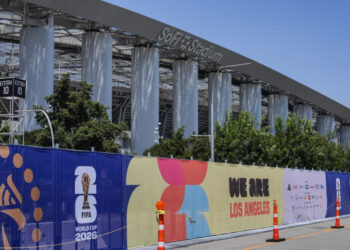
Since the start of the World Cup, the media has been filled with stories about foreign tourists’ delight at discovering everyday American institutions, from Buc-ee’s and 24‑hour big‑box stores to Waffle House, country music—and, yes, ranch dressing. They came for the soccer, but ended up rating late‑night diner meals and filming supermarket aisles. It has been entertaining to watch the world discover America—and, in the process, to see our own country through someone else’s eyes.
The World Cup has shown how American influence is often built: spontaneously, beyond negotiating rooms, through unfiltered encounters with our institutions and people. Ranch dressing may be a punchline, but it also stands for something serious. It is quintessentially American, easily accessible, and doesn’t need a global marketing campaign. People simply try it and find themselves asking why they can’t get this condiment back home. The same is true for much of what visitors have seen during the World Cup, from small kindnesses by strangers to familiar songs in unfamiliar places. These are soft‑power assets hiding in plain sight.
Yet America’s formal diplomacy was built for a different world. Like most countries, the U.S. still relies heavily on treaties hammered out over months and staged interactions between senior officials. Our country has created an entire multilateral architecture to facilitate such diplomacy, from the United Nations to the International Monetary Fund to the World Bank. This system has long been the primary way that America advances its interests abroad.
But can this succeed alone? Pew recently found that in 36 major countries, only 37 percent of adults have a favorable view of the U.S., even though views of America often improve when people experience the country directly—not filtered through algorithms or communiqués.
At the same time, many of the forces shaping national power now operate beyond government. Supply chains affect security. Technology platforms influence public debate. Universities create networks that last for decades. Commercial strategy and national influence are intertwined, and America’s competitors act on that reality every day.
The U.S. should respond in a distinctly American way: by treating private and civic institutions as full partners in building consequential relationships overseas. Not by turning businesses, universities, or sports leagues into instruments of Washington, but by creating practical ways for them to reinforce each other.
We already have models that show the path forward. Since 1940, the State Department’s Bureau of Educational and Cultural Affairs has led exchanges that bring emerging leaders to the U.S. and send Americans abroad. The International Visitor Leadership Program alone has brought tens of thousands of participants here; more than 500 have gone on to become heads of state or government. When a Jamaican participant came to the U.S. this year, she visited Arrowhead Stadium in Kansas City and met with leaders of the Washington Commanders. The experience produced concrete ideas for public-private stadium partnerships in Jamaica as they prepare to co-host the 2031 FIFA Women’s World Cup, creating exactly the sort of lived experience that changes how people think about the U.S.
But we need more. Trade missions, two‑way investment, student and scientific exchanges, and cultural and digital learning partnerships should be seen as core tools of American diplomacy, not sidebars. American companies should treat these soft power assets as strategic investments that build trust, expand markets, and strengthen U.S. competitiveness.
Can it be done? Yes, and Washington has a role to play. Outdated regulations that discourage responsible engagement should be modernized to make it easier for smaller firms, universities, cities, and cultural institutions to participate in trade missions and exchanges, and to align investment, trade, and public diplomacy tools so they pull in the same direction.
At the Overseas Private Investment Corporation, we spent years fighting to modernize a decades-old statute that barred the agency from making equity investments and capped its authorities well below what the private sector needed. Those reforms finally passed as the BUILD Act in 2018, creating the Development Finance Corporation–which literally builds bridges around the world. It was a major soft power victory that serves as the American counterweight to China’s Belt and Road Initiative. But the fight shouldn’t have taken more than a decade, and similar efforts today need to be realized tomorrow. Washington should prioritize breaking barriers to foreign interaction with U.S. cultural and corporate leaders, because they can build more goodwill and partnerships than the government alone. We can measure our diplomatic success not only by the treaties we sign but also by the breadth and depth of the networks we build. If something as simple as ranch dressing can change how visitors feel about the U.S., imagine what we could accomplish by deliberately connecting more people to the full range of American ideas and opportunities.
America must urgently rethink diplomacy because the global competition for leadership is intensifying by the day. The World Cup is a powerful reminder that we have so many soft-power assets that can charm allies and enemies alike to a deeper appreciation for—and partnership with—America. In the 21st Century, we aren’t going to win global hearts with treaties and joint statements alone. We will win hearts by inspiring people—because soft power, not ranch dressing, is America’s secret sauce.
David Bohigian, who led the transition of the Overseas Private Investment Corporation into the U.S. International Development Finance Corporation from 2017-2019, is CEO of the Meridian International Center.
The opinions expressed in Fortune.com commentary pieces are solely the views of their authors and do not necessarily reflect the opinions and beliefs of Fortune.
The post Ranch dressing is quietly doing America’s diplomacy for it appeared first on Fortune.