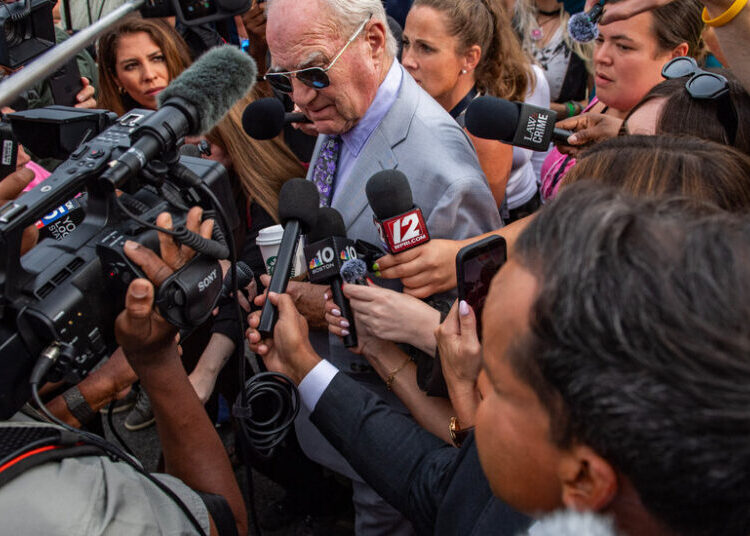
Troy Jackson, a progressive, took a significant step on Sunday toward replacing Graham Platner as the Democratic Senate nominee in Maine as two of Mr. Jackson’s leading candidates dropped out of the race.
On Sunday afternoon, Dr. Nirav Shah, a former public health official who finished second in the Democratic primary for governor last month, said he was suspending campaign operations and endorsing Mr. Jackson. Hours earlier, Shenna Bellows, the Maine secretary of state, ended her Senate campaign.
Their exits left Mr. Jackson, a former president of the Maine Senate, with dwindling competition going into a statewide nominating convention where some 600 delegates will choose a replacement for Mr. Platner, who ended his campaign after a rape accusation that he has denied.
The Democratic nominee who emerges will face Senator Susan Collins, a vulnerable fifth-term Republican incumbent, in the November midterm election. The race in Maine is considered central to Democrats’ chances of winning back the Senate.
In ending their runs, Dr. Shah and Ms. Bellows seemed to be bowing to Mr. Jackson’s resounding success at the county gatherings where the delegates were chosen. Dr. Shah said in a statement that he was suspending his campaign because the Democratic Party “must be unified” to defeat Ms. Collins.
“Susan Collins, Donald Trump, and Senate Republicans are banking on disunity and frustration from Maine Democrats to try and win this seat, and we are not going to give them that,” Dr. Shah said. “Maine Democrats are united, angry, and energized.”
By Sunday, an analysis of county results showed a clear majority of the delegates who will be invited to attend the convention from each of the state’s 16 counties were listed as supporting Mr. Jackson in a slate of delegates released by his campaign. Mr. Jackson’s momentum during the weekend was also clear in interviews with candidates, voters, delegates and party operatives.
At the convention, delegates from the counties and a state Democratic committee will vote on a replacement for Mr. Platner. The winning candidate will need a majority to clinch the nomination.
While some delegates have described their preferences in their nominating documents, they could still change their minds before the convention. Other variables, including a high-profile debate scheduled for this week, could still shift the race. At least one delegate, Sherrell Holtshouser of Stockton Springs in Waldo County, said she had been erroneously listed by Mr. Jackson’s campaign as a delegate supporting him.
“I think he’s a good candidate,” she said, but she added, “I did not commit to a candidate.”
The leading candidates to replace Mr. Platner had been broadly aligned on politics. At a debate last week, they disagreed on little beyond daylight saving time.
But Mr. Jackson, a fifth-generation logger from northern Maine, had been seen as perhaps the most closely aligned ideologically with Mr. Platner, who had campaigned on a progressive, populist message. Mr. Jackson has significant union support and talks often of “solidarity.” Like Mr. Platner, he supports universal health care and accuses Israel of carrying out a genocide in Gaza. And he had joined Mr. Platner on the campaign trail.
“He’s the heir of the campaign that just fell apart for Graham,” said State Representative Nina Milliken, a Democrat from Blue Hill, Maine. “The issues that Troy has been fighting for in the State Senate and in the State House are very similar to the ones Graham was fighting for on the campaign trail.”
Mr. Jackson ran for governor last month, finishing third. Ms. Bellows finished fourth in that race, while Dr. Nirav Shah finished second. All three quickly entered the race for Senate after Mr. Platner’s campaign imploded.
But Ms. Bellows said in a statement Sunday morning that “the best way that I can serve our state and country at this moment is by focusing” on her role as Maine’s secretary of state.
“The most important thing we can do in this moment is unite to defeat Susan Collins,” Ms. Bellows wrote on social media, adding in her statement that “Democrats don’t have a day to waste.” She did not immediately endorse another candidate.
Ms. Bellows ran against Ms. Collins in 2014 and lost by 37 percentage points.
Democrats in Maine spent the weekend gathering at county meetings to select 500 delegates who will join about 100 members of a state party committee in voting at the convention, which is set to be held in Bangor.
On Sunday, in a gusty parking lot outside a performing arts center in Southern Maine, Mr. Jackson gave a speech to his supporters before the York County delegate vote started.
“Yesterday, we showed them what this movement can do, what your movement can do,” he said. “Today, York County gets that chance. Let’s elect this slate, let’s win this nomination, and let’s unite this party.”
Farther north, in coastal Hancock County, Mr. Platner’s home county, all but one of the 23 delegates chosen Saturday appeared to be supporters of Mr. Jackson, said Marcia Myers, chair of the Hancock County Democrats.
“Nobody is committed — officially committed,” Ms. Myers said, but she added that Mr. Jackson’s success apparently stemmed from a mix of strong organization and a sense among Mr. Platner’s supporters that Mr. Jackson was the closest politically to the former nominee. “His supporters have seemed pretty closely aligned with Troy from early on, even before Graham dropped out.”
In recent days, union organizers supporting Mr. Jackson mobilized over calls that ran early into the morning to build slates for the meetings, said Andy O’Brien, a spokesman for the Maine A.F.L.-C.I.O., a federation of labor unions.
“This whole convention that was set up is really our bread and butter,” Mr. O’Brien said. “We’re organizers. So we were able to quickly organize and get slates for Troy in every county.”
The approach appeared to work resoundingly.
In Cumberland County, for example, which includes Portland, it appeared that all 149 people listed on Mr. Jackson’s slate of delegates were elected to fill the county’s 149 spots.
Mr. Jackson moved Sunday to secure the support of Mainers who had backed Ms. Bellows, as he thanked her on social media for her “friendship,” her “service” and her “dedication to our shared values.”
“Defeating Susan Collins will take all of us,” he added, “and I’m grateful for your commitment to bringing Democrats together around that mission.”
Another candidate, Jordan Wood, who lost in a competitive House primary last month, also responded swiftly to Ms. Bellows’s exit, saying on social media that he was inspired by her. “Proud to call you a friend,” he wrote.
The candidates piled into the unusual race after Mr. Platner’s exit and have built campaigns on the fly.
In a debate last week, Ms. Bellows acknowledged that she was rushing to study up on Ms. Collins’s recent voting record. When a debate moderator corrected her about Ms. Collins’s position on U.S. military action in Venezuela, Ms. Bellows said, “Forgive me — a week ago I was on vacation.”
The post In Maine, Jackson Takes Big Step Toward Nomination as Top Rivals Bow Out appeared first on New York Times.