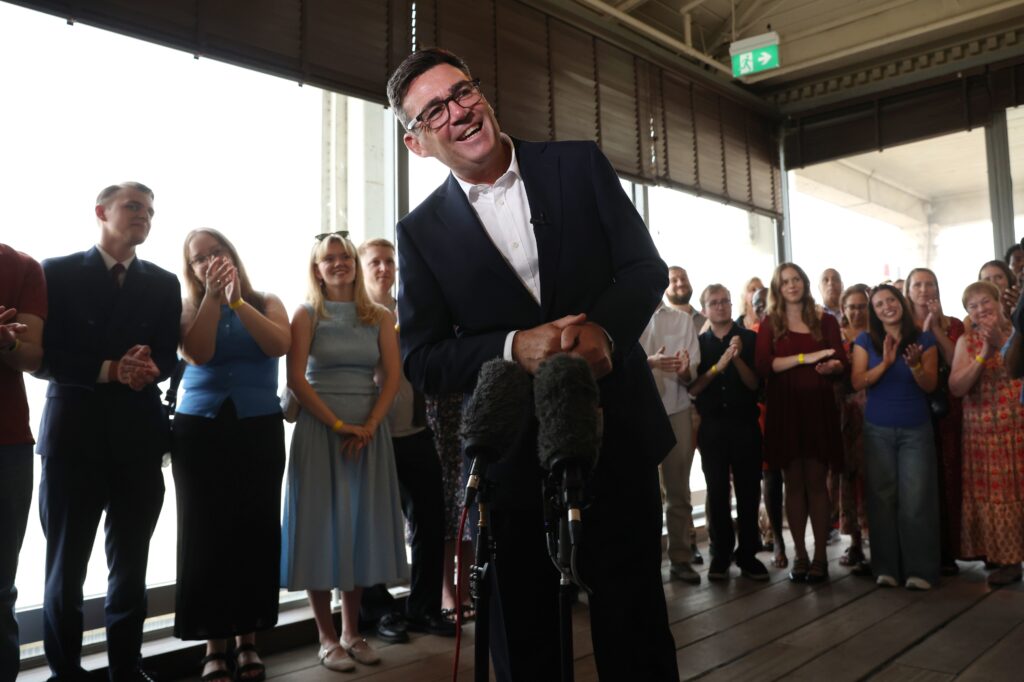
LONDON — Andy Burnham, until lately the mayor of Greater Manchester, takes office as Britain’s prime minister Monday with little foreign policy experience beyond trade missions to China and a soft spot for music festivals in Texas. Yet he faces daunting international challenges, a risk-management list that includes the Middle East, China, Russia — and President Donald Trump.
Burnham — who will replace Keir Starmer in Britain’s top job as the ruling Labour Party scrambles to shore up its sagging popularity — has for weeks been considering his foreign policy team and briefing up on the most explosive hot spots.
And while bracing for dealings with Trump might not quite be akin to prepping for the next pandemic, the mercurial Oval Office holder does require planning and strategy and contingencies that would have been unthinkable for previous administrations.
“Trump is obviously an ally and not a security threat,” said a Labour Party official who spoke on the condition of anonymity to discuss sensitive details. “But the combination of his unpredictability and his power means he is absolutely an issue that has to be prepared for in a way that other presidents were not.”
“They are certainly thinking about it already,” the official said. “It is an area where you may see some differences to Keir.”
Nearly every U.S.-allied government has had to wrestle with the same question: How much of your leader’s dignity does the White House relationship demand? Across countries, the foreign policy establishment’s answer tends toward pride-swallowing pragmatism — compliments over confrontations, manage the presidential ego rather than provoke it.
Starmer, who had been in office for six months when Trump was inaugurated for the second time, bet on flattery — an on-camera invitation to a state visit, a fixed smile, all criticisms muted and couched in commitments to the “special relationship.”
For a while it paid off, with Britain securing relatively favorable treatment from Trump on trade and tariffs compared with its European neighbors. But in March that blew up, when Starmer’s refusal to fully join the U.S.-Israel war in Iran provoked a shower of disdain from Trump, who dismissed the prime minister as “no Winston Churchill.”
Nor did the strategy go over very well with a British public that quailed at what critics said was bending the knee to Trump. A January Ipsos poll found that 47 percent of British respondents thought Starmer was doing a bad job managing the relationship with the United States.
It didn’t help that the president remains deeply unpopular in Britain and has only sunk in public approval during his second term. Fully 69 percent of Britons view Trump unfavorably in the latest Ipsos poll, exactly the same proportion who disapprove of “taking your shoes off on public transport.”
“He’s never been popular, and he’s getting less so,” said Gideon Skinner, the head of U.K. political research at Ipsos. “But there is also recognition that prime ministers will sometimes have to take a wider set of issues into account in these relationships.”
Trump is just one tricky item in a foreign affairs portfolio that is not expected to be high on Burnham’s list of priorities, at least until events inevitably force their way onto the agenda. He has made clear that his instincts, and his mandate, are relentlessly domestic — he announced plans to govern partly from Manchester, a signal that the new No. 10 will have its eyes fixed inward rather than across the Atlantic.
Burnham is largely expected, in early months at least, to carry on Starmer’s general approach, according to a British official familiar with internal discussions, who spoke on the condition of anonymity to share sensitive details: seeking to champion Ukraine, contain Russia, and ease militarily and economically closer to European countries without formally bidding to rejoin the European Union.
The foreign policy inbox — Trump included — is expected to be substantially subcontracted to a heavyweight foreign secretary. Some of the names he is reported to be mulling are the current foreign secretary, Yvette Cooper; former foreign secretaries David Miliband and David Lammy; and John Healey, the defense minister who resigned last month to protest what he characterized as Starmer’s inadequate military spending.
Whoever gets the job is expected to play an outsize role in international affairs while Burnham focuses on the economy and government reforms.
“I would be really surprised if Burnham ends up caring a lot about foreign policy. This is not really his thing,” said Joshi Herrmann, who has covered Burnham closely for six years at The Mill, a Manchester news outlet. “I think the most foreign policy he’s done is going to South by Southwest,” a festival in Austin.
Those who have worked with and covered Burnham say he is likely to approach the Trump part of the job differently than Starmer did, partly because of Burnham’s personality and partly because of changing circumstances.
Starmer, a former prosecutor, is seen as a coolheaded technocrat, unruffled by the insults as long as he was making his case. Burnham, a Liverpool native, has honed a warmer, plainspoken touch. A longtime member of Parliament from northern England and former Labour cabinet minister, he is frequently compared to Bill Clinton as a pol who feeds off the affirmation of others.
That sociability could be an asset in any encounter with a president who responds to personal chemistry in ways he doesn’t respond to formal diplomacy. But it could also make the incoming prime minister vulnerable when the Truth Social attacks start flying from the White House residence at 3 a.m.
Herrmann finds the prime-minister-in-waiting to be more emotionally exposed than Starmer, or other predecessors.
“A concern with Burnham is that he’s not like [former prime minister Tony] Blair, who had cold ice in his veins,” Herrmann said. “Burnham’s not like that. If Trump says stuff about Burnham, he will feel the need to try and make up with him or respond or something.”
Mark Malloch Brown served alongside Burnham when they were ministers in former Labour prime minister’s Gordon Brown’s government. His political talents were obvious even then, he said, but so was an underlying neediness.
“The Burnham I remember from 10 years ago did have that politician’s weakness of wanting to be loved,” said Malloch Brown, who now sits in the House of Lords.
It remained to be seen whether Burnham’s decade of governing Greater Manchester’s population of some 3 million has tempered his glad-handing instincts with a layer of emotional resilience.
“I expect it’s 10 years in which he’s been toughened in the trenches of an executive job and all those times he’s had to say no to people,” he said. “Let’s see if it’s toughened him up.”
Burnham may benefit from a changing political climate. When Trump returned to the White House, the consensus in Britain’s ruling circles was that Starmer’s safest course was to flatter and cajole and placate. The leaders of the Conservative and Reform UK parties were quick to jump on any perceived threat to the “special relationship.”
Following Trump’s attacks on Iran, even Starmer’s opponents have quieted, including Reform UK founder Nigel Farage, a longtime Trump ally.
“I think the whole British political class along with British public opinion has reassessed that and realized that Trump is Trump and that you have to separate between Trump and the U.S.,” Malloch Brown said. “That will give Burnham a chance to stand taller in his dealings with the Trump administration than Starmer did.”
So far, there has been no beef and neither Trump nor Burnham seems in a hurry to meet.
Burnham has said little about Trump, unlike his Labour-mayor colleague Sadiq Khan, the mayor of London, who seems to delight in his running feud with the president.
Burnham did tweet after the Jan. 6 attacks on the U.S. Capitol, “Any UK politician who gave Trump the time of day should be ashamed right now.” But in a 2024 book, he also expressed sympathy for Trump voters, saying that both Trump and Farage have been “effective in connecting with people who feel politicians have neglected the place where they live”.
Trump, when asked last month what he knew of Britain’s likely new leader, was dismissive.
“I don’t know anything,” he said in the Oval Office. “I see that he was, I guess, the mayor of a town.”
He did not expect to host Burnham at the White House any time soon, he said.
“I think we’re probably of a different persuasion. He’s very liberal,” Trump said.
The post Andy Burnham prepares to lead Britain — and face Trump appeared first on Washington Post.