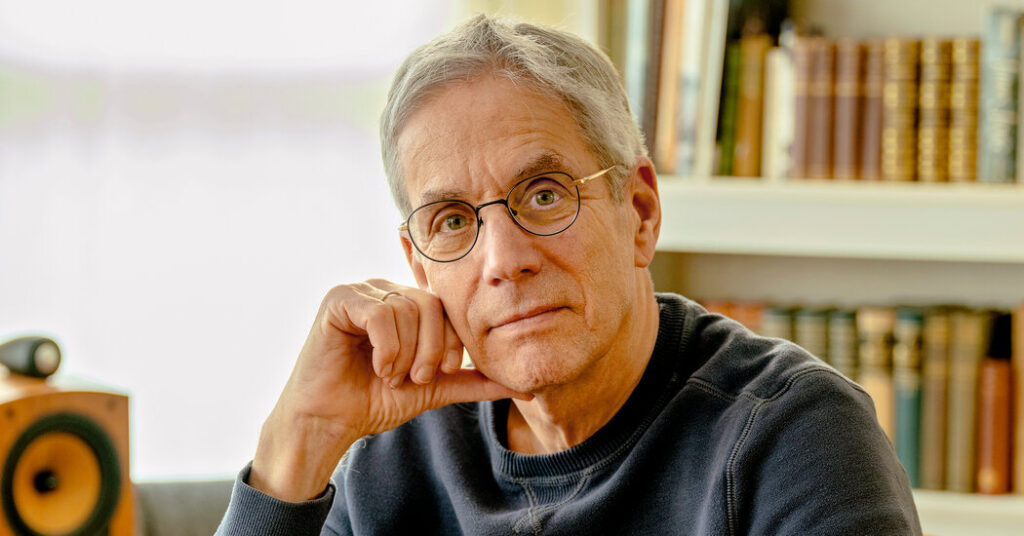
Walt Odets, a psychologist whose work with gay men in the Bay Area at the height of the AIDS epidemic led him to write a book on a nearly taboo topic, the survivor’s guilt and depression experienced by men who were not infected with H.I.V., died on July 7 at his home in Berkeley, Calif. He was 79.
The cause was complications of Alzheimer’s disease, his companion, Armen Davoudian, said.
Mr. Odets’s 1995 book, “In the Shadow of the Epidemic: Being H.I.V.-Negative in the Age of AIDS,” appeared more than a decade into the crisis — before effective treatments arrived and as thousands of men dying in their prime continued to grip gay communities in grief, fear and anger.
Mr. Odets, who was gay, wrote that there was also a “psychological epidemic” among those who were H.I.V.-negative, who were “anxious and lonely in their ‘wellness.’”
“For many,” he added, “survival is so difficult they sometimes wish they had not survived and sometimes hope they will not.”
Speaking about this population, he acknowledged, was fraught.
“It has often seemed selfish, inappropriate or simply ridiculous for the uninfected to have any important feelings about themselves,” he wrote. “Feelings about oneself seemed the exclusive right of those who were infected, sick or dying.”
But such feelings mattered, he continued, because a sense of fatalism among H.I.V.-negative men encouraged unsafe sex.
Reviewing “In the Shadow of the Epidemic” for The New York Times Book Review, David L. Kirp, a professor of public policy at the University of California, Berkeley, wrote that it belonged on the same shelf as two classic studies of populations living with trauma: Robert Coles’s “Children of Crisis,” about the effects of racism, and Robert Jay Lifton’s “Death in Life,” about Hiroshima survivors.
Walt Whitman Odets was born on Feb. 4, 1947, in Los Angeles. He was the son of the playwright Clifford Odets, the author of “Awake and Sing!,” “Waiting for Lefty” and other works, and an actress, Bette Grayson. An older sister, Nora, was born with a mental disability; their parents chose not to institutionalize her, and she grew up with the family.
Both of his parents died by the time he was 16, and Walt spent part of his late adolescence in New York with his legal guardians, Lee Strasberg, the Method acting pioneer, and Strasberg’s wife, Paula.
He received a B.A. in philosophy from Wesleyan University in 1969. He was married to Paula Harrington, a journalist in the Bay Area, from 1983 to 1986. His sister died in 2008. His companion, Mr. Davoudian, is his only immediate survivor.
Photography was Mr. Odets’s first career. His works are in the collections of the Oakland Museum of California, the Brooklyn Museum and the Cantor Arts Center at Stanford University.
After training in clinical psychology at the California Professional School of Psychology in San Francisco, he received his Ph.D. in 1989 and offered therapy in Berkeley to gay men as individuals or couples. In the years before his first book appeared, Mr. Odets was best known in the Bay Area as a fierce critic of AIDS prevention campaigns that had failed to slow infections among younger men.
He juggled his practice with writing some of the earliest and most influential watch reviews on the internet in the late 1990s. He disassembled timepieces, examined their mechanics with a microscope and wrote knowing assessments for TimeZone, a website catering to watch collectors and horology buffs.
A quarter-century after “In the Shadow of the Epidemic,” he wrote an update on gay men’s psychology, “Out of the Shadows: Reimagining Gay Men’s Lives” (2019).
Despite evidence of progress — treatments, beginning in 1996, that drove AIDS mortality sharply downward; same-sex marriage becoming the law of the land — Mr. Odets dismissed the notion that America had outgrown its deep homophobia.
He wrote that shame remained an ever-present emotion for many gay men and “still often lurks unconsciously behind the most successful of gay lives.”
Gay identity, he maintained, entailed far more than merely a physical attraction to other men. Because his mother had died when he was a child and his sister was disabled, his emotional attachment to his father, he wrote, was a major influence on how he understood what it meant to be a gay man.
“I have emotional feelings for men that I’m cautious about with women,” he explained to Publishers Weekly. “That’s really the crux of the whole book, that being gay is a whole internal life and a sensibility, and it’s much broader and much richer than the conventional male identity that’s so heavily promoted.”
“Out of the Shadows” ends with an affecting account of the lifelong bonds that Mr. Odets forged with a gay college classmate and the man’s live-in lover. For decades, they were a bicoastal throuple, which sometimes expanded romantically to others, including a partner of Mr. Odets’s, Robb Caramico, who died of AIDS in 1992.
“There’s sadness in Odets’s life story,” Benoit Denizet-Lewis wrote in a Times review of the book, “but there’s mostly resilience, tenderness and a willingness to fashion an unapologetic gay life, sometimes against all odds.”
The post Walt Odets, Who Delved Into the Minds of Gay Men, Dies at 79 appeared first on New York Times.