Speeding is a waste of time.
Minnesota researchers have proved there’s no “need for speed” after finding that driving too fast saves less than 60 seconds, per a rubber-burning study published in the Nature journal Communications Sustainability.
“If your goal is to shave one minute off your time, then you’ve got to drive fast,’ snarked study co-author Professor William Northrop of the University of Minnesota, in a statement. “If your objective is to get to your destination safely and to save fuel, then you might drive slower than the speed limit.”
Northrop and his team had reportedly set out to discover the effect that burning rubber has on fuel economy, time and emissions.
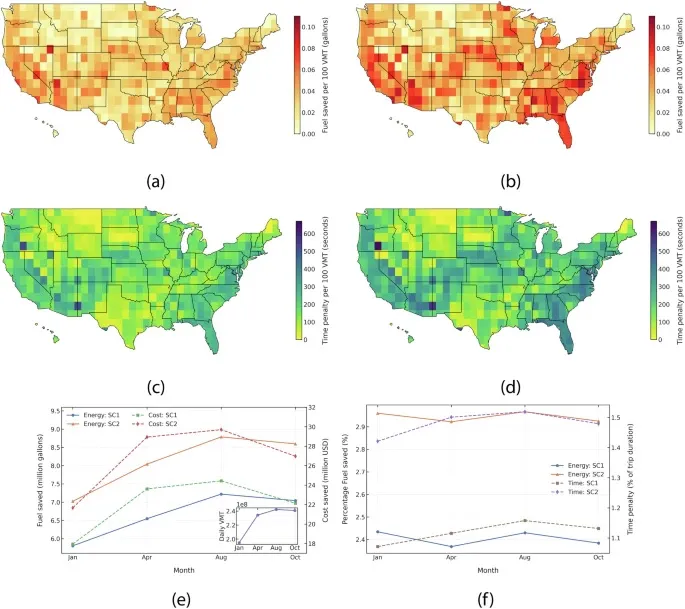
To determine if committing the crime saved time, the scientists reportedly analyzed 120 million car trips across the US in 2021, relying on driving data on national road networks, speed limits and elevation metrics from the US Geological Survey.
They restricted the sample to roads where the speed limit was 45 mph or higher.
The team found that, contrary to what many speed demons would have you believe, driving at or below the speed limit only corresponded to around 54 seconds longer per day when the average daily distance was 28.6 miles.
This extrapolates out to just over 6 minutes per week.
Despite failing to meaningfully expedite one’s car trip, a troubling number of motorists go pedal to the metal. According to the study, 43 percent of the trips included one incident of speeding, while drivers spent 12 percent of their time behind the wheel exceeding the speed limit.
“While internal combustion engine-powered vehicles have become significantly more efficient in the past decades, they have also become much more powerful,” said Northrop. “Driving fast is easier than ever.”
Unfortunately, wasting time isn’t the only side effect of this pedal crime. Going full-throttle can have your fuel tank gone in 60 seconds, per the study, which found that speeders burn 2.3 to 3 percent more gasoline on average.
Were drivers to comply with posted speed limits, it could save an average of $22 million and 6.7 million gallons of fuel — in other words, the juice is not worth the speed.
Researchers declared that the only thing that gas-holes accelerate is the decline of the Ozone, estimating that ignoring speed limits wastes 7,000 metric tons of carbon dioxide every single day for light-duty engine-powered vehicles.
Ultimately, the study demonstrates that motorists can have their gas-guzzlers and drive them too.
“Our study examines an obvious yet difficult-to-implement intervention for major fuel savings that can be achieved without replacing our cars: driving slower,” concluded Northrop.
The post Speed kills — but a new study reveals that’s not the only downside to driving too fast appeared first on New York Post.