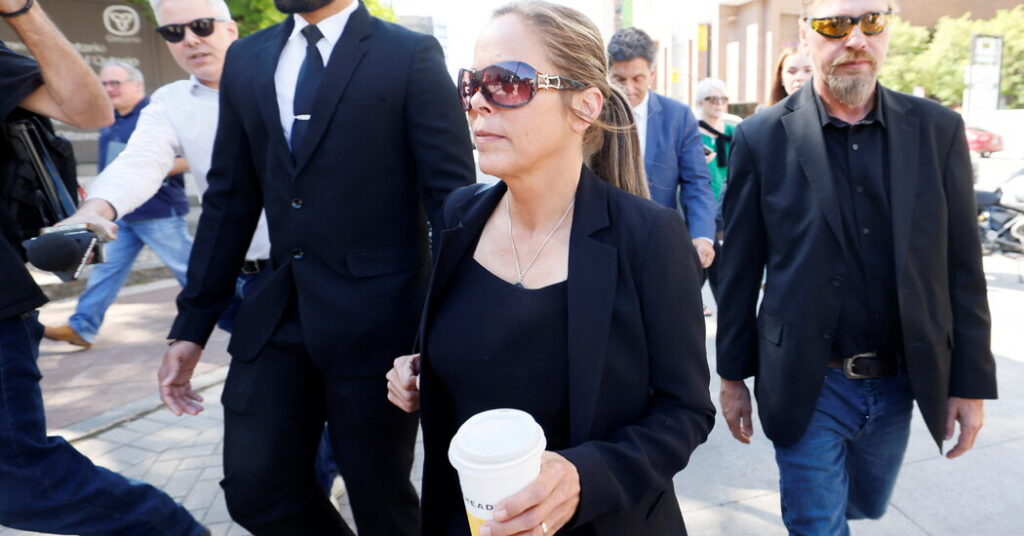
The woman convicted of organizing a trucker convoy that paralyzed downtown Ottawa for nearly a month surprised residents of the Canadian capital when she popped up at the United States Embassy’s July 4 garden party, despite being under house arrest. Now Tamara Lich is asking a court to loosen the conditions of her sentence to let her travel to the United States, where she hopes, among other things, to visit the White House and join a cruise.
In a court filing opposing the request, prosecutors say Ms. Lich wants “a ‘blank cheque’ in approving international travel for the purposes of self promotion.”
“This is getting ridiculous,” said Catherine McKenney, the Ottawa City Council member for downtown in 2022 who now represents the area in Ontario’s legislature. “You’re either under house arrest or you’re not.”
Ms. Lich was convicted last year as one of the organizers of the convoy, in which large trucks occupied downtown Ottawa in what began as a protest against vaccine mandates and evolved into a broad anti-government movement.
The blockade effectively shut down most of the capital’s downtown streets, forcing a major shopping mall, hotels and other businesses to close and causing an estimated $150 million to $210 million in lost trade and wages. Until a court order was issued, truckers blasted their air horns day and night, keeping residents awake. Evidence at Ms. Lich’s trial showed that many downtown residents felt harassed and intimidated.
The protest provoked anger and outrage among many residents, including Mark Carney, now the prime minister, who was then working in finance after returning to the city from his post as governor of the Bank of England.
In an opinion article for The Globe and Mail written during the convoy’s second week, Mr. Carney said residents were being “terrorized” and called the protest “blatant treachery” and “sedition.”
“Those who are still helping to extend this occupation must be identified and punished to the full force of the law,” Mr. Carney wrote at the time.
Ms. Lich, the protest’s primary spokeswoman and fund-raiser, received an 18-month conditional sentence. For the first year, she is required to remain under house arrest at her home in Medicine Hat, Alberta, with a handful of exceptions.
But in an online post made after the embassy party, Ms. Lich said that she was able to travel roughly 3,000 kilometers from Medicine Hat to Ottawa because of one of those exemptions, and her new job.
Ms. Lich, who previously worked in oil and gas administration and was unemployed at the time of her sentencing, is now a “community ambassador” for Rebel News, a site known for championing right-wing causes and for its often confrontational interviewing style.
As reviled as she is in Ottawa, Ms. Lich is something of a folk hero in right-wing circles, where her conviction and sentence are seen as an unjust intrusion on free speech.
In an online fund-raising post, Rebel News said it sent its job offer to Ms. Lich’s sentence supervisor in Alberta “and walked her through it, line by line — including the parts about Tamara traveling. And to our relief, the probation officer approved it!”
The only explicit travel exemption written into her sentencing conditions allows her to go to and from Ottawa for court hearings.
Lawrence Greenspon, Ms. Lich’s lawyer, said that since his client began working with Rebel News in January, she has made 13 trips to other Canadian provinces, including her Ottawa visit on July 4. They were individually approved by her supervisor, he said, and she was required to file detailed itineraries for each one.
“She’s doing her job,” Mr. Greenspon said. “And she’s doing it under very strict conditions.”
Ms. Lich is appealing her conviction, and prosecutors are separately appealing her conditional sentence, seeking a more severe punishment. They had asked that she be jailed for seven years at her sentencing.
Ms. Lich has said that she was invited to the embassy party, though the State Department said in a statement that she was accredited as a journalist. Neither the State Department nor the embassy responded to questions about whether they knew she was still under house arrest.
Ms. Lich wrote on Rebel News that she met with Pete Hoekstra, the United States ambassador, “to thank him personally for the support he and so many Americans showed during the Freedom Convoy.”
In her request to the court, Ms. Lich says she plans on “doing press at the White House/on American politics.” According to the prosecutors’ response, she also wants to speak and do book signings on a Rebel News Caribbean cruise in November and December, and to travel to Arizona to be interviewed by Rob Schneider, the actor, comedian and director who has spoken out against child vaccination requirements.
Prosecutors note that Ms. Lich’s supervisor has already granted her permission to take her grandchildren to and from school, in addition to the “numerous exemptions” allowing her to leave the province for her job with Rebel News.
In an unsigned email, Alberta’s department of public safety declined to comment, citing privacy laws.
Kent Roach, a law professor specializing in criminal justice at the University of Toronto, said Ms. Lich’s request opened the door for the judge to make her sentencing conditions more restrictive after a hearing scheduled for July 22. He also noted that Quebec’s Court of Appeal has ruled that conditional sentences cannot be served outside Canada because supervision would be impossible.
Mr. Greenspon said that it was not unusual for people under conditional sentences to be allowed to travel for work and that Ms. Lich should not be treated differently.
“There are people who don’t like Tamara, and what they really don’t like is that she’s in the public eye,” he said. “What they really want is that she be put behind bars.”
In the original sentencing decision, Justice Heather E. Perkins-McVey of the Ontario Court of Justice said that a conditional sentence “is not a lenient alternative to probation” and noted that the Supreme Court of Canada “emphasized that conditional sentences must include meaningful restrictions on liberty.”
In their filing, prosectors argue that granting Ms. Lich’s request “would create a sentence too lenient when considered against the nature and seriousness of the offense.” They also wrote that if she is allowed to sign her book about the convoy, “Hold the Line: My Story From the Heart of the Freedom Convoy,” or speak about her experiences on the cruise, she will “effectively monetize her involvement in the Freedom Convoy — the exact thing that she is serving a sentence for.”
Ian Austen reports on Canada for The Times. A Windsor, Ontario, native now based in Ottawa, he has reported on the country for two decades. He can be reached at [email protected].
An Orange Fog Descends, Forcing Communities to Flee Advancing Flames
Once again, hundreds of people have fled wildfires and the smoke from blazes in Ontario that shrouded cities in Canada and the United States, including Toronto, Chicago, Detroit and New York, in a toxic orange fog this week.
As millions of people cope with the effects of the smoke spewing from wildfires in Ontario, the natural disaster took a political turn on Friday. After four Republican lawmakers in Michigan complained about smoke created by what they claimed are Canada’s poor forest management policies, President Trump weighed in and threatened to impose tariffs on Canadian exports. He said he would call Prime Minister Mark Carney on Saturday to “find out what they are going to do about it.”
Mr. Carney had earlier called out the Trump administration for its rollbacks of climate change measures. Doug Ford, Ontario’s premier, was more direct, noting that his province has aided the United States when it has been hit by large-scale disasters.
“If there’s some politicians out there chirping away, well, maybe what you should do rather than complain is send support, send help, because we have done the exact same thing for our American friends,” Mr. Ford told reporters.
Of course, smoke can move both ways across the border. Ephrat Livni looked back at times when Canadians were choking on smoke from fires in the United States.
The immediate forecast for the fires and the smoke is not promising. We have regularly updated smoke tracking and air quality maps here.
Judson Jones, a meteorologist at The Times, lays out the factors that make it difficult to predict when the smoke will go away.
Watch the wildfire smoke ooze across North America from space, as satellite imagery shows the wide footprint of the smoke across the continent.
Vjosa Isai and Amy Graff reported that this year’s fires are exhibiting a worrying pattern. Historically, night meant that temperatures fell, humidity rose and wildfires dropped in intensity, giving firefighters a chance. But now, high temperatures even at night have created a 24-hour fire cycle.
We are marshaling reporters, photographers and editors for continuing coverage of the fires and the smoke, while also keeping a close watch on the fires forcing evacuations in British Columbia.
— Ian Austen
Trans Canada
-
The police found several hundred firearms while searching the Dauphin, Manitoba, home of Inky Mark, who spent 13 years as a Conservative member of Parliament. He was arrested and charged with a dozen gun offenses, including firearms trafficking and multiple possession charges.
-
Two people were killed and at least four others injured during a shooting at a popular street festival in Toronto last Saturday evening.
The Canada Letter is edited by Shawna Richer, who oversees Canada coverage on the International desk at The Times. She lives in Toronto.
How are we doing? We’re eager to have your thoughts about this newsletter and events in Canada in general. Please send them to [email protected].
Like this email? Forward it to your friends, and let them know they can sign up here.
The post Freedom Convoy Leader, Under House Arrest, Wants to Visit the White House appeared first on New York Times.