I can always tell that a trend has burst into the mainstream when I start to face the “what’s the deal with …” questions.
For months now, readers, friends, even my brother have hit me with a new one: “What’s the deal with the hats with the upside-down words?”
And that’s all it is: a hat with “Nashville” or “Coffee” or “Mother” or “Drunk” stitched across the crown in an inverted arch. (That last one might make the most sense, following the logic that these are the headwear relatives of the groany boardwalk T-shirts that say, in upside-down script, “If you can read this, put me back on my bar stool.)
You can buy hats with “EBITDA” written upside down (what you’d wear, I guess, if your start-up goes the way of Enron), hats with “Republican” upside down and hats with “Jesus” upside down.
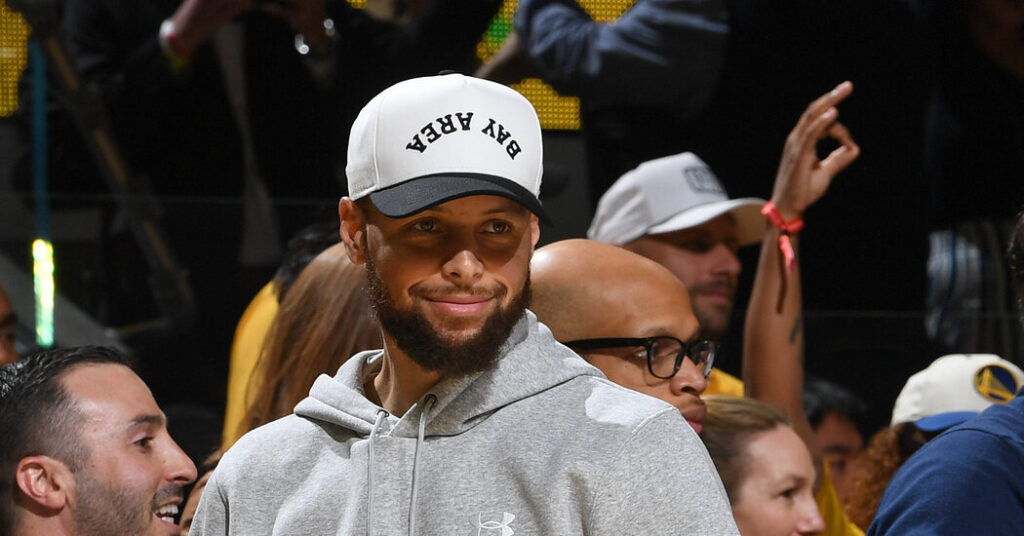
The capsized cap has particular purchase among pro athletes and those who track them. Steph Curry has worn a cap with “Bay Area” inverted. The golfer Jose Luis Ballester wore an upside down “Sun Devils” hat as he shot his way through the Masters last year. I’ve seen hats with inverted text for “Pebble Beach,” “Putt,” “Birdies” or the consciously droll “Golf.” Sorry, that is “Flog.” Kind of.
In the forest that is contemporary fashion, these hats occupy a branch with performance polos, Lululemon chinos and On sneakers. Their target demo is a Barstool Sports reader, not a Balenciaga client.
That’s to say, they’re more merch than fashion. Their purpose isn’t to look interesting but to shout an interest. The tweaked text, like “Made ya look,” turns up the shout. Many are also green and cream.
The origin of many trends is hazy. This one has a patient zero: True Brvnd, a Dallas company that claims to have invented the idea when it flipped its hometown, put it on hats and started selling them in 2020. (I can’t find evidence of an earlier inverted design, and based on Google Trends data, 2020 is when searches for “upside-down hat” begin to rise, so I will believe True Brvnd.)
Sang Truong, the company’s founder, said the spark came from the feeling of unease in the early days of the Covid pandemic. “I remember seeing this thing that says, ‘The world’s upside down,’” he said. “So I literally took the word ‘Dallas,’ and I flipped it upside down on a hat.”
Sales jumped when, through an acquaintance, he got the hat on the Cowboys quarterback Dak Prescott. Klay Thompson and Dez Bryant have since worn “Sallad” hats. Truong has sold 600,000 hats, he said.
But the general concept has gone further. I’ve seen inverted text hats as far away as Paris. New Era, the largest player in the fitted hat industry, now sells a range of caps with flipped team logos.
“Brands have popped up in the last year or two that if you go to their sites, the whole premise is an upside-down logo,” said Adam Herstig, the senior vice president of marketing and partnerships at Lids.
Herstig, for his part, cited Kill the Hype, a streetwear label that appears to have been the first to sell hats with a flipped Los Angeles Dodgers logo, with convincing more labels to flip their logos.
Herstig noted that some sports teams had been more precious than others about futzing with their logos. On the Lids website you can find a hat with “New York” upside down but notably not a hat with the Yankees logo flipped.
“We think we could drive a lot of sales if we were able to do it across all teams, all leagues, but that’s not currently the case,” Herstig said.
These hats underline the thinking that fashion often isn’t about radical rethinks but small tweaks on styles we’ve known forever.
The inverted text, Troung said, “keeps it unique without going too crazy on the spectrum of, like, ‘Man, that’s out there.’” He cited Virgil Abloh’s ethos that you only need to tweak an existing idea three percent to make something new. I doubt that Abloh was thinking about golf course apparel when he said that.
But, it’s true, the inverted cap doesn’t overhaul the form or deviate in color or pattern in an unsettling way. It isn’t so wild that you’d arrive at the bar in one and look to your peers as if you were trying something, which is the true kiss of death in men’s fashion. It tweaks one small thing: a word. And that is enough to make a trend.
Sports Wear
The ESPYs were held on Wednesday evening. Beyond the awards show’s usual, only mildly confusing categories (if a team won a championship, aren’t they already … you know, the Best Team?), there were a lot of strapless gowns and, for that matter, a lot of enviable biceps. Kate Upton in croc-embossed Schiaparelli, Jordyn Woods in crystal-y Oscar de la Renta, Simone Biles in a champagne Eman Alajlan gown with a high slit.
Alysa Liu, who has sped to being a fashion-world favorite after winning Olympic gold, was in a scoopy-neck Louis Vuitton gown. (She is a “house ambassador” of the brand.) The backless gown was said by someone to have channeled Shirley MacLaine, but to me it looked a lot like Chrome Hearts. (Sorry!)
It has been fun charting the championship Knicks’ respective glow-ups — their embrace of luxury fashion and luxury fashion’s embrace of them. Jalen Brunson looked about as sharp as I can remember in a peak-lapel Louis Vuitton suit. OG Anunoby was in a Burberry suit with a narrow double-breasted closure. Karl-Anthony Towns wore a more down-the-middle black Gucci suit. There was, in fact, a lot of Gucci on display: Lindsey Vonn and the stock car racer Toni Breidinger were both in dresses from the brand. Evidently, the answer to who is wearing Demna’s Gucci is pro athletes.
Other things worth knowing about:
-
The winner of “The Odyssey” press tour? Zendaya as a fallen angel in Matières Fécales.
-
On Saturday in Miami, Norway’s national team lost its last World Cup game. By Tuesday, the team’s standout striker, Erling Haaland, was seated at the Dolce & Gabbana fashion show in Taormina, Sicily. When it comes to celeb wrangling, one must strike while the striker is hot.
-
I, for one, find it fitting that OpenAI’s new clothing collection looks as if a machine studied every insipid streetwear brand from my Instagram Explore page and spit back out some tees. It’s not lazy design! It’s just showing what your product can do.
-
Ahead of playing the World Cup final halftime show, Justin Bieber has opened a pop-up for his Skylrk fashion brand in the Meatpacking District in New York. I went by on Thursday afternoon and found a down-the-block line. Inside, shoppers (many already wearing Bieber merch) grabbed capri sweat shorts and swaddling hoodies. Bieber can still move units.
-
Credit to my friend Jonah Weiner for pointing out that the Notion co-founder Ivan Zhao was not wearing Armani in Sun Valley, Idaho, as I speculated in my last newsletter, but was actually in Evan Kinori. Zhao’s $1,275 tumbled hemp Kinori jacket is sold out, but you can still get the vest if you’re a size small.
-
And thanks also to the reader who caught that the $298 red Polo windbreaker that was only at Ralph Lauren stores in France, and that I mentioned in a newsletter way back in March, is now available on R.L.’s American web shop.
Ask Vanessa
Why is it so difficult to find fashionable clothes that have sleeves? I know it’s hot out, but the skin on my upper limbs is no longer something I want to show off, and increasingly I feel there is no alternative. What is someone to do if they want to survive the current temperatures and look stylish but aren’t happy about revealing their arms? — Rebecca, Savannah, Ga.
You are correct in noting the growth of sleeveless clothing. According to Cognitive Market Research, the global sleeveless market is “projected to grow from $24.36 billion in 2021 to over $51.39 billion by 2033.” Moreover, Alexandra Van Houtte, the founder of the fashion search engine Tagwalk, said it had seen a 133 percent increase in sleeveless looks in the spring 2026 collections versus spring 2025. The most obvious reason for this is environmental: In increasingly sweltering summers, everyone’s fancy lightly turns to thoughts of less fabric. Fitness culture also plays a role, as do changing gender norms. … Read more.
Look of the week
The post What’s the Deal With Those Upside-Down Hats? appeared first on New York Times.