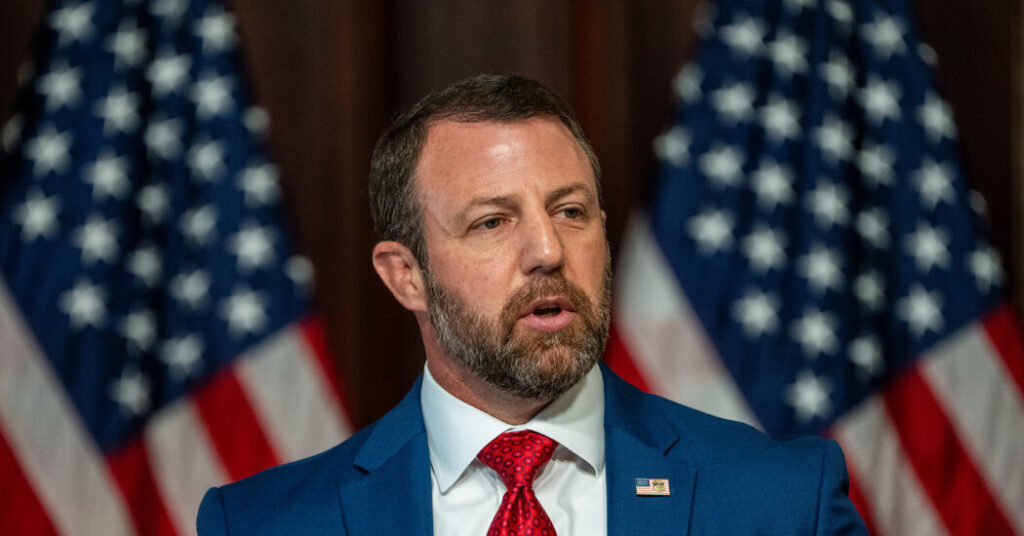
Homeland Security Secretary Markwayne Mullin threatened local election officials on Friday with prison time if they did not comply with the Trump administration’s efforts to change election policies, while reiterating many of President Trump’s unsubstantiated claims about the security of American elections.
Mr. Mullin pledged to “dig in just a little bit deeper” than a prime-time speech that Mr. Trump gave on Thursday, when the president claimed without concrete evidence that American elections were rife with “hacking, manipulation and corruption.” The secretary largely stuck to similar talking points, repeating the president’s unverified claim that the government had found hundreds of thousands of noncitizens on voter rolls in at least four states. Neither Mr. Trump nor Mr. Mullin offered any specifics on how they derived those numbers, and officials in at least two of the states said their voter rolls were properly maintained.
Mr. Mullin also repeated claims that foreign actors could exploit vulnerabilities identified in election systems to change votes, despite offering no evidence that such a breach has ever occurred. Cybersecurity experts and election officials say that such a scenario is extremely unlikely, as voting equipment is generally not connected to the internet and most hypothetical scenarios of tampering would require physical access to machines.
The secretary’s remarks follow an increasingly vocal effort by the Trump administration to use the power and pulpit of government to bolster the president’s long-held false claims about elections. Mr. Trump’s speech on Thursday, coupled with Mr. Mullin’s pledge to continue pressing those false claims, was a significant escalation of such rhetoric and risked creating additional chaos and doubt for election administrators and voters alike as the midterms draw near.
The louder and more aggressive claims come as the president and his allies seek greater control over the levers of the nation’s election infrastructure, despite clear legal limits. The Constitution grants the power to govern elections to Congress and the states, and grants no explicit authority to the executive branch.
That didn’t stop Mr. Mullin from ramping up pressure on state and local election officials in his remarks on Friday.
“If the election officials, once we gave them the information they need to secure their elections, and they chose not to, then those individuals can also be held accountable by fines, by penalties and even, depending on how far it goes, prison time,” Mr. Mullin said.
This is not the first time the Trump administration has threatened election administrators with jail time. This month, the Justice Department sent letters to all 50 states and the District of Columbia threatening criminal prosecution if election officials counted any ballots cast by noncitizens in upcoming elections. Last year, senior Justice Department officials began exploring whether they could bring criminal charges against state or local election officials.
Mr. Mullin’s reiteration of Mr. Trump’s claim — that the Homeland Security Department had found more than 250,000 noncitizens on the voter rolls in California, New Jersey, Nevada and Pennsylvania — did not entirely square with a letter the secretary sent to one of those states on Thursday indicating that the number was most likely just an initial estimate. Like Mr. Trump’s and Mr. Mullin’s remarks, the letter offered no specifics on how the government had investigated the voter rolls in those states.
“Preliminary review of the records revealed that there may be as many as 14,576 noncitizens registered to vote in Pennsylvania,” Mr. Mullin wrote to local election officials in the state, according to a copy of the letter obtained by The New York Times. He wrote that the review was based on an “analysis of Pennsylvania’s publicly available voter registration database information.”
Officials in California, Pennsylvania and Nevada quickly pushed back on the claims. “Noncitizen voting remains exceedingly rare,” Shirley N. Weber, the Democratic secretary of state in California, said in a statement. “In California, election officials work every day to maintain accurate voter rolls and ensure that only eligible voters are registered.”
The government’s analysis appears to have used publicly available state voter records that are scrubbed for privacy reasons of important identifying information, including driver’s license numbers. The invalidity of analyses on such data — and the tendency to inflate numbers — have been well documented.
The administration has been trying for months to force Democrat-led states to turn over their unredacted voter records. Many states have opposed the effort, partly on the grounds of protecting the privacy of voters and complying with state laws.
In a court filing submitted in the U.S. Court of Appeals in April in one such case against California, Justice Department attorneys explained that the purpose of their request for driver’s license numbers was to “distinguish duplicate names that are not otherwise easily identifiable.”
The Center for Election Innovation and Research, a nonpartisan nonprofit organization, recently noted that claims of large numbers of noncitizen voters were often revised “significantly downward after proper investigation and scrutiny.”
Evidence-free claims that noncitizens have voted in elections have been a core tenet of the president’s political message, and central to his argument for enacting the SAVE America Act, federal voting legislation that voting-rights advocates say is aimed at making it harder for some voters, including young voters and people of color, who tend to vote for Democratic candidates.
Mr. Mullin also repeated the president’s conflation and exaggeration of potential foreign involvement in America’s elections, presenting a far more sinister portrait of what took place in the 2020 election, which Mr. Trump has falsely claimed was rigged to elect former President Joseph R. Biden Jr.
Most egregiously, Mr. Mullin said Iran had hacked state voter files in an attempt to “compromise, is the best word I can use,” a system that allows members of the military as well as civilians to vote when stationed or living overseas. Mr. Mullin was referring to activity that occurred and was made public in 2020, in which Iran-linked hackers gained access to a voter registration database in Alaska and then created a video purporting to show hackers using that data to fraudulently cast overseas ballots. The voting seen in the video was faked and never actually took place, according to Trump administration officials at the time and a Justice Department indictment of two Iranians connected to the scheme.
Iran’s video was widely seen, including by Trump officials at the time, as a disinformation effort intended to sow doubts about the election. Yet nearly six years later, Mr. Mullin essentially parroted the hackers’ claims. He also claimed that information related to the incident was withheld from Mr. Trump during his first term, as well as from Mr. Biden when he was in office.
In reality, top Trump officials, including his spy chief at the time, John Ratcliffe, who now serves as Mr. Trump’s C.I.A. director, informed the public in a televised address in 2020 about Iran’s election meddling.
“This video and any claims about such allegedly fraudulent ballots are not true,” Mr. Ratcliffe said in the speech.
Mr. Mullin said the Homeland Security Department’s cybersecurity agency would release an updated election infrastructure plan for states that would be public within 30 days and was intended to increase the security of elections. Under Mr. Trump’s watch, that agency has been gutted, and across the administration, election security work has been sharply curtailed.
Alexandra Berzon contributed reporting.
The post Trump’s Homeland Security Chief Threatens Election Officials With Prison Time appeared first on New York Times.